Merz defends the German team; Nagelsmann will remain in charge

Merz's support for the German team after its defeat sparks political criticism.

Merz’s support and the political storm

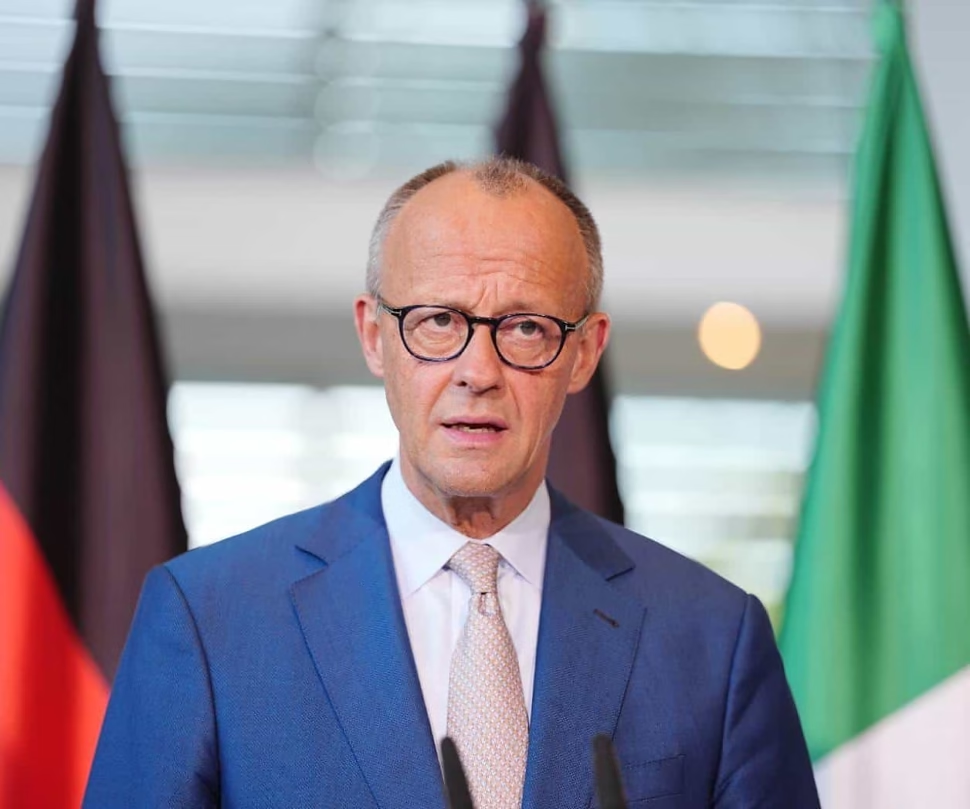
German Chancellor Friedrich Merz ignited the political and sporting debate by posting on social media his support for the national team, eliminated on penalties by Paraguay in the round of 32 of the 2026 World Cup. “Although the elimination hurts: What a game! With your commitment and team spirit, you moved our country. We are proud of you,” he wrote.

The reaction was immediate. MEP Marie-Agnes Strack-Zimmermann and opposition member Sevim Dagdelen accused him of losing touch with reality. The daily Tagesspiegel suggested that the publication was a mistake by an employee of the Federal Press Office.

RelatedGermany seeks redemption in the World Cup with Nagelsmann and the return of Neuer

The federation analyzes the performance

Bernd Neuendorf, president of the DFB, acknowledged the disappointment and held a workshop with coach Julian Nagelsmann and directors Andreas Rettig and Rudi Voeller to evaluate the team’s performance.

Despite rumors about his departure, Nagelsmann made it clear that he will not resign. “If the DFB wants me to continue, I will. And if not, they can tell me. I know how football works,” he said. Voeller backed him up: “He’s the right person in the right place.”

Klopp, meanwhile, ruled out any return. From the United States, where he works as a commentator, he said he was satisfied as Red Bull’s global football director. The German team thus begins an analysis process without immediate changes on the bench.

Hormuz: Trump assures it is open, Iran closes it

Trump insists that the crossing is operational, while Iran declares it closed. Tension escalates in the Gulf.

Pulse through the Strait of Hormuz

The struggle between Washington and Tehran for control of the Strait of Hormuz escalated this week with attacks and crossed statements. “Hormuz is open. We hit them hard,” said President Donald Trump at the end of a night of bombings against Iran. Tehran “does not control the strait,” he added.

The US Central Command (CENTCOM) endorsed the position: US forces are deployed to “ensure freedom of navigation, despite Iran’s unjustified aggression, threats and arbitrary statements.” Shortly after, the military command reported new attacks against missile systems, air defense and vessels of the Islamic Revolutionary Guard.

Hours earlier, an apparent calm and talks in Muscat – mediated by Oman and Qatar – had raised hopes of detente. But in the early hours of Saturday to Sunday, Iran announced the closure of the strait after attacking a Cyprus-flagged ship with a drone.

Washington’s response was immediate: a third round of attacks against 140 Iranian facilities in the vicinity of the pass, raising the weekly total to 310 targets. “Iran made the wrong decision. Now it is paying the consequences,” said Defense Secretary Pete Hegseth.

Tehran counterattacked with missiles towards US bases in the Middle East. Three fell in Jordan, and Qatar reported three injuries – including a minor – from shrapnel during the interception. Oman denounced having been the target of Iranian attacks and summoned the Iranian ambassador for a formal protest. Saudi Arabia condemned “Iran’s persistent destabilizing behavior.”

Trump expressed frustration: “On Saturday night we had a deal with Iran. It was perfect for us. No nuclear program, none of this, none of that. Iran gave in on everything, but they walked out of the room and an hour later they launched a drone at a ship. They’re sick.”

The Iranian Supreme Leader’s military advisor, Mohsen Rezaei, warned: “This strategic step is worth more than dozens of atomic bombs and the Islamic Republic will protect it.”

For Trump, keeping Hormuz open is key to avoiding a global economic depression. However, the fifth section of the memorandum – which addresses control of the strait – has generated controversy. Analysts point out that its wording gives Iran some influence over the step that it did not previously have, and its ambiguity could fuel new friction.

The scenario complicates negotiations on the Iranian nuclear program, where pessimism is growing even within the US administration.

Continue reading

The death toll from the double earthquake in Venezuela increases to 4,490

Official report raises the death toll to 4,490 and the number of victims to 17,907 after the June 24 earthquake.

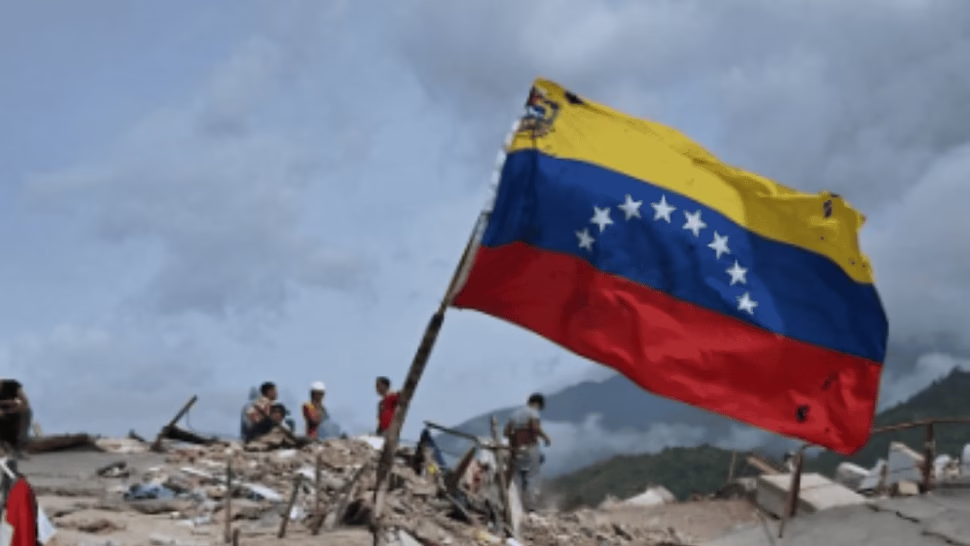
The number of victims from the June 24 earthquake in Venezuela continues to rise. Authorities updated the official balance this Monday: 4,490 people lost their lives and 17,907 were left homeless.

Updated figures

Jorge Rodríguez, president of the National Assembly and head of the cabinet for temporary camps, spread the new report through Telegram. The number of deaths increased by 157 compared to the previous day.

The injured remain at 16,740. So far, 32,401 people have received medical attention in hospitals since the beginning of the emergency.

Government response

The interim president, Delcy Rodríguez, reported that 19,583 people remain in 108 temporary camps distributed throughout the country. More than half – 10,908 – are in La Guaira, the most affected coastal area. Another 6,429 are staying in Caracas.

Authorities have recorded 1,222 aftershocks throughout Venezuelan territory since the June 24 earthquake, according to official data.

Continue reading

El Salvador deploys humanitarian hospital in Venezuela

El Salvador installs humanitarian hospital in Venezuela after the double earthquake on June 24.

Immediate response after the earthquake

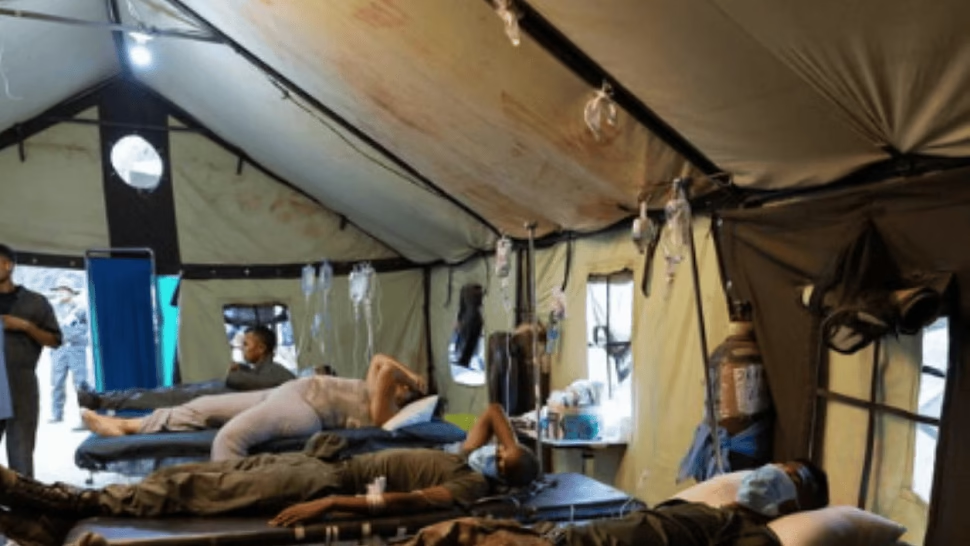
The government of El Salvador installed a humanitarian hospital on the main avenue of Playa Grande, La Guaira state, to respond to the emergency caused by the double earthquake that shook northern Venezuela on June 24.

The initiative responds to a direct order from Salvadoran President Nayib Bukele, who monitors the situation and coordinates the distribution of aid, according to an official statement.

Details of the Salvadoran contingent

The temporary hospital seeks to relieve pressure on the local health system in one of the areas most affected by seismic activity. The team is made up of doctors, paramedics and a team of veterinarians.

Medical care is provided 24 hours a day. Veterinary services for pets and companion animals are available from 8 a.m. to 6 p.m. (local time).

The Salvadoran government’s commitment to the emergency is reflected in the rapid installation of this center, which seeks to mitigate the impact of the earthquake on the affected community.

Continue reading