Doctor missing in Sinaloa is found safe and sound

After hours of uncertainty, the traumatologist reappeared without explanation, while colleagues demanded answers.

Finding of doctor Javier Adrián García after disappearance in Sinaloa

The orthopedic traumatologist Javier Adrián García Valdez, reported missing last Friday while on his way to the Regional General Hospital of Sinaloa, was located in good health. The State Person Search Commission deactivated his location file after confirming his appearance, although without revealing details about the circumstances of his disappearance or rescue.

Context and details of the disappearance

According to the family complaint, García Valdez, 35 years old and 1.81 meters tall, left his home at dawn heading to the hospital, where he practices his profession. Contact was lost around 6:30 a.m. while traveling along the road towards the Imala receivership. His unusual absence from work alerted colleagues, who began peaceful protests demanding immediate action from the authorities.

RelatedNational Guard locates its element safe and sound in Mazatlán

The search file described him as a man of robust build, dressed in gray surgical suit and with distinctive moles on his face and body. Despite institutional and community mobilization, his return occurred without him offering explanations about his whereabouts during those critical hours.

Implications and reactions

This incident reignites the debate about the safety of health professionals in areas with high rates of violence. Data from the National Citizen Observatory indicate that Sinaloa registered a 12% increase in disappearances in 2025 compared to the previous year, especially on road routes. Public security experts emphasize the need for specific protocols for cases of temporary disappearances, given their psychological impact on victims and families.

Authorities’ silence on the technical details of the search—such as possible use of surveillance cameras or phone records—raises questions about the effectiveness of response mechanisms. However, the positive outcome contrasts with other pending cases in the region, where the location time exceeds the critical 72 hours.

Were you interested in this note? Share it on your social networks to make workplace safety issues visible and continue exploring our content on human rights and public health.

Colombians arrested for training in the manufacture of explosives in Michoacán

Colombian detainees linked to the manufacture of explosives in Michoacán.

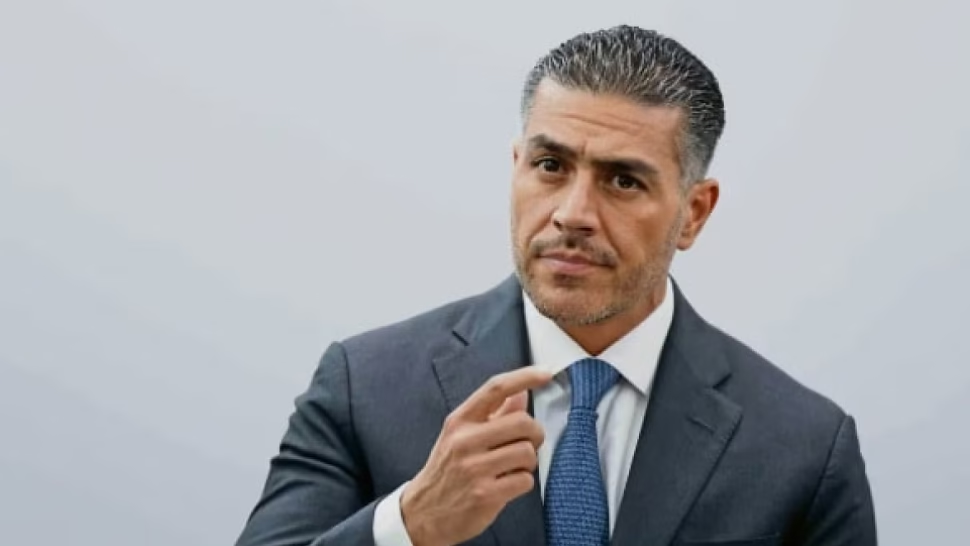
The Security Cabinet has arrested Colombian citizens linked to the training and manufacturing of improvised explosive devices in Michoacán. This was reported by the Secretary of Security and Citizen Protection, Omar García Harfuch, during the morning conference on Friday, July 3 in Morelia.

These arrests are part of investigations that identified the entry of several people involved into the country, mainly through the Mexico City International Airport and other air entry points. The National Intelligence Center monitored these movements.

The entry of foreign people by land was also detected, who allegedly collaborate in the training of members of criminal groups to install these devices. García Harfuch pointed out that there is an ongoing investigation to locate the leaders of these networks in Michoacán, including alleged high-level members of the Jalisco Nueva Generación Cartel.

The head of the SSPC confirmed the participation of citizens from different countries, mainly from Colombia. We are working in coordination with Colombian authorities to strengthen the investigations. In the coming days, the exact number of people arrested related to the manufacture and use of these explosives will be specified.

Continue reading

PRI warns about digital fraud and asks to reinforce prevention

The PRI warns about the advance of digital fraud and demands greater protection for families.

PRI warns about digital fraud and demands greater action

The Institutional Revolutionary Party (PRI) in the Senate warned about the increase in telephone fraud and extortion in Mexico. He pointed out that these digital crimes affect the assets and security of millions of families.

PRI legislators detailed that criminal organizations have perfected their methods. They use techniques such as phishing, smishing, vishing, cloning of messaging accounts, kidnapping simulations, fake job offers and artificial intelligence to create manipulated audio and videos that facilitate deception.

Given this panorama, the PRI called on federal and state authorities to strengthen prevention, investigation and combat strategies against these behaviors. He emphasized the need to implement more effective measures to protect citizens.

The growing concern for security has led the party to demand a more rigorous approach in the fight against these crimes that affect the tranquility of the population.

Continue reading

The United States does not extend the T-MEC, markets without problems

Markets calm due to the non-extension of the T-MEC until 2042, according to analysis.

T-MEC: No extension until 2042, stable markets

The United States decided not to extend the validity of the USMCA until 2042. The treaty will remain in force until 2036 with annual reviews. The decision did not generate turbulence in the financial markets. Analysts were already anticipating this scenario, according to the Mexico organization How are we doing?

In its report ‘The T-MEC is still in force’, the organization detailed that annual reviews were a possibility contemplated. Therefore, variables such as the exchange rate did not show negative reactions. On July 1, the peso stood at 17.54 units per dollar, with no relevant movements after the announcement.

Productive integration in North America is key. Mexico maintains its role as the main supplier of fresh fruits and vegetables to the United States. This strengthens regional food security, especially in the agri-food sector.

Looking ahead to the next negotiations, the central issues will be the reduction of tariffs, the defense of the rules of origin and access to agricultural markets. The United States will seek to reduce its trade deficit, while Canada will try to protect its key sectors.

Continue reading