Massacre in Sudan hospital: war makes health a target

An attack on a hospital in Darfur leaves dozens dead, including minors, in the midst of a civil war that already has thousands of victims.

The war in Sudan reaches a new horror

The numbers are cold, but the horror is real. An attack on Al Daein University Hospital in Darfur left at least 64 people dead and 89 others injured. Among the deceased there are 13 children. The World Health Organization (WHO) confirmed the data and reported that the medical center was out of service.

This is not an isolated event. It is part of the brutal pattern of a civil war that broke out in April between the Sudanese army and the Rapid Support Forces.

“Since the beginning of the conflict, the WHO estimates that more than 2,000 people have died in attacks on medical facilities,”

turning hospitals and health centers into vulnerable targets. It is a tactic that disarms entire communities.

RelatedDrones massacre 114 people in Sudan, including 63 children

The context of chaos

The struggle has plunged the country into total chaos. Official figures speak of more than 40,000 deaths, but humanitarian organizations warn: the real number could be much higher. Each new attack like this distances any possibility of peace and deepens the humanitarian crisis.

What remains when even places meant to heal become battlefields? The answer lies in the dozens of families torn apart in Al Daein and the thousands more across Sudan. The international community watches, but the violence continues its relentless course.
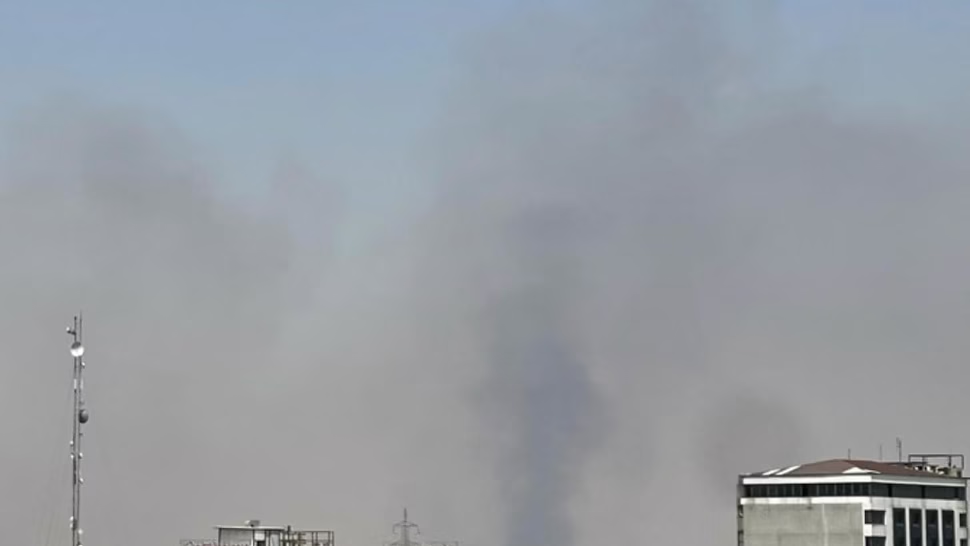
The United States and Iran escalate hostilities without diplomatic truce

Washington disables a second ship in the Gulf of Oman while Tehran attacks US bases in the region.

The US military disabled the M/T Lavine in the Gulf of Oman on Friday after the vessel attempted to break the Iranian naval blockade four times. US Central Command spokesman Capt. Tim Hawkins told The Associated Press that the crew ignored warnings and were fired upon in the engine room. It is the second commercial ship affected since the blockade was reimposed.

Incident in the Gulf of Oman

Hours earlier, President Donald Trump called the negotiations with Iran “by far the most serious we’ve ever seen,” although he added that he is “in no rush” to end the war. Meanwhile, Iran’s Revolutionary Guard vowed not to bow to pressure and attacked US bases in Iraq, Kuwait and Bahrain. The United States responded by bombing an Iranian naval base in the north of the country and targets on the Qeshm islands and Isfahan province.

The Strait of Hormuz, a key passage for global energy supplies, remains de facto closed due to Iranian attacks. The Houthis, allies of Tehran, attacked two Saudi oil tankers in the Red Sea, increasing pressure on shipping. Brent crude fell slightly to $96 per barrel, well above $72 before the conflict. In the United States, a gallon of gasoline averages $4.11, according to AAA.

Human cost and diplomatic stagnation

Iran’s Ministry of Health reports 3,434 deaths since the start of hostilities. The International Maritime Organization estimates that 6,000 seafarers are stranded on 400 vessels near the strait. The UN high commissioner for human rights, Volker Türk, called for urgent measures to help them.

There are no signs of diplomatic progress. Iranian Foreign Minister Abbas Araghchi told local media that he “will not be intimidated by threats” and downplayed mediation efforts. A delegation from Oman arrived in Tehran to discuss maritime traffic, but the talks show no results. Israel announced that Prime Minister Benjamin Netanyahu will travel to Washington next week to meet with Trump.

Continue reading

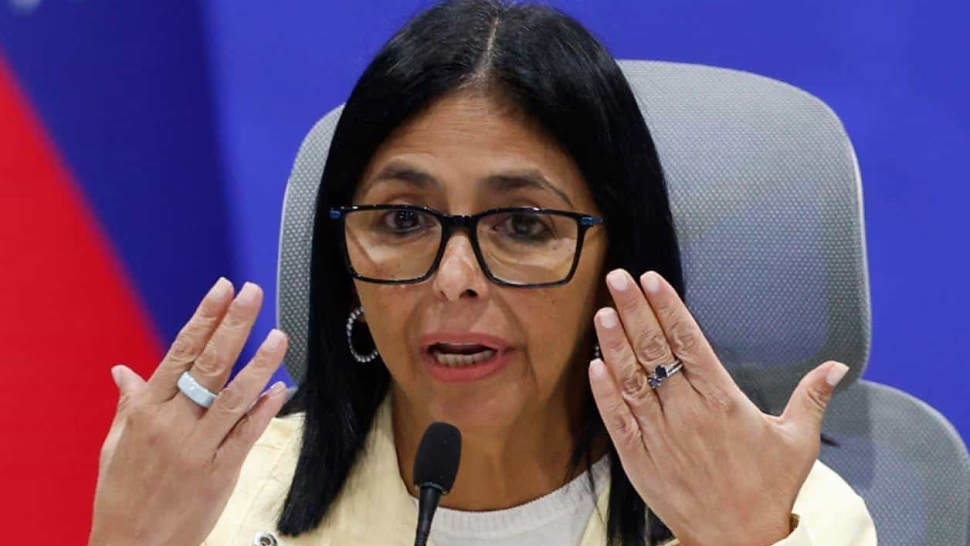
Venezuela announces its definitive withdrawal from the International Criminal Court

The Venezuelan government makes its departure from the international court official after criticizing geographical biases.

The government of Venezuela’s interim president, Delcy Rodríguez, announced on Friday its “firm and definitive” decision to withdraw from the International Criminal Court (ICC).

Foreign Minister Félix Plasencia explained in

The reasons behind the departure

The decision comes seven months after the National Assembly, with a pro-government majority, approved a law to repeal accession to the Statute. Plasencia accused the court of “geographical bias” and of concentrating its work “disproportionately in African and Latin American countries.” He added that the ICC has been “instrumentalized to deepen inequalities” and rejected the use of “lawfare”, a term that describes the use of the law as a political weapon.

Venezuela ratified the Statute in June 2000 during the mandate of Hugo Chávez. The ICC investigates war crimes and crimes against humanity when countries are unable or unwilling to do so.

Tensive relationship with the Prosecutor’s Office

The now former president Nicolás Maduro had criticized the Prosecutor’s Office in The Hague for closing its office in Caracas last December. The court argued “lack of real progress” in cooperation. Despite the closure, the investigation into the violence following the 2017 protests “remains active,” according to the ICC.

The investigation was opened in 2021 after a request from Argentina, Canada, Colombia, Chile, Paraguay and Peru. So far there are no arrest warrants.

In parallel, former chief prosecutor Karim Khan was dismissed on Friday for “serious misconduct”, in an unprecedented decision. Khan had already been suspended last June.

Continue reading

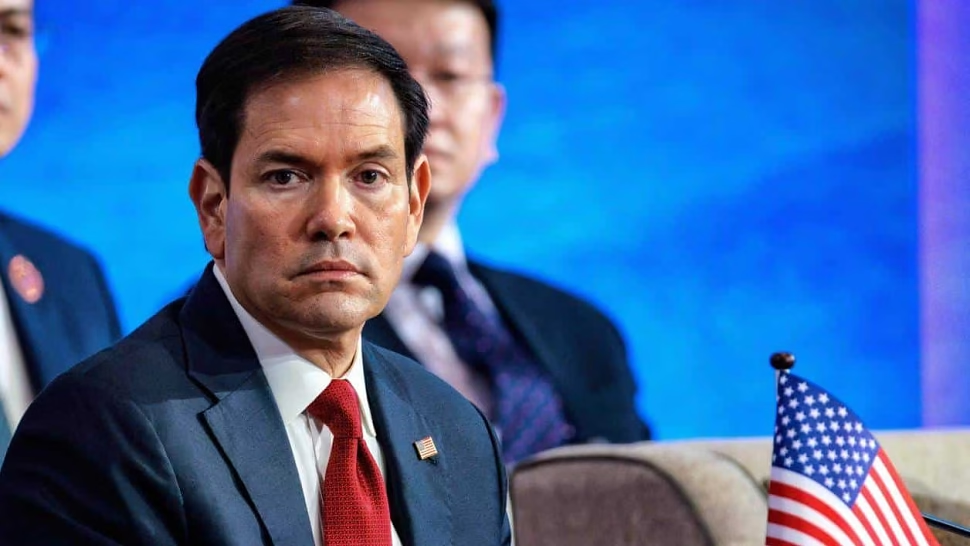
Marco Rubio recognizes difficulties in resolving the conflict in Ukraine

Rubio seeks diplomatic alternatives for Ukraine at ASEAN summit.

Rubio at the ASEAN summit

US Secretary of State Marco Rubio participated in the 33rd ASEAN Regional Forum. During the meeting, he addressed the conflict in Ukraine with his Russian counterpart, Sergei Lavrov. Rubio assured that his country remains willing to collaborate to end the war, although he acknowledged that there is no quick solution. He stated that new diplomatic alternatives are required to reach an agreement acceptable to both parties.

Previous attempts at mediation have had limited results, the official admitted. However, Washington will continue to promote negotiations if favorable conditions exist. Russia, for its part, reiterated its willingness to seek a political solution, but insisted on rejecting the shipment of more Western weapons to Ukraine. Rubio responded that it will be necessary to present new proposals that can be accepted by both Moscow and kyiv, without modifying US military support for the Ukrainian government.

Regional tensions

As part of the summit, Rubio also met with Chinese Foreign Minister Wang Yi. He described the recent incident between Chinese and Philippine vessels in the South China Sea as “escalatory.” Despite the simultaneous conflicts in Ukraine, Iran and other regions, the Secretary of State affirmed that the United States maintains its strategic commitment to Asia. He stressed that diplomacy will continue to be a priority to reduce international tensions.

Continue reading