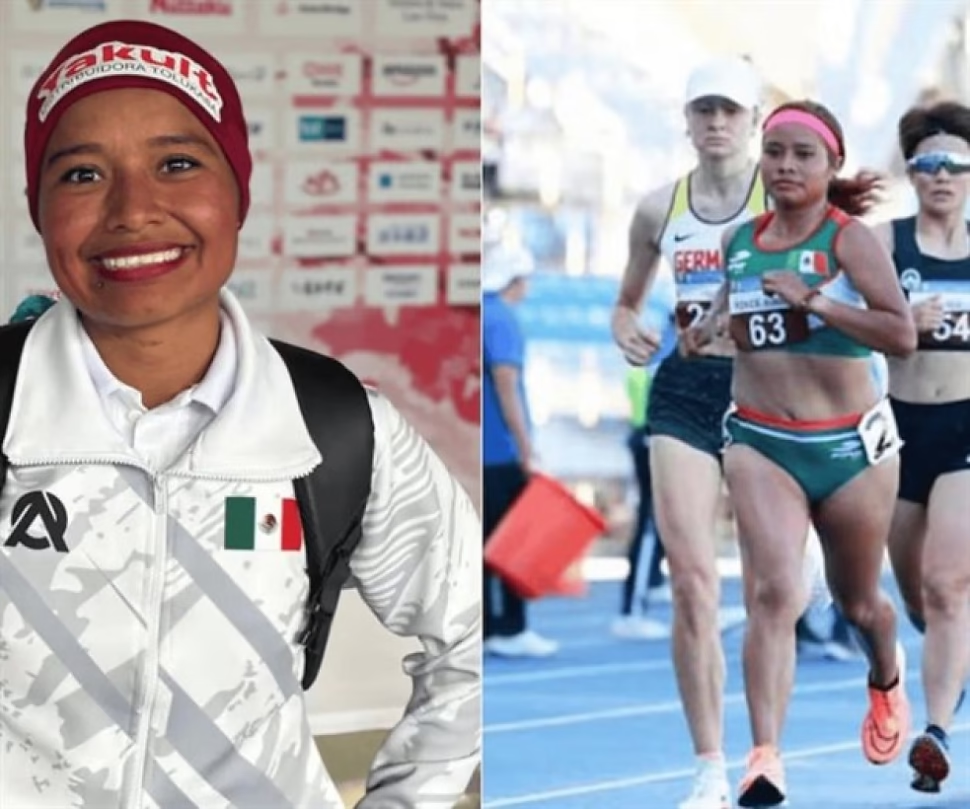
Lourdes Ponce wins the first gold for Mexico in Tokyo 2025

The Mexican athlete made history with a crushing victory on the track, unleashing euphoria in the national medal table.

The day the silence sounded louder than a scream

In a turn of events that no one, except perhaps her and her coach, saw coming, Lourdes Ponce decided that the only thing better than winning a gold medal was winning it in a way that left everyone speechless and breathless… even though she probably didn’t hear the applause. That’s right, at the Tokyo 2025 Deaf Olympic Games, the Mexican woman stood on the 10,000 meter dash track and, with a smile that could have easily meant “I’m tired of running,” she delivered a superhuman effort that culminated in the first gold medal for Mexico in the event. Because what’s a little extreme exhaustion compared to eternal glory and a photogenic podium?

With a stopwatch that read 36:17.07, enough time for an ordinary mortal to rethink all his life decisions, Ponce crossed the finish line not only first, but with an elegance that suggested he might have a date after the race. His arduous preparation, which no doubt included completely ignoring audio distractions, paid off and allowed him to be filled with glory in the eyes of the world. A world that, ironically, celebrated at the top of its lungs a victory in which sound was largely absent.

RelatedThe Cueva twins win silver in the Diving World Cup

The flag, the podium and the rivals who were left wanting to applaud louder

The subsequent scene was, of course, cinematic. With a huge smile that defied any previous concept of fatigue, Ponce grabbed the national flag and waved it as if trying to stoke the patriotic fervor of an entire country. By climbing to the top of the podium, he received the respect (and visually intense applause) of his rivals and fans of adapted athletics. Because nothing brings people together more than seeing someone reach the top, except maybe seeing someone reach the top after running a whopping ten kilometers.

This gold medal not only helped Lourdes inscribe her name in the annals of history with golden letters, but also snatched the momentary prominence from the judoka Isabel Huitrón, who had won a meritorious silver medal in the -48 kg category. One can almost imagine the conversation: “Silver, how cute… Oh, wait, Lourdes won gold? Okay, so put me on the back burner.” With this, the Mexican medal holder won his second medal, showing that when it comes to sporting feats, sometimes the representation team prefers to do it in silence, but with style.

The ambitious (and large) team that wants to make noise without making noise

As Lourdes walks around with her gold, it is easy to forget that the Mexican delegation did not travel to Tokyo for sightseeing. The delegation participates in no less than eight different disciplines: athletics, judo, taekwondo, Greco-Roman wrestling, men’s indoor volleyball, golf, soccer and swimming. A total of 45 athletes who, hopefully, are coordinating with signs to avoid stepping on each other’s heels in the Olympic Village.

The great objective of this adapted sports battalion is to surpass its best historical performance, achieved in Caxias do Sul 2022, where they won two golds and one silver. With Ponce’s golden metal already in his pocket, the pressure is on. Can others emulate their success and turn these games into the best edition for Mexico? Or, as one sarcastic commentator would say: Will they break the mark of “more medals than team meetings with hearing interruptions”?

The triumph of Lourdes is more than a time on a track; It is a reminder that talent and determination know no barriers. And that, sometimes, the most resounding victory is the one that is celebrated in the most absolute and glorious silence.

Do you love seeing barriers broken and history made? Share this incredible feat on your social networks and make the triumph of Lourdes travel around the world! Don’t stay with the emotion, explore more content about our heroes of adapted sports.

FIFA investigates complaint against Ryan Mendes, Cape Verde captain

FIFA contacts New Zealand authorities regarding a complaint against Cape Verde captain.

FIFA confirmed that it has already initiated contacts with the New Zealand authorities following the complaint of sexual assault filed by a Brazilian woman against Ryan Mendes, forward and captain of the Cape Verde national team. The player will face Argentina in the round of 32 of the 2026 World Cup.

The facts according to the complaint

The Brazilian newspaper O Globo revealed that the sexual assault occurred in Auckland, New Zealand, where local police are investigating the case. The complainant worked as an interpreter for the Cape Verde team during a tour of Oceania last March. According to her story, Mendes entered her room, physically assaulted her and then sexually assaulted her. The outlet published photographs of the injuries suffered by the woman and a WhatsApp conversation in which an official from the Cape Verde federation described the incident as “Ryan’s personal matter,” without offering support.

FIFA’s position

After the spread of the case, organizations requested the exclusion of Mendes from the 2026 World Cup. The Cape Verdean Football Federation and FIFA were notified of the incident. In a statement sent to O Globo, the entity chaired by Gianni Infantino stated:

“FIFA takes any reports of inappropriate conduct very seriously and has a clear procedure for anyone in the football community who wishes to report an incident.”

The text adds that independent judicial bodies do not comment on complaints received or ongoing investigations. “Any information they wish to share will be disclosed at their discretion. We cannot comment further at the moment,” FIFA concludes.

The Cape Verde team, which faces Argentina, is under scrutiny as the investigation progresses in New Zealand.

Continue reading

Mexico vs Ecuador: the most expensive match of the round of 32

The duel between Mexico and Ecuador is the most expensive of the phase, with tickets over 60 thousand pesos.

Record-breaking prices

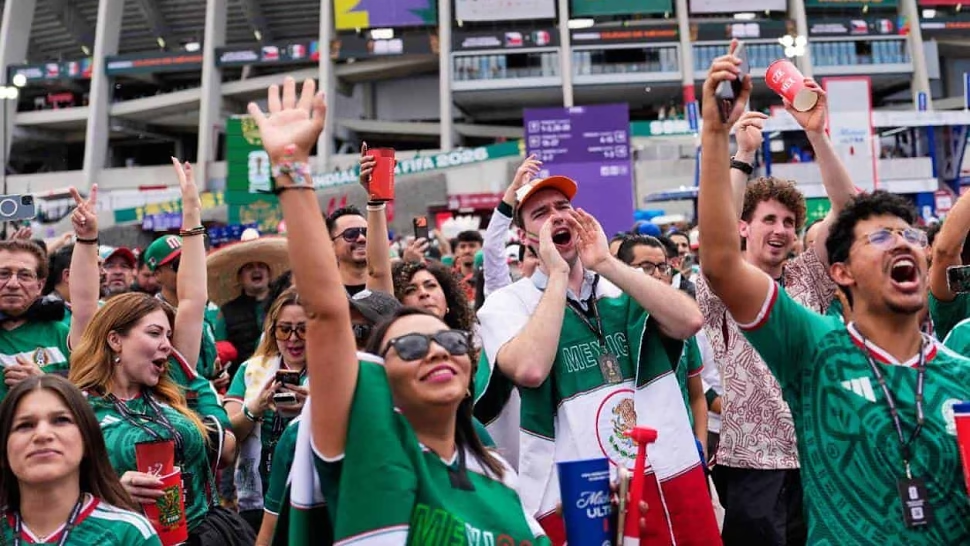
The match between the Mexican National Team and Ecuador, scheduled for this Tuesday, June 30 at the Mexico City stadium, is not only one of the most attractive of the round of 32 of the 2026 World Cup, but also the most expensive.

According to data from Ticketdata, a platform that monitors the value of tickets, the average ticket for this match reaches 3,259 dollars, equivalent to almost 60 thousand Mexican pesos.

Demand has been increasing since Javier Aguirre’s El Tri secured their pass. In March 2026 the cost was around 14 thousand pesos. After the rival was confirmed on Saturday, prices shot up to 50 thousand pesos and remain at that level.

A full stadium despite the cost

Although admissions are through the roof, the building is expected to be completely full. The match exceeds the price of matches between Argentina and Portugal in the same phase, according to Ticketdata.

The organizing body had already sold some tickets through packages, but there is still limited availability for sale and resale. The fever for the duel is such that it marks a price record in this round of the tournament.

Continue reading

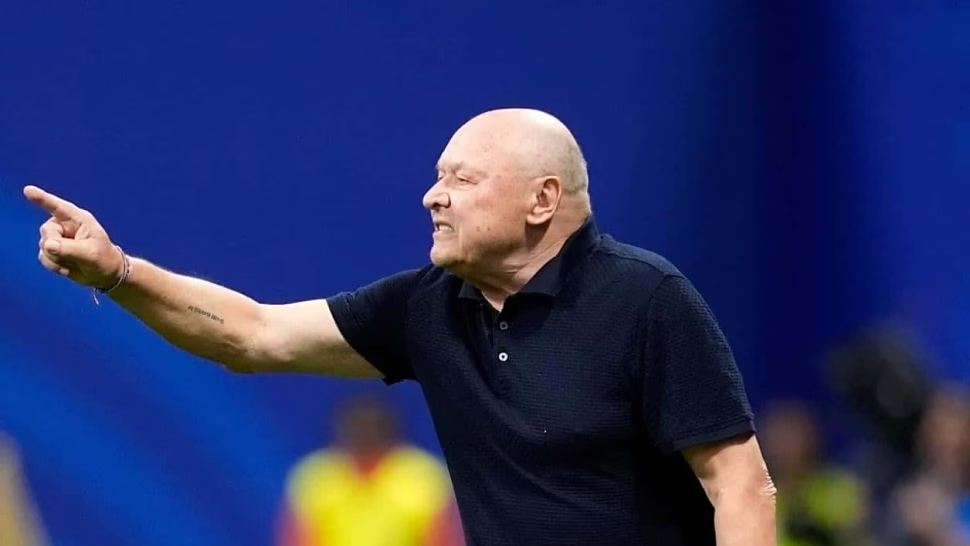
Miroslav Koubek leaves the Czech national team after failure in the 2026 World Cup

Czech coach resigns after finishing last in Group A of the 2026 World Cup.

Unexpected resignation in Czech football

The Football Association of the Czech Republic (FACR) confirmed the resignation of technical director Miroslav Koubek, 74, after the elimination in the group stage of the 2026 World Cup. Koubek had a contract valid until 2028, but decided to step aside.

The Czech team finished last in Group A with only one point: they drew 1-1 against South Africa and lost 2-1 against South Korea and 3-0 against Mexico. Despite having qualified the country for a World Cup after a 20-year absence, the strategist argued external reasons for his departure.

“My decision is also due to a media campaign based on a series of half-truths about me. In this context, my work for the Czech national team would no longer make sense,” Koubek said in an official statement.

The president of the FACR, David Trunda, explained that Koubek presented his formal resignation during a meeting after the delegation’s return to the country. The departure of the helmsman adds to the recent loss of striker Patrik Schick, who days ago announced the end of his international cycle with 56 games and 26 goals.

Continue reading