Religious leaders renew their commitment to dialogue after the death of Francis

Spiritual leaders honor Francis' legacy by reinforcing his message of unity and fraternity.

A call for unity in honor of Francisco

In a historical moment of deep reflection, relevants of Catholicism, Judaism, Islam and evangelical communities in Argentina came together to honor the memory of Pope Francis, reaffirming their commitment to the interreligious dialogue that he promoted so much. His message of global peace and fraternity resonated strongly in the Cathedral of Buenos Aires, where spiritual leaders highlighted his legacy as a beacon of hope.

The power of spiritual connection

Monsignor Jorge García Cuerva, archbishop of Buenos Aires, recalled the words of the pontiff: “Dialogue between religions is for the common good and the most vulnerable”. He stressed that conflicts do not arise from faith convictions, but from their distortions. “God loves us all; let’s build peace together. It is the best tribute to Francisco,” he said with emotion.

RelatedCelebrities say goodbye to Pope Francis with emotional messages

Francis, a pioneer as the first Latin American pope, dedicated his life to weaving bridges between faiths. He founded the Interfaith Dialogue Institute (IDI) 20 years ago, insisting: “Dialogue is essential for world peace.” His vision transcended borders, inspiring generations.

Rabbi Daniel Goldman, a member of the IDI, described him as “the great guide of our time”, a visionary who believed in solutions born in Latin America. Meanwhile, Sheikh Salim Delgado Dassum highlighted his commitment to global conflicts, such as his constant support for the Gaza community.

Methodist pastor Mariel Pons captured the shared sentiment: “Francis eased the path to authentic connection for us.” His legacy lives on in every conversation that brings religions together and in every gesture that builds harmony.

Share this message of unity and explore more about how dialogue transforms the world! 🌍✨ #LegadoDeFrancisco #PazGlobal

Bolivia keeps fuel prices frozen

Bolivia extends the fuel price freeze for six more months after the protests.

Bolivian President Rodrigo Paz decided to extend the fuel price freeze for six months. The measure responds to the prolonged protests and blockades in May and June that demanded his resignation.

Official measure

The decree was issued after a review of the subsidy scheme. Last December, the president withdrew almost all state support for fuel, as part of his anti-crisis plan, and established a mechanism for semiannual adjustments.

“We already had a previous decree that had frozen prices, what has been done is to modify it so that it is extended for another six months,” explained the presidential spokesperson, José Luis Gálvez.

A liter of gasoline remains at 6.96 bolivianos (0.71 dollars) and diesel at 9.80 bolivianos (more than a dollar). The price of gas also remains frozen.

Economic context

The government seeks to normalize supply after the blockades. The mobilizations aggravated the economic situation, with depleted international reserves. Bolivia depends on fuel imports, according to experts.

The country maintained a subsidy for about 20 years, which generated a strong outflow of foreign currency in a context of dollar illiquidity, according to the government.

Former Hydrocarbons Minister Álvaro Ríos criticized the decision as political: with it, the State would pay a higher price than what it sells to the final consumer.

Continue reading

Women fishermen in Kenya: from the sea to ecotourism due to the climate crisis

Kenyan women transform their relationship with the sea in the face of the fishing crisis.

Women fishermen in Kenya: from the sea to ecotourism due to the climate crisis

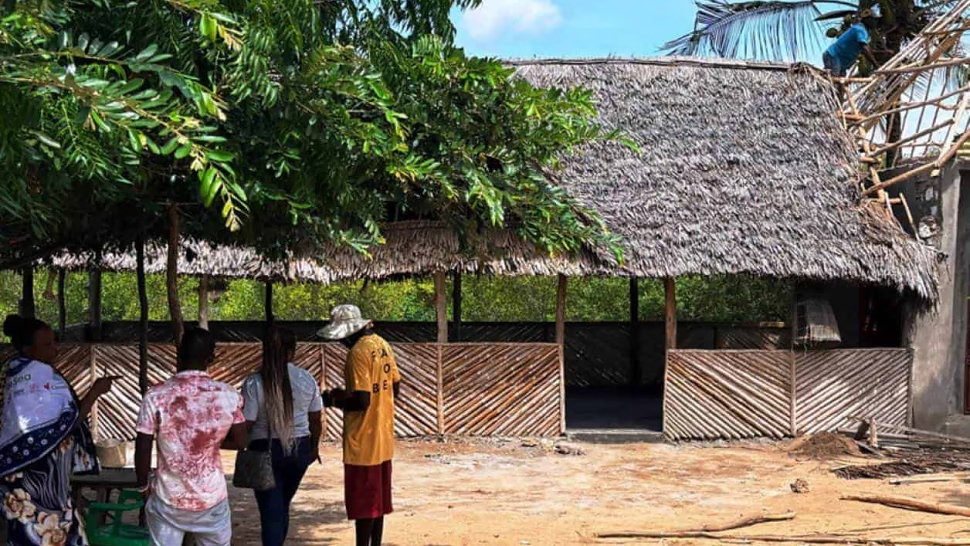
Nuru Mohammed, 54, leads a group of women hanging fishing nets as decorations at her new restaurant in Malindi, northeast of Mombasa. In a few days it will open its doors. “For us women, this is hope,” she says. “It will help support many families who have depended on the ocean for decades.”

Along the East African coast, fishermen are reinventing themselves. Climate change, overfishing and ocean deterioration threaten their livelihoods. In Kenya, women transform restored mangroves into sources of income through beekeeping and ecotourism. In Zanzibar, communities protect reefs with locally managed closures. In Mozambique, seagrass restoration creates jobs.

“Communities that depend on the ocean are also its best guardians,” says Andréanne Martel, project director of the ReSea conservation program. “When local people, especially women, lead in conservation, they protect biodiversity and create more resilient livelihoods.”

Mohammed says that his boats have been stolen and that it is difficult for him to compete with industrial trawlers. A nearby Chinese processing plant reflects the changes. “I can’t compete with that power,” he says. “It’s been hard. I fought to stay a fisherman, but I think it’s a battle I can’t win anymore.”

10 kilometers away, Beatrice Mwanyiro oversees a mangrove nursery and restaurant for Samahco, a self-help group of 30 women supported by the Canadian government. “We have to adapt. The number of fish decreases every year. Without another source of income we will not be able to feed our families,” he explains.

Mohamed Somo, a fishing leader in Lamu, says that they used to catch up to 100 kilos of fish per boat; now less than 30. Kenyan law prohibits trawling within 9 kilometers of the coast, but some vessels operate closer. Illegal, unreported and unregulated fishing costs $23 billion annually, according to the FAO.

“The trawlers fish on the high seas during the day, but at night they enter the shallow waters where we artisanal workers work. There is very little left in the morning,” adds Somo.

Jerry Mang’ena of Action for Ocean in Tanzania says: “Coastal communities are on the front lines of climate change, but they are also drivers of resilience. If we want to protect the ocean, we must invest in those who have cared for it.”

At the recent Our Ocean Conference in Mombasa, organizations called for ratifying the BBNJ (high seas) treaty, which came into force in January and has been signed by 145 countries and ratified by 81. Aliou Ba of Greenpeace Africa says: “The agreement offers a historic opportunity to protect the high seas and tackle illegal fishing that deprives communities of food and income. Governments cannot delay.”

Continue reading

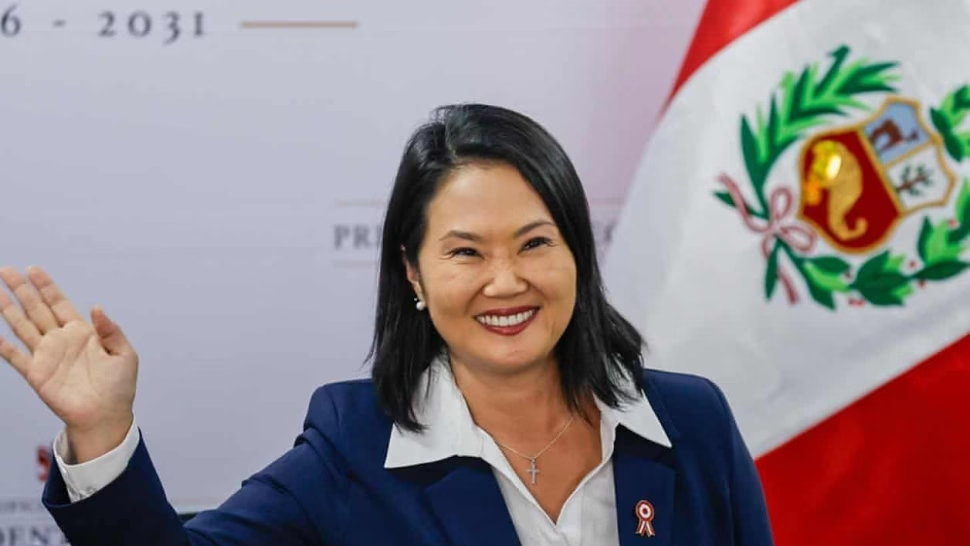
Fujimori announces intention to resume ties with Mexico

The elected president of Peru seeks to reestablish dialogue with Mexico after statements by Sheinbaum.

The elected president of Peru, Keiko Fujimori, stated on Thursday that she has “every intention” of resuming diplomatic relations with Mexico. The statement came a day after the Mexican president, Claudia Sheinbaum, indicated that she had not yet contacted Fujimori to congratulate her on her electoral victory.

“On my side there will be every intention to be able to resume relations between Peru and Mexico,” Fujimori briefly told the press during a public event in Lima.

Background of distancing

Sheinbaum had declared in his morning conference: “We are going to wait, remember that they broke off relations with us.” The break occurred in 2025, when Peru decided to break ties after the diplomatic asylum granted by Mexico to former Prime Minister Betssy Chávez, who took refuge in the Mexican embassy in Lima. Chávez is still waiting for safe passage to travel to Mexico, which Peru has not granted.

The conflict originated in December 2022, when the Peruvian Congress dismissed then-president Pedro Castillo, who was imprisoned after trying to dissolve the Legislature. In this context, Castillo’s wife and two minor children received asylum at the Mexican embassy and then moved to Mexico. Since then, both Andrés Manuel López Obrador and Sheinbaum requested Castillo’s release.

Castillo’s arrest sparked protests that left 50 dead during the repression by security forces under the government of Dina Boluarte. Later, Castillo and Chávez were sentenced to 11 years in prison for conspiracy to rebel. Castillo has appealed the sentence and faces other corruption investigations.

Asked if she considers Castillo’s detention illegal, as Sheinbaum claims, Fujimori responded: “I am very respectful of the institutions of my country.” However, before being proclaimed the winner, she had already pointed out that Peru and Mexico share the Pacific Alliance bloc and that there are “ties of friendship that must be prioritized beyond differences.”

Continue reading