LEGO launches a replica of the World Cup with a secret inside

The iconic cup now comes in construction format, with a secret detail inside that will delight the most fanatical collectors.

FIFA and LEGO come together so you can build glory (piece by piece)

Just when you thought that your toxic relationship with football was going to give you a break until 2026, FIFA arrives hand in hand with LEGO to empty your wallet with a new must-have. 190 days before the mega-event, they presented the official replica of the most desired trophy on the planet, because what better way to wait for a World Cup than to build it literally from scratch, with the patience of a saint and sore fingers? The premise is as simple as it is brilliant: “legends are made.” Or, in colloquial Spanish, “your bookshelf can look like that of a champion, without having to run or break a sweat.”

This is not just any model. It’s a collector’s item designed for two seemingly different but equally obsessive tribes: the football fans who know everything and the AFOLs (Adult Fans of LEGO, for the uninitiated) who have more blocks than common sense. It’s the crossover that no one asked for, but that we all secretly wanted.

RelatedLEGO launches special set for the Day of the Dead

A trophy with an Easter egg included (and almost 3000 pieces of patience)

Let’s get into details, this is the juicy part. The replica is a colossus 36 centimeters high. To give you an idea, it’s taller than your cat and probably more imposing than some regional league trophies. The kit comes with a whopping 2,842 pieces. Yes, you read that right. It’s a project for a quarantine, a rainy weekend or to postpone all your adult responsibilities with the perfect excuse: “I’m building the World Cup, do not disturb.”

But the star detail, the one that makes every damn tiny piece that falls under the couch worth it, is at the top. In the sphere that represents the Earth, there is a secret compartment. Opening it is like finding the ring in a happy meal, but in an elite version. Inside, a LEGO doll holds a miniature version of the trophy and the official World Cup logo on a miniature grass. It’s meta, it’s adorable, and it’s exactly the kind of detail that will make collectors gasp with excitement. It’s like Stan Lee’s cameo, but in the brick world.

The price of pride (and release date)

How much does this piece of plastic glory cost? The official site of the Danish brick masters has it clearly labeled: 4,799 Mexican pesos. It’s not an impulse supermarket purchase, it’s an investment in entertainment and nerdy decoration. However, here comes the *plot twist* that proves your true desire: it won’t be available until March 1, 2026. That’s right, the tournament will start in June, but you can have the trophy from March. The only thing you can do for now is reserve it. It is the definitive test of faith. It is committing to an object that you will not see for almost a year, like ordering a child from a catalogue, but less compromising in the long term.

In short, this collaboration between LEGO and FIFA is pure marketing genius. Transform the ultimate symbol of world football into an interactive experience, a building challenge and a collector’s item with a playful twist inside. It’s expensive, yes. It requires patience, too. But the end result promises to be that center of conversation in your living room that will justify all the hours invested and the money spent. Because in the end, not all of us can lift the real cup, but with enough blocks and determination, we can at least fake it in our own home.

Are you interested in building your own championship trophy?Share this news on your networks and tag that football (or LEGO) fanatic friend who needs to know now. And if you’re left wanting more, explore our site to discover other epic collaborations between toys and sports that you won’t believe exist.
Sheinbaum highlights record in clean energy and economic rebound

Sheinbaum reports historic growth in renewables and low inflation at 3.55%.

Economy and energy: the president’s announcements

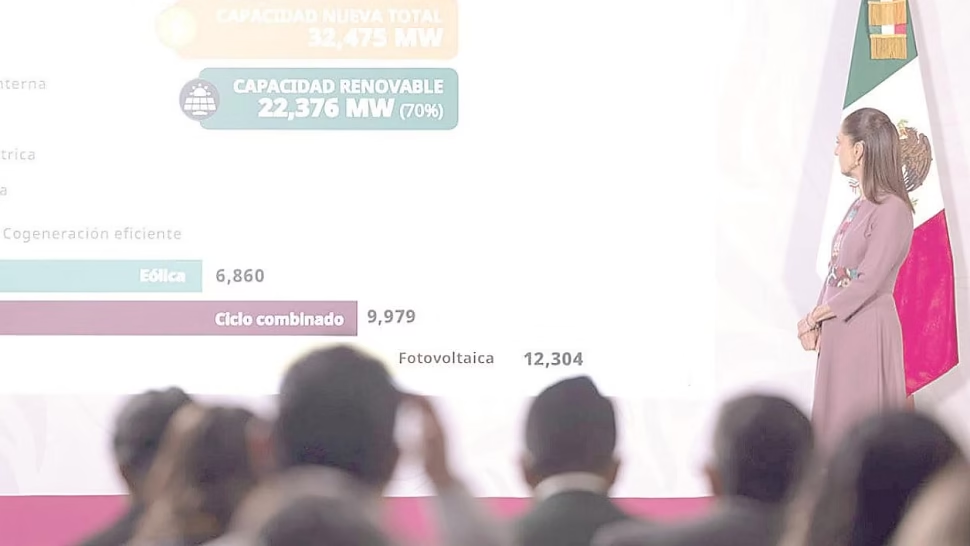
President Claudia Sheinbaum reported that, for the first time, Mexico has projects for 32 thousand megawatts of additional electrical capacity, of which 70% are renewable. “When we leave the government, natural gas consumption will decrease and energy generated by renewable resources will increase,” he stated.

Sheinbaum also highlighted economic growth. According to Inegi, the Global Indicator of Economic Activity (IGAE) rose 1.2% in April compared to March, the best advance since 2021. The annual rate reached 2.2%. The president attributed this to the boost in construction, especially the housing program.

Regarding inflation, the president pointed out that it fell to 3.55% annually in the first half of June, its lowest level since October 2025. This is due, she said, to agreements with gas stations to set maximum fuel prices and the Package Against Inflation and Scarcity (Pacic) to control the basic basket.

Energy transition with 32 thousand megawatts

The Secretary of Energy, Luz Elena González, explained that by 2030 32 thousand megawatts will be added; 22 thousand will be renewable. The goal is for at least 38% of generation to be clean to meet climate commitments. He assured that the CFE will maintain its majority participation, providing 61% of the electricity at the end of the six-year term.

The director of CFE, Emilia Calleja, explained the projects. In Baja California Sur, the Oasis System will combine solar energy, batteries and green hydrogen to supply Mulegé and 40 thousand homes. It includes a 72 megawatt plant, 20 megawatt storage and will produce 120 cubic meters of water per year, avoiding 94 thousand tons of CO2.

In Sonora, the “Rafael Galván” photovoltaic plant in Puerto Peñasco will reach one thousand megawatts of capacity and 246 megawatts of storage. It currently provides 400 megawatts. The investment exceeds 1.4 billion dollars. “They are environmental benefits that strengthen energy sovereignty,” concluded Secretary González.

Continue reading

Controversy over an interview with Monsiváis reaches the Senate and the Palace

The republication of a 1999 interview unleashes accusations between the Executive and legislators.

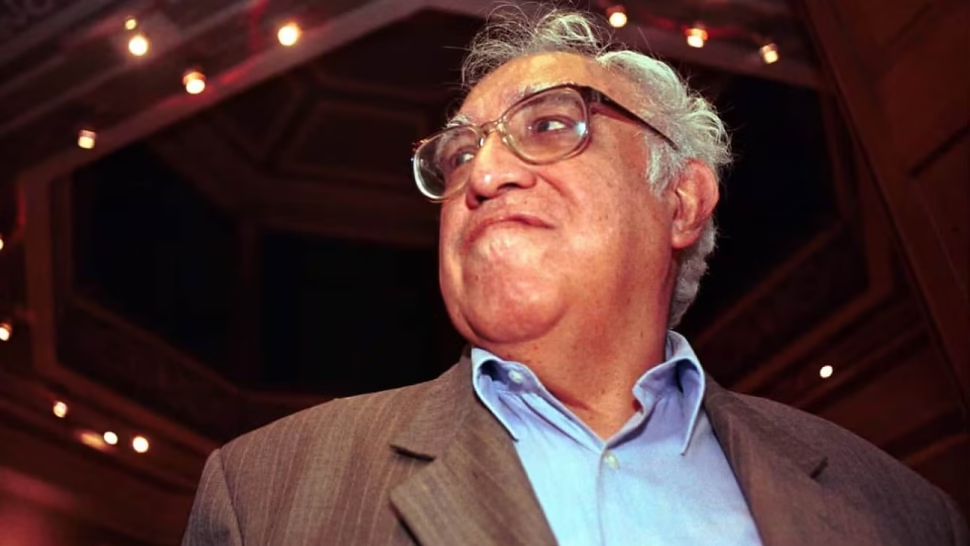
The republication of an old interview attributed to Carlos Monsiváis climbed to the center of the Mexican political debate this Wednesday. The issue was discussed both in the Senate and in President Claudia Sheinbaum’s morning conference.

The original text was written by journalist Edmundo Cázares in 1999 and recently republished by El Universal. It contains statements about the then head of Government Andrés Manuel López Obrador. Its veracity and context have been questioned, generating conflicting positions.

Sheinbaum describes the content as “grotesque”

During her conference, the president harshly criticized the publication. He described the content as “grotesque” and accused the medium of generating a controversy that distorts the tribute to the Mexican intellectual.

Reactions in the Senate

The issue also reached Congress. Senator Lilly Téllez read fragments of the text on the platform. In response, Gerardo Fernández Noroña rejected its use and maintained that it was a false publication with the intention of political attack.

The exchange reflects the polarization around the figure of López Obrador and the use of historical documents as partisan weapons.

Continue reading

PRI demands urgent action against violence in Guerrero

They denounce an incursion of armed civilians in Coyuca de Catalán; party calls for state intervention.

The national leadership of the PRI demanded that the Mexican State intervene urgently in response to the complaint by inhabitants of the Guajes de Ayala ejido, in Coyuca de Catalán, Guerrero. The residents reported the incursion of armed civilians into their community in the Sierra.

Call for safety

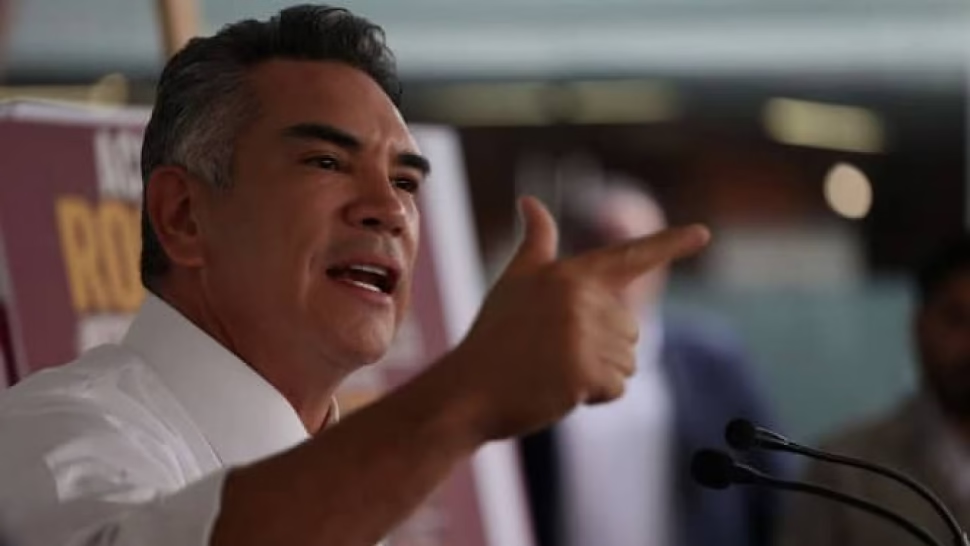
Alejandro Moreno Cárdenas, president of the party, asked the authorities to guarantee the safety of the families. He warned that these events should not be normalized due to the risk they represent for the civilian population.

The leader pointed out that in various communities in Guerrero they live under siege by armed groups. This has caused displacement, confinement of inhabitants and a constant climate of fear and uncertainty. He considered an immediate response from the State necessary.

Moreno Cárdenas also criticized the federal government for minimizing the situation of violence in the country. He affirmed that the population faces conditions of insecurity that require priority attention to restore the rule of law in the region.

Continue reading