


Chilpancingo: Where Normality is a Distant Memory
Ah, Chilpancingo. The picturesque capital of Guerrero that has decided that formal education is a high-risk activity. With a shortage of public transportation that would make an urban planner cry and a suspension of classes ranging from the little ones in preschool to the almost-adults of the Autonomous University of Guerrero, the city woke up as if an apocalyptic film director had shouted “action!” And the script, of course, is written by a new and vibrant wave of violence that, with the punctuality of a broken Swiss watch, has adorned the last three days.
The result? A city where going to school has become an extreme sport not recognized by the Olympic Committee.
Education on Pause: An Unofficially Official Measure
In a plot twist that not even the most twisted of the scriptwriters would have dared to propose, the head of the Guerrero Education Secretariat (SEG), Mr. Ricardo Castillo Peña, confirmed the massive closure of educational establishments. The beauty of Mexican bureaucracy shines here in all its splendor: the closure is confirmed, but no one bothers to count how many. Why quantify disaster when it can be managed with a shrug and a “that’s just the way things are”?
The jewel in the crown in this nonsense is the official’s clarification: the suspension of classes is not official. Of course, because nothing says “unofficial” like the fact that absolutely no one is in the classrooms. It’s like saying you’re not wet while a torrent falls on you. It’s the “it’s not official, but please stay home” that defines our era. Parents and directors, turned into anonymous heroes of social networks, were the true heralds of this educational truce, announcing the measure in the face of the more than understandable absence of public transportation service.
Because, let’s face it, who needs a government decree when you have a WhatsApp group full of terrified moms and a street scene that is more reminiscent of a “Mad Max” set than a functional city?
Empty Streets and Late Security
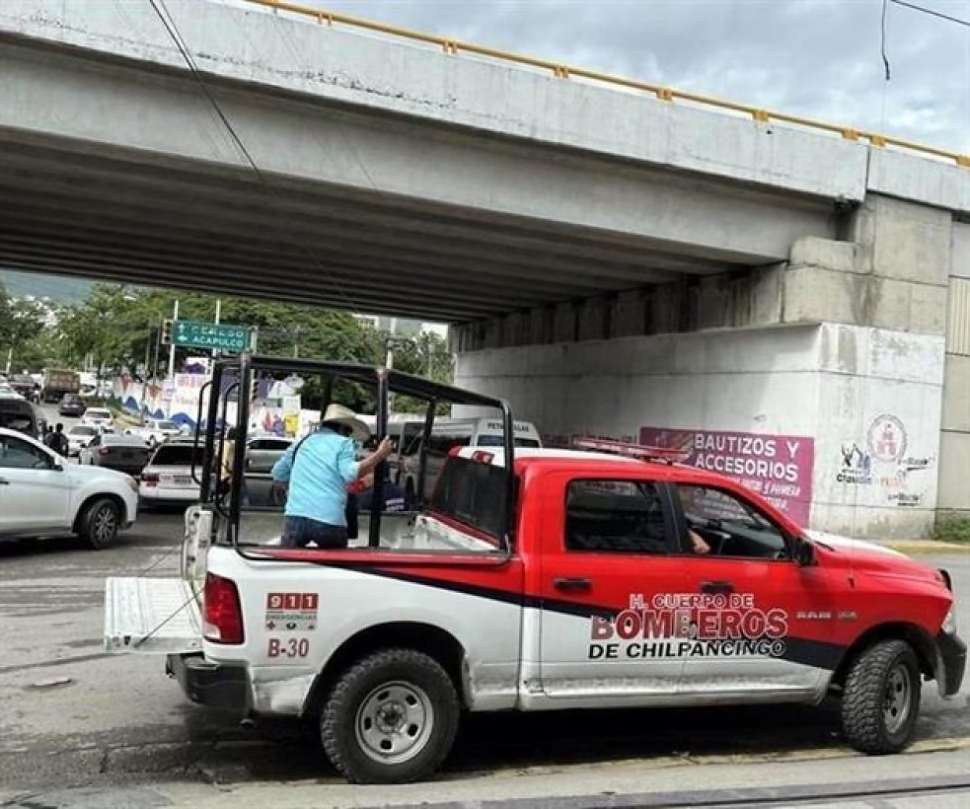
The streets of Chilpancingo present a surreal spectacle. Few transportation units dare to challenge the environment, offering a skeletal service to the brave (or reckless) who need to move. To fill the void, we have the parade of force: State Police patrols, vehicles of the National Guard and even the Mexican Army walk the avenues. It’s comforting, if you think about it, to see size XXL security after the problem has already taken its toll. It’s like calling the fire department when the house is already ashes, but with camouflage uniforms.
And in the midst of this chaos, there emerges a flash of human ingenuity, or perhaps desperation. With the escort of the security forces, the transporters, those eternal optimists of the informal economy, have installed a base of operations on Vicente Guerrero Boulevard, specifically at the point known as El Puente. A site that, overnight, has become the nerve center for the mobility of the communities of Mochitlán, Quechultenango and Juan R. Escudero. Imagine the scene: an oasis of mobility guarded by soldiers, where getting into a van feels the same dramatic tension as a hostage exchange scene.
It is the perfect solution for modern Mexico: a temporary, heroically improvised patch for a structural problem that no one wants to talk about. Solve violence at its roots? That’s very boring and requires long-term planning. Set up a fortified transport point? That’s pure ingenuity and immediate action!
This is how life goes in Chilpancingo, where normality is a luxury and the exception is the rule. Where kids get an unrequested day off and adults wonder, once again, when safety will become more than a campaign promise. The city breathes, but with a sigh of resignation, waiting for this “wave” to pass, so that the next one can begin.
Did this chronicle of the “new normal” in Guerrero impact you?Share this article on your social networks to make the situation visible and help us make more people aware of the reality that exists in various regions of the country. Explore more content related to safety and social life in our national news section.


