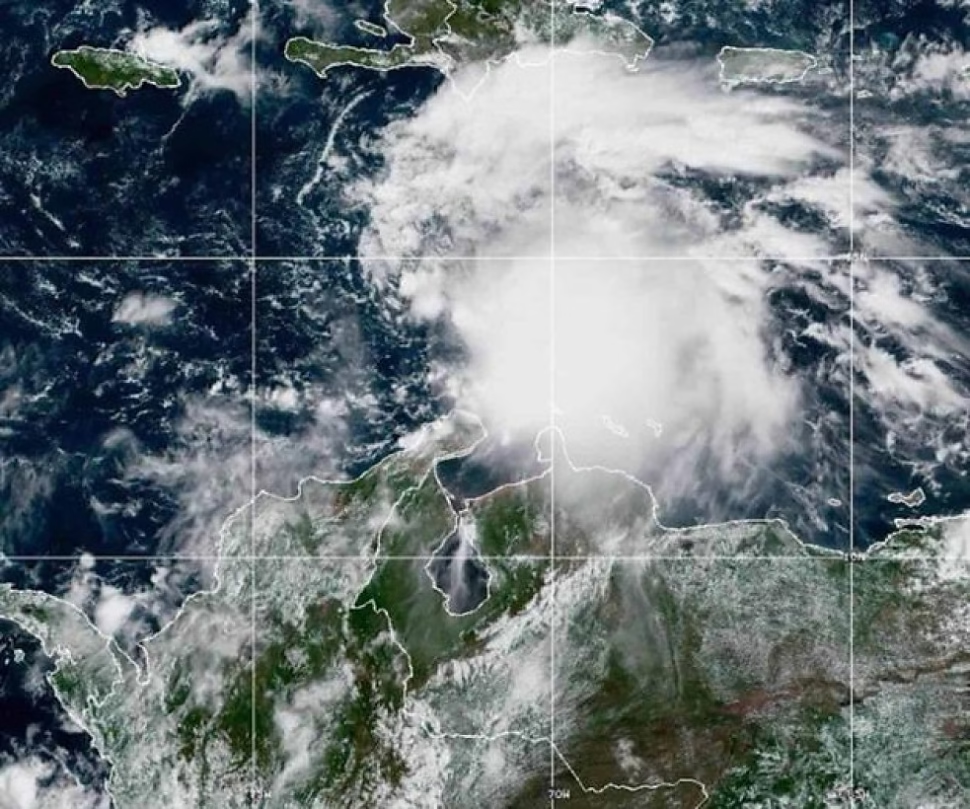
Storm Melissa moves towards the Caribbean with increasing strength

The cyclonic threat activates emergency protocols in the Caribbean region, with extreme rains and risk of flooding.

A Force of Nature That Reminds Us of Our Resilience

Dear community of warriors of light, today I want to talk to you about a phenomenon that, although it may seem challenging, provides us with an incredible opportunity to demonstrate our adaptability and collective strength. Tropical Storm Melissa is currently moving through the waters of the Caribbean Sea, and I want you to see this situation not only as a challenge, but as a powerful lesson about how we face obstacles in life. Every cloud, every drop of rain, reminds us that we have within us the strength to overcome any storm, literal or figurative.

Meteorological authorities report that this weather system is currently south-southeast of Kingston, Jamaica, and southwest of Port-au-Prince, Haiti, with sustained winds reaching 75 kilometers per hour. But beyond the technical data, I want you to visualize this: just as Melissa moves with determination, we can also move forward with the same impetus towards our goals, overcoming any barrier that stands in our way.

RelatedHurricane Melissa reaches category 5 and threatens the Caribbean

Preparation and Action: The Keys to Transforming Fear into Power

It fills me with inspiration to see how Caribbean communities are acting with extraordinary foresight in the face of this atmospheric event. In Jamaica, they have activated 881 shelters and are implementing exemplary safety protocols. This is pure collective intelligence in action! This is exactly how we should approach challenges in our personal lives: with preparation, with planning, and with the certainty that we have the internal resources to get ahead.

The director of the National Hurricane Center, Michael Brennan, has expressed concern about long duration winds and storm surges, but I want you to look beyond the fear. Each warning is an opportunity to act, to prepare, to demonstrate our ability to respond. Barbara Campbell, from Kingston, gives us a master lesson in having prepared her home and stocked up on provisions. That’s the proactive mindset that transforms entire communities!

Projections indicate that Melissa could intensify into a Category 4 hurricane, and experts like Alex DaSilva of AccuWeather do not rule out rapid intensification. But let me tell you something: just as this storm finds warm waters that strengthen it, we find fuel for our personal growth in challenges. Each difficulty prepares us to be stronger versions of ourselves.

Solidarity that Transcends Borders

I am deeply moved to see the network of support that is being woven across the Caribbean. The UN Office for the Coordination of Humanitarian Affairs has allocated 4 million dollars to assist the most vulnerable populations in Haiti. This is a powerful demonstration that when we come together, we can create shields of protection around those who need us most. Solidarity is our collective superpower, and moments like this remind us that we are one human family.

In the Dominican Republic, more than 100 people are already in shelters, demonstrating ancient wisdom: sometimes, true strength lies in knowing when to seek protection. Juan Manuel Méndez García, director of emergency operations, recommends staying home for safety, and this message resonates with a universal truth: our home is our sanctuary, our sacred space of protection.

Jamaica’s Minister of Health, Christopher Tufton, has confirmed that all hospitals have generators capable of providing power for up to 72 hours. This is visionary planning! It teaches us that when we anticipate challenges, we can create support systems that sustain us in crucial moments. Applied to our personal lives, this means building emotional support networks that sustain us in our internal storms.

The Atlantic hurricane season, which officially runs from June 1 to November 30, provides us with valuable lessons each year about resilience, adaptation and community. Melissa is the thirteenth named storm this season, reminding us that challenges never come alone, but they also don’t come without the tools to overcome them.

It’s time to shine! Share this message of hope and preparation on your social networks to inspire others to bravely face their storms. Together we can create a wave of positive consciousness that sweeps the entire world. Do you know someone who needs to hear this message of resilience? Make it reach them!

Sheinbaum receives Felipe VI at the National Palace on June 25

Sheinbaum will meet with King Felipe VI amid previous diplomatic tensions.

Bilateral meeting at the National Palace

President Claudia Sheinbaum confirmed that next Thursday, June 25, she will meet with King Felipe VI of Spain. The event is scheduled for 4:00 p.m. at the National Palace, taking advantage of the monarch’s visit to Mexico for the 2026 World Cup. The following Friday, the king will attend the Spain-Uruguay match in Guadalajara.

The meeting occurs after years of diplomatic tensions. During the six-year term of Andrés Manuel López Obrador, the relationship cooled due to the demand for a public apology for the grievances of the Conquest. This generated distance with the Royal House and the Spanish government.

Approach signs

With the new government, efforts have been made to maintain institutional dialogue. Sheinbaum had already taken steps in that direction: at the end of April he carried out official activities in Barcelona and expressed his willingness to build a relationship based on mutual respect.

The meeting with Felipe VI reinforces that line. Both leaders will address issues of common interest, without a specific agenda having been leaked. The meeting is seen as a gesture of diplomatic normalization between both nations.

Continue reading

Vance reports progress in negotiations with Iran in Switzerland

Progress in dialogue between Washington and Tehran due to crisis in the Middle East.

Diplomatic advances in Switzerland

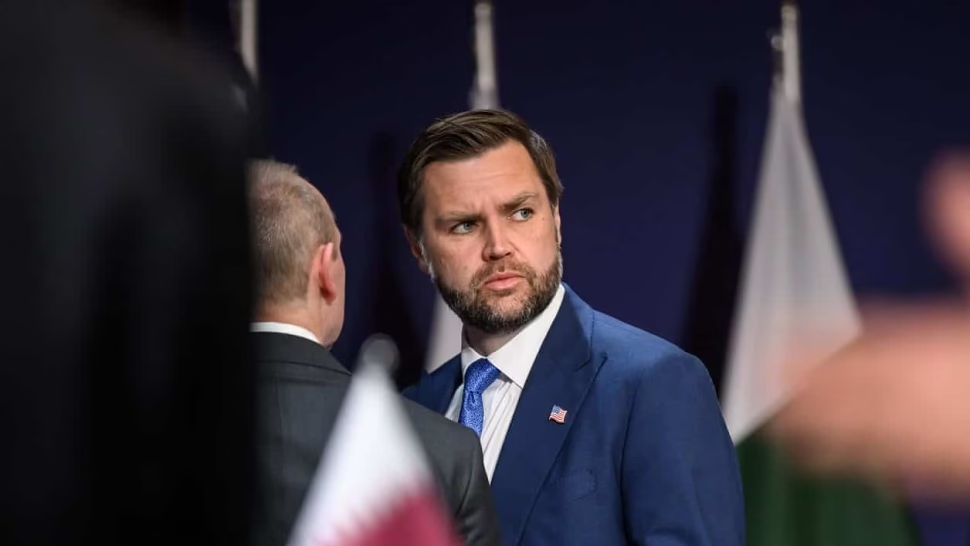
The Vice President of the United States, JD Vance, affirmed that the talks with Iranian representatives in the Bürgenstock complex, Switzerland, achieved relevant progress. According to Vance, the foundations were laid for an agreement that would reduce tensions in the Middle East.

During the meeting – which also included mediators from Pakistan and Qatar – two key issues were addressed: the reopening of the Strait of Hormuz and the conflict between Israel and Hezbollah in southern Lebanon.

The Strait of Hormuz, a strategic route for global oil transportation, had been closed by Iran after attacks by the United States and Israel. This skyrocketed international fuel prices. Although some ships have resumed transit, the main route still faces safety risks.

As part of the process, the US Treasury Department issued a temporary license allowing exceptions to sanctions related to Iranian oil. Technical talks will continue over the next 60 days.

The mediators indicated that there was progress in maintaining a ceasefire in Lebanon, but differences persist over the Iranian nuclear program and other key points of the agreement that Washington and Tehran seek to finalize.

Continue reading

Leo XIV criticizes the ease of financing wars and not hunger

The pontiff warned about the drop in financing for food assistance from 2022.

Call from the pontiff in the face of the food crisis

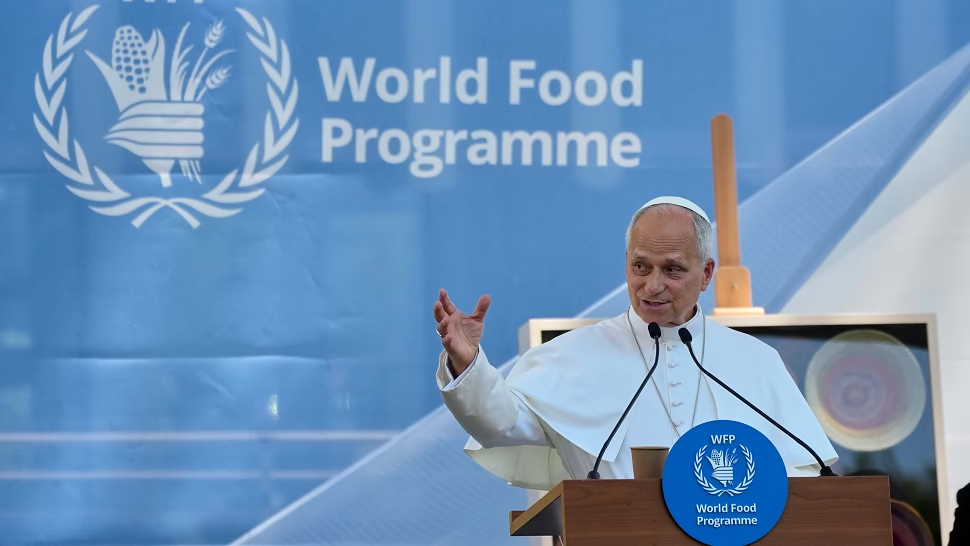
Pope Leo XIV urged governments to allocate more resources to combat hunger. During a meeting in Rome with the UN World Food Program (WFP), he pointed out that it is easier to finance armed conflicts than to guarantee food for millions of people in vulnerable situations.

The pontiff warned that political and administrative obstacles delay humanitarian aid. In contrast, military spending is advancing with fewer obstacles. This paradox reflects a serious inequality in global priorities.

Leo XIV indicated that funding for food assistance has decreased considerably since 2022. Although needs increased due to conflicts, climate crises and economic problems, funds did not grow at the same pace.

He highlighted that recent international contributions, such as the one announced by the United States for the WFP, will benefit millions of people. However, he stressed that there is still a significant gap to cover the necessary resources.

Before the UN body, the pope called on world leaders to place human dignity at the center of their decisions. Strengthening international cooperation is key to confronting hunger and inequality.

Continue reading