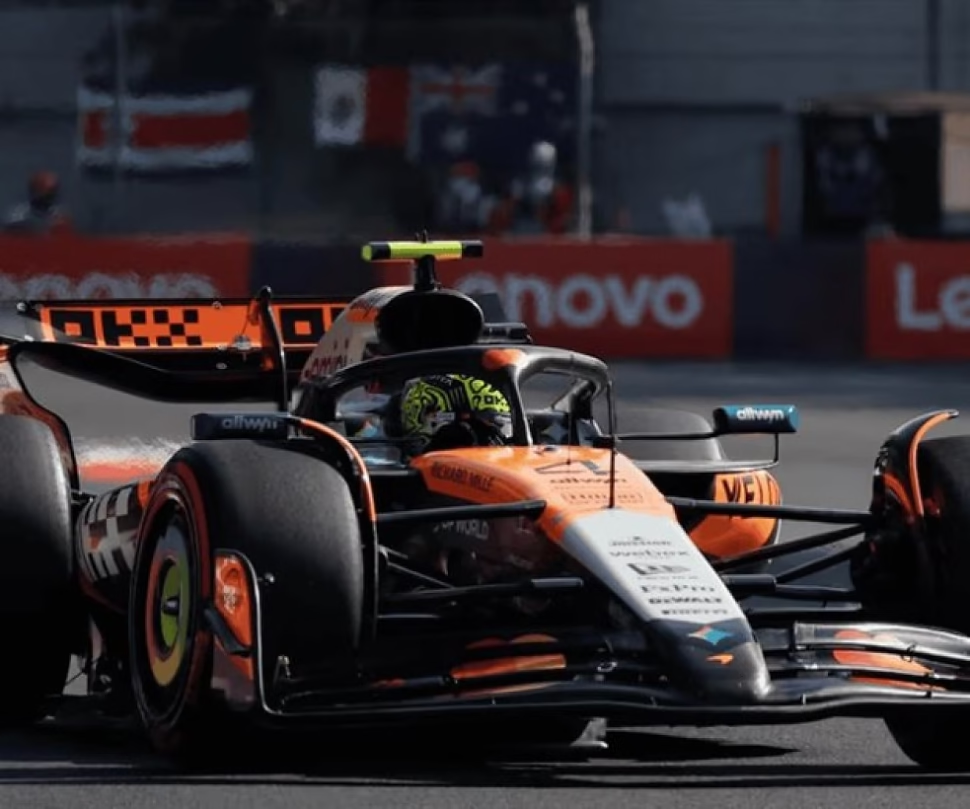
Pole position in Mexico does not guarantee final victory

The position on the grid hides the key to victory at the Autódromo Hermanos Rodríguez. Discover the secret pattern that all the winners have followed.

The Lie of the Pole: A Tale with an Uncertain Ending

Ah, pole position. That glorious and ephemeral moment in which a driver feels like the king of the world, the master and lord of the asphalt, the guy who has more chances than anyone else to win. Or so they want us to believe. Because in the picturesque and muggy setting of the Autódromo Hermanos Rodríguez, starting first on Sunday is just a nice memory for Saturday’s photo album. A participation medal with the smell of burning fuel.

It turns out that, according to data and statistics lovers (those beings who find pleasure in spoiling the magic of sport), starting from pole position is not a direct ticket to the highest podium. What a disappointment, right? After all that theater on Saturday, the clean laps and the frayed nerves, the only thing you have won is the right to be the first to reach the first corner. Touching. However, here comes the ironic twist of the plot: to win in Mexico, it is absolutely vital to sneak into the top four party. That’s right, in the last decade, the winner has always started from one of the first two rows. One hundred percent effective. It seems the key is not to be number one, but simply not to be an absolute disaster on Saturday. A consolation for the mediocre.

RelatedVerstappen stalks the F1 title in Mexico

The Lucky Ones Who DID Turn Pole Into Victory

Since the Grand Prix returned to the Mexican capital, only four lucky individuals have managed the feat of not screwing it up after setting the best time. An exclusive and short list: Nico Rosberg in 2015, Lewis Hamilton in 2016, Max Verstappen in 2022 and the newcomer to the club, Carlos Sainz in 2024. Four names in nine editions. The odds aren’t exactly overwhelming. It is almost as if the car that goes first was cursed, destined to suffer a hydraulic failure, an error in strategy or simply to be devoured by the desire of those who come behind.

But the real lesson, the “life hack” of the Autódromo Hermanos Rodríguez, is that placing yourself in the first two lines is the true “hack” of the system. The furthest position from which anyone has won here is fourth, a feat achieved by Hamilton himself in 2019. That is, if you are not on the second row or further forward, you better pray for a miracle or for a monumental chaos at the start that eliminates half of the grid. Championship strategies, without a doubt.

Verstappen, Norris and the Impossible Comebacks

And then there is Max Verstappen, who treats the Mexican circuit as if it were his backyard. The Dutchman has won here five times, demonstrating enviable flexibility: once from pole, twice from third position and another couple from second. It seems like he doesn’t care where he starts; If you have a competitive car, victory is yours. An admirably irritating attitude for his rivals.

This brings us to the highlight of the weekend: Lando Norris took his first pole in Mexico. At last! It marked a difference of more than two tenths over the Ferraris, which in current F1 parlance is basically an eternity. Everyone expects me to win from start to finish, right? Well, history suggests not to trust appearances. Meanwhile, Verstappen and his Red Bull will have to climb from fifth position, and his McLaren teammate, Oscar Piastri, from eighth. According to our friend the record book, coming back from so far back to win is about as likely as finding a hundred dollar bill on the paddock floor. Highly unlikely.

That epic comeback by the Frenchman Alain Prost in 1990, who won from thirteenth position, is very far away. A feat from another era, when pilots had to fight with wooden steering wheels and the danger was real. Today, his countryman Isack Hadjar honors him on his helmet, a nice nostalgic gesture that will not change the fact that, in modern F1, strategy and starting position often outweigh pure talent to come back.

Are you ready for the show? Share this analysis with other fans on your social networks and discover more content about the incredible and often absurd strategy in Formula 1.

Brasil pierde a Wesley por lesión a días del Mundial

Lesión de aductor deja fuera al lateral derecho; Ederson lo reemplaza en la lista mundialista.

La selección brasileña sufrió una baja sensible a menos de una semana de su debut en el Mundial. Wesley, lateral derecho de 22 años, quedó descartado por una lesión en el aductor del muslo izquierdo.

La Confederación Brasileña de Fútbol (CBF) confirmó el domingo el cambio. El jugador de la Roma fue sometido a una resonancia magnética que reveló la gravedad del problema, sufrido durante el amistoso del sábado ante Egipto en Cleveland.

“Wesley es un jugador querido por el grupo y siempre será considerado parte de este equipo que busca el campeonato mundial por sexta vez”, dijo la CBF en un comunicado.

El lateral fue sustituido al minuto 16 por Danilo, en un partido que Brasil ganó 2-1. Pidió el cambio tras sentir dolor en la pierna izquierda. Sus compañeros en el banquillo lo consolaron.

RelatedAncelotti renueva con Brasil hasta el Mundial 2030

En redes sociales, Wesley expresó su sentir:

“Hoy tengo que poner un sueño en pausa debido a una lesión. Duele no poder seguir vistiendo la camiseta de la selección brasileña en este momento, pero quien conoce mi historia sabe que rendirse nunca ha sido una opción.”

Y agregó: “Caer es parte del camino. Volver a levantarme siempre ha sido mi mayor fortaleza”.

Reemplazo y panorama

El volante Ederson, de 26 años y jugador del Atalanta, se incorporará al equipo en Estados Unidos. Fue parte de la primera lista de Ancelotti en junio de 2025, aunque no llegó a debutar.

Brasil debutará el sábado en Meadowlands, East Rutherford, Nueva Jersey. En el Grupo C también enfrentará a Escocia y Haití.

Otra incógnita es Neymar. El delantero de 34 años no viajó a Cleveland y lucha contrarreloj para el debut por una lesión en la pantorrilla.

Continue reading

Rivero explota a la ofensiva; Angelinos vencen a Dodgers

Rivero se fue de 5-5 con 6 impulsadas y los Angelinos evitaron la barrida.

Actuación clave de Rivero y Soriano

El receptor venezolano Sebastián Rivero se fue de 5-5 con seis carreras impulsadas. Su actuación encabezó el gran rendimiento de los últimos cuatro bateadores del orden, quienes sumaron 13 de 15 al bat. Esto permitió a los Angelinos de Los Ángeles imponerse 13-5 a los Dodgers y evitar la barrida en la temporada.

Los Dodgers, líderes del Oeste de la Liga Nacional, habían ganado cinco de seis juegos en la Serie Freeway, superando a los Angelinos 46-18. El año pasado, los Angelinos barrieron 6-0 a sus rivales antes de que los Dodgers ganaran su segundo campeonato consecutivo de la Serie Mundial.

RelatedTigers devastate Angels with home runs and impeccable pitches

El abridor dominicano José Soriano (7-4) trabajó seis entradas, permitió cinco carreras (cuatro limpias) y ocho hits, con dos ponches.

El orden inferior despega

Los Angelinos respondieron al final de su alineación, encabezada por Rivero, noveno al bat. El dominicano José Siri conectó de 3-3 con dos impulsadas y dos anotadas.

El abridor de los Dodgers, Emmet Sheehan (3-3), fue retirado tras 49 lanzamientos (35 en la segunda entrada). El derecho permitió dos carreras, tres hits y dos bases por bolas en 1.1 entradas.

La victoria no solo evita la barrida, sino que resalta el aporte de Rivero y Soriano en un juego crucial de la temporada.

Continue reading

Documental ‘Héroe’ revive el Mundial 1986 en México

La cinta oficial de la FIFA revive el torneo que consagró a Maradona en México.

A meses de que México reciba el Mundial 2026, la FIFA mantiene disponible su documental ‘Héroe’, dedicado al torneo de 1986. La producción reúne imágenes emblemáticas de aquella copa, desde la actuación de Diego Maradona hasta el ambiente en los estadios y calles del país.

¿Qué muestra el documental?

‘Héroe’ no sigue un guion tradicional. Combina secuencias de los partidos clave con material fuera de la cancha. La figura central es Maradona, entonces capitán de Argentina. Llegó a México como estrella y se fue convertido en leyenda tras ganar el título y anotar el famoso gol de la ‘Mano de Dios’.

RelatedThe UBA analyzes the Maradona phenomenon in a congress

El 22 de junio de 1986, Argentina enfrentó a Inglaterra en cuartos de final. En el minuto 51, Maradona se adelantó al portero Peter Shilton y empujó el balón con la mano. El gol, polémico, definió el 2-1 final. El propio Diego reconoció después que fue “un poco con la cabeza y un poco con la mano de Dios”.

También aparecen otras figuras como Hugo Sánchez, Gary Lineker, Emilio Butragueño y Careca.

¿Dónde verlo?

La cinta se ha convertido en una de las producciones oficiales más recordadas por los aficionados. Está disponible en el canal de YouTube de la FIFA.

Continue reading