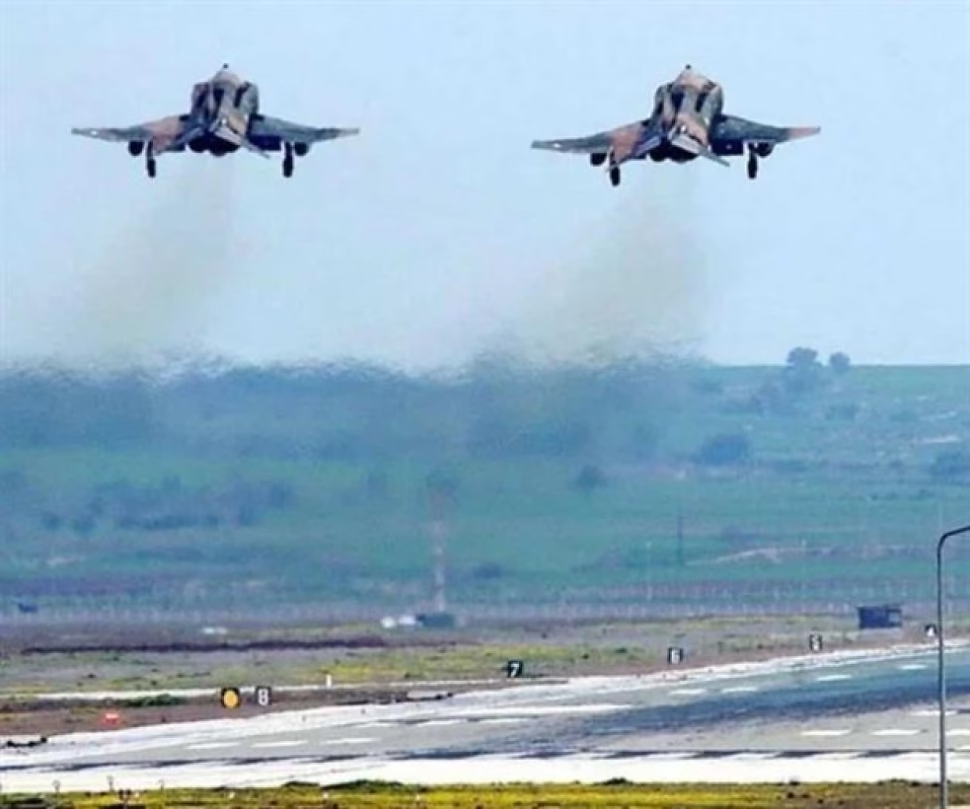
NATO intercepts Iranian missile over Türkiye

An Iranian missile was intercepted by NATO systems after entering Turkish airspace, in an incident that increases tensions.

A new missile intercepted, an old tension that escalates

The Turkish Ministry of Defense confirmed what is beginning to be a worrying pattern. A ballistic projectile from Iran was shot down by NATO defense systems deployed in the eastern Mediterranean. It entered Turkish airspace and was neutralized. It’s not the first.

This is the fourth missile launched from Iran towards Türkiye that the Atlantic alliance has managed to intercept since the conflict between Washington, Tel Aviv and Tehran intensified. The Islamic Republic, as is its custom, denies any responsibility. But the facts on the ground speak louder.

“All necessary measures are being taken decisively and without hesitation in the face of any direct threat to the territory and airspace of our country,” the Ministry declared in Ankara.

The official phrase sounds forceful, but it does not clarify the most important thing: where exactly did it fall? The precise location of the intercept remains a mystery. However, we have clues from the recent past.

RelatedNATO intercepts Russian drones in Polish airspace

The remains that reveal the proximity of danger

The remains of the first missile intercepted a few weeks ago fell in Dortyol, a city in southeastern Anatolia. That information is crucial. Dortyol is just one hundred kilometers from Incirlik air base, a key military facility used by both Türkiye and the United States.

That is, these projectiles do not pass through uninhabited areas. They fly near strategic infrastructure and over civilian populations. Each successful interception prevents a tragedy, but it also sets a dangerous precedent.

The pattern is clear: launches from Iran, official denials and NATO interceptions on Turkish soil. It is a cycle that repeats itself and that brings two regional powers with complex histories closer and closer to the edge of the precipice. The question now is not if there will be a fifth missile, but when.
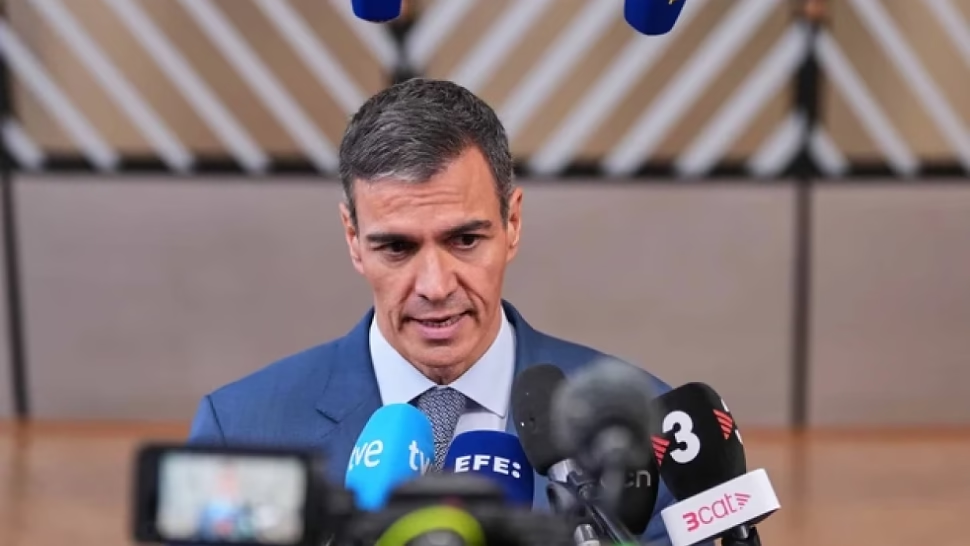

Begoña Gómez, on trial for influence peddling in Spain

The wife of the Spanish president will face trial for alleged corruption crimes.

Court order against Sánchez’s wife

An investigating judge in Madrid ordered that Begoña Gómez, wife of the president of the Spanish government, Pedro Sánchez, sit in the dock for alleged crimes of influence peddling and corruption. The resolution includes the delivery of his passport and the obligation to appear in court every two weeks.

Judge Juan Carlos Peinado argued that there is a risk of flight. A trial date has not yet been set. The court decision has intensified the political debate in Spain.

Reactions and context

The opposition has demanded a response from the socialist government. Several political leaders consider that the case affects the integrity of the executive. For now, Sánchez maintains his support for his wife and has reiterated his confidence in justice.

The process continues and it is expected that the coming weeks will define the judicial calendar.

Continue reading

Train collision in England: one dead and 9 in critical condition

Nine passengers in critical condition and the driver died after a nighttime crash.

Train collision in central England

Nine people were in critical condition Saturday following a collision between two passenger trains that occurred the night before in central England. The driver of one of the locomotives died in the incident, police reported.

More than 80 people received medical attention

The head of the British Transport Police, Lucy D’Orsi, said that more than 80 people were treated in hospitals after the crash, which occurred late on Friday. A day later, 28 of them were still hospitalized. Authorities continue to investigate the causes of the accident.

Continue reading

Colombia votes between progressive continuity and conservative turn

Colombia defines its future between two opposite poles: the continuity of Petro or a conservative turn.

Two visions, one country on the limit

Colombians go to the polls this Sunday for the closest presidential second round in years. The progressive Iván Cepeda, an ally of Gustavo Petro, faces the conservative Abelardo de la Espriella, an outsider who surprised by leading the first round with 43.73% of the votes.

“I am concerned about the extreme polarization. There are two very opposing sides and the violence worries me,” lawyer John Manrique told The Associated Press from Bogotá. “I hope we accept the result and seek a social consensus.”

The ghost of polarization

Glaeldys González, analyst at the International Crisis Group, warns that the levels of polarization are “extremely high” and that the electorate is looking for a real solution to violence, health, corruption and finance in both poles.

De la Espriella, known as “El Tigre”, promises a tough hand: mega prisons like Bukele’s and confronting illegal groups. He received the endorsement of Donald Trump. Cepeda, philosopher and former communist, promises to deepen Petro’s social reforms and maintain peace talks. This week, 100 members of armed groups demobilized thanks to this policy.

Allegations of fraud and call for calm

The second round has tense the atmosphere. Cepeda admitted that Petro did not recognize the preliminary count, although he later accepted the official count. The Ombudsman’s Office asked candidates and leaders to promote trust in institutions and avoid unsubstantiated allegations of fraud.

González pointed out that Crisis Group views possible outbreaks of post-election violence with concern, but trusts that international institutions and observers will help contain them.

Yamile Guevara, a retired teacher, criticized the historical distrust of the left: “The left has always been seen as something negative. People forget history.”

On Sunday, Colombia decides between two opposite paths, with democracy and peace as a backdrop.

Continue reading