Wrestling conquers the World Cup in Mexico

Tourists from all over the world surrender to the magic of wrestling during the World Cup.

A Mexican classic in football times

It appears everywhere: around stadiums, at celebrations, having a beer in bars. The anonymous masked wrestler has become one of the emblematic images of the World Cup in Mexico. Mexican wrestling found a new showcase in the soccer arena.

Travelers from all over the world have surrendered to this sport that, along with football, leads national passions. Inside the arenas, they forget about the World Cup fever for a few hours to live a unique night.

RelatedWrestling masks, ready to conquer the 2026 World Cup

How is wrestling experienced in the context of the World Cup?

As Spain took on Uruguay in Guadalajara, tens of thousands of fans tuned in to another spectacle: Místico and Máscara Dorada against The Bestia Mortos and Sammy Guevara in the iconic Arena México, known as the cathedral of wrestling.

“It was just fantastic, we really enjoyed it,” said Andy Winston, a native of Manchester, who has visited the three World Cup venues with his family. “You can’t come to Mexico and not come to wrestling. It’s a great tradition, a classic.”

In the stands, fans supported their favorites wearing jerseys from teams such as England, Japan, Brazil, Colombia and Mexico.

“It was a wonderful night, much better than I imagined,” said Brazilian Henrique Nunes dos Santos. “You connect in a way that seems like it’s all real… there’s a gigantic energy.”

The identity of a country

The origins of Mexican wrestling date back to the beginning of the 20th century. His style fuses techniques from American wrestling and Greco-Roman wrestling with aerial acrobatics. It was declared cultural heritage of Mexico City in 2018.

“Wrestling is in our roots. For almost 93 years of history it has been part of us Mexicans and it has also become a letter of introduction,” explained Julio César Rivera, spokesperson for the World Wrestling Council (CMLL).

The show combines sport, theater and tradition. The vibrant and colorful masks represent superheroes, animals or symbolic figures. Each one is designed to convey a unique visual language.

“Wrestling is my life,” said Star Black, a 30-year-old wrestler. “I began to fall in love with the masks, the capes, the flights, the sets and one day I made the decision to train.”

High prices at other tournament venues made Mexico a popular destination for tourists, according to José Ángel Garfias Frías, a UNAM wrestling expert. “The arenas are much more crowded and we see many tourists wearing t-shirts of their teams,” he said.

Although FIFA banned the use of masks in stadiums for safety, many fans wore them outside. “Wrestling is Mexico. It is part of our identity and it is as popular as soccer,” said Claudio Díaz, one of the masked men at the celebrations.

For some, wrestling best represents the country. “I feel that soccer does not represent us Mexicans so much; wrestling represents us more,” said the Legendary Dragon wrestler. “Here comes from all types of social classes: from the grandmother to the businessman.”
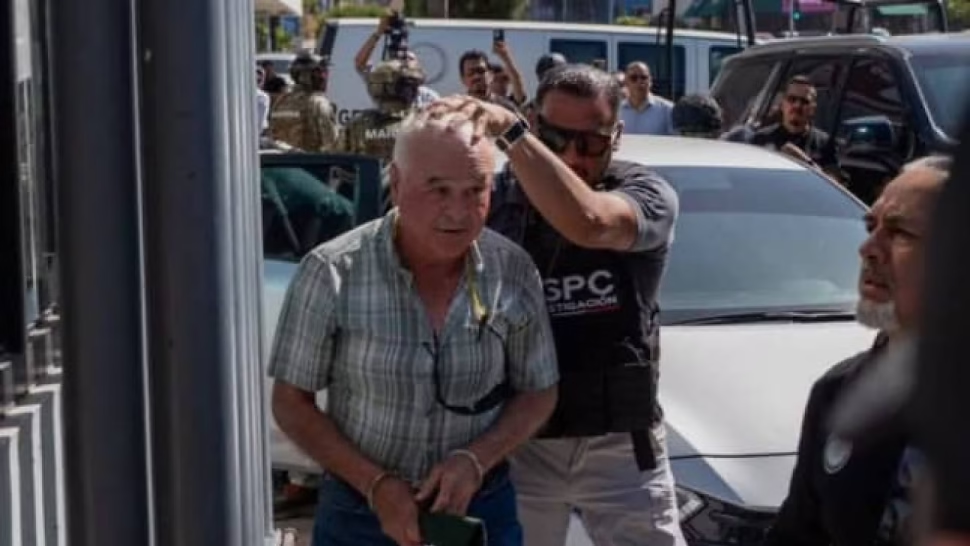
Ruffo Appel hearing exceeds 14 hours without resolution

Hearing against Ruffo Appel exceeds 14 hours and could be extended another day due to the complexity of the case.

The hearing in which it will be decided whether the former governor of Baja California, Ernesto Ruffo Appel, and seven other defendants are linked to proceedings for alleged fuel tax fraud has been taking more than 14 hours. Until now, it continues behind closed doors.

The control judge Alejandra Ramírez de la Vega directs the proceedings by videoconference from the Federal Criminal Justice Center in Almoloya de Juárez, State of Mexico. It began before eight pm on Tuesday.

Judicial sources indicate that the debate could last more than 24 hours. The complexity of the case and the volume of evidence presented by the Attorney General’s Office (FGR) lengthened the session.

The defenses of the eight defendants try to discredit nearly one hundred pieces of evidence presented by the FGR. The accusation accuses Ruffo Appel and the others of being part of a network dedicated to fuel smuggling. The alleged damage to the treasury exceeds 4 billion pesos.

At the end of the analysis, the judge will determine if there are elements to link them to proceedings for organized crime and hydrocarbon smuggling. If convicted, the former president could face up to 26 years in prison.

Continue reading

They block bank accounts of former governor Ernesto Ruffo

The UIF froze funds from the former president, who faces prosecution for smuggling. His daughter denounces legal obstacles.

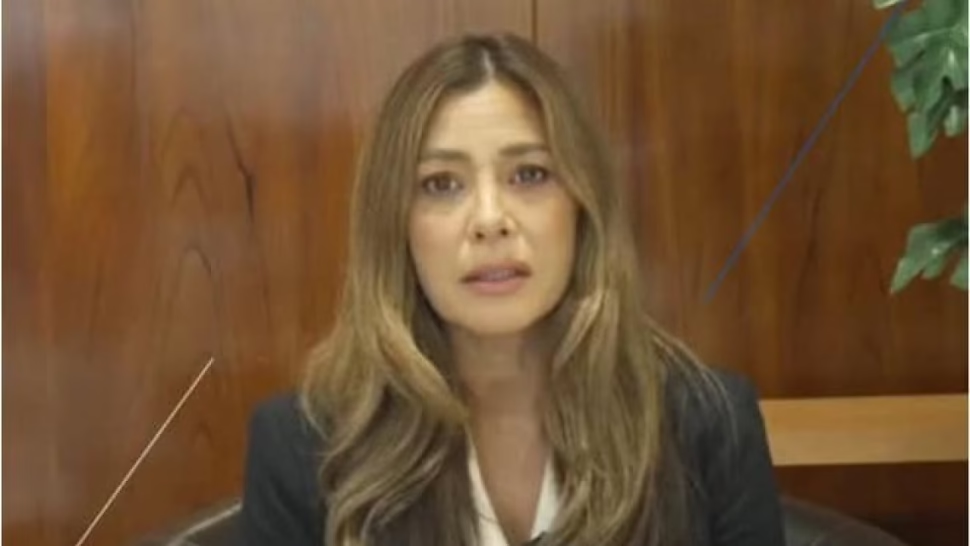
The Financial Intelligence Unit (UIF) froze the bank accounts of the former governor of Baja California Ernesto Ruffo Appel. The measure occurs within the framework of a judicial process for alleged fuel smuggling. The information was disseminated by his daughter, Verónica Ruffo, who pointed out that the former president appeared on the list of blocked people of the Ministry of Finance and Public Credit (SHCP).

Verónica Ruffo declared that the Attorney General’s Office (FGR) has limited her father’s right to defense. He explained that this Wednesday they were denied access to a warehouse of the Ingemar company in Mexico City. There they were looking for documents that, according to her, are relevant to the case. He assured that personnel from the Prosecutor’s Office prevented entry to the property, which makes it difficult to prepare the legal strategy.

The former president’s daughter also reported that she went to the United States Embassy in Mexico. He denounced what he describes as political persecution against his father. In addition, it seeks that human rights bodies take cognizance of the case and follow up on the alleged irregularities.

For his part, Ernesto Ruffo Appel continues to appear before a control judge. The judicial authority will define their legal situation in the process for alleged fuel smuggling. So far, federal authorities have not issued a public position on the accusations by the former governor’s family.

Continue reading

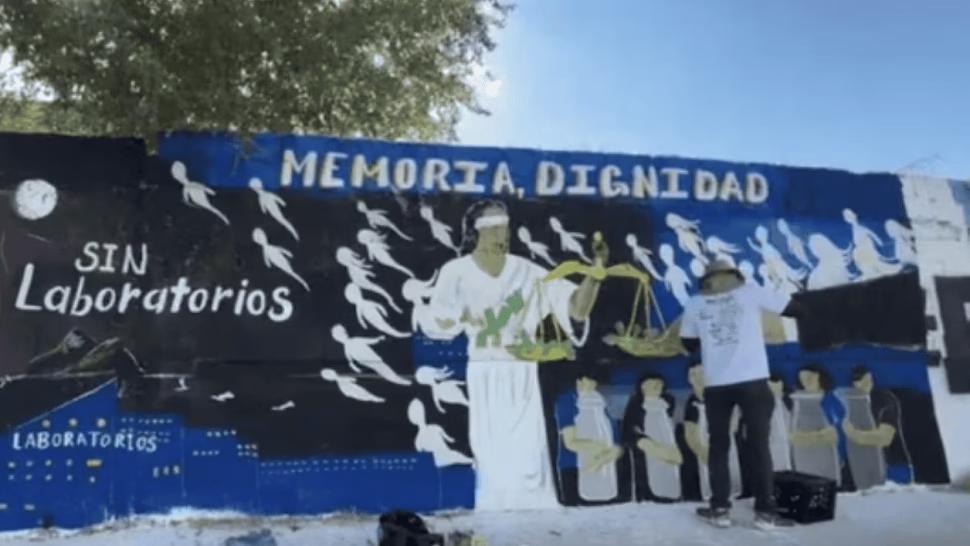
Mural demands justice for 386 people in Plenitude Crematorium

Families of victims of the Plenitude Crematorium unveil mural on Paseo de la Victoria.

The Memory, Dignity and Justice collective presented this Wednesday a commemorative mural for the Plenitude Crematorium case. On June 26, 386 uncremated bodies were found at that location. The families of the deceased led the event to unveil the work titled “Memory, Dignity and Justice for 386.”

A tribute that is also a complaint

The mural, painted on a wall on Paseo de la Victoria, seeks to honor the memory of the 386 people. But, according to the members of the group, it also symbolizes the pain and uncertainty that more than 1,500 families are experiencing. “We continue to search for answers and we hope to know with certainty the fate of our loved ones,” they noted.

The families affirmed that the investigation and justice process has not responded to the magnitude of the case. “We consider that there are still questions and irregularities that must be clarified with transparency,” they expressed.

“Behind every urn there is a story, a family and a life project.”

With this act, the families seek to keep the memory alive and prevent the case from being reduced to a figure. They demand that society know the truth and that what happened at the Plenitude Crematorium is not forgotten.

Continue reading