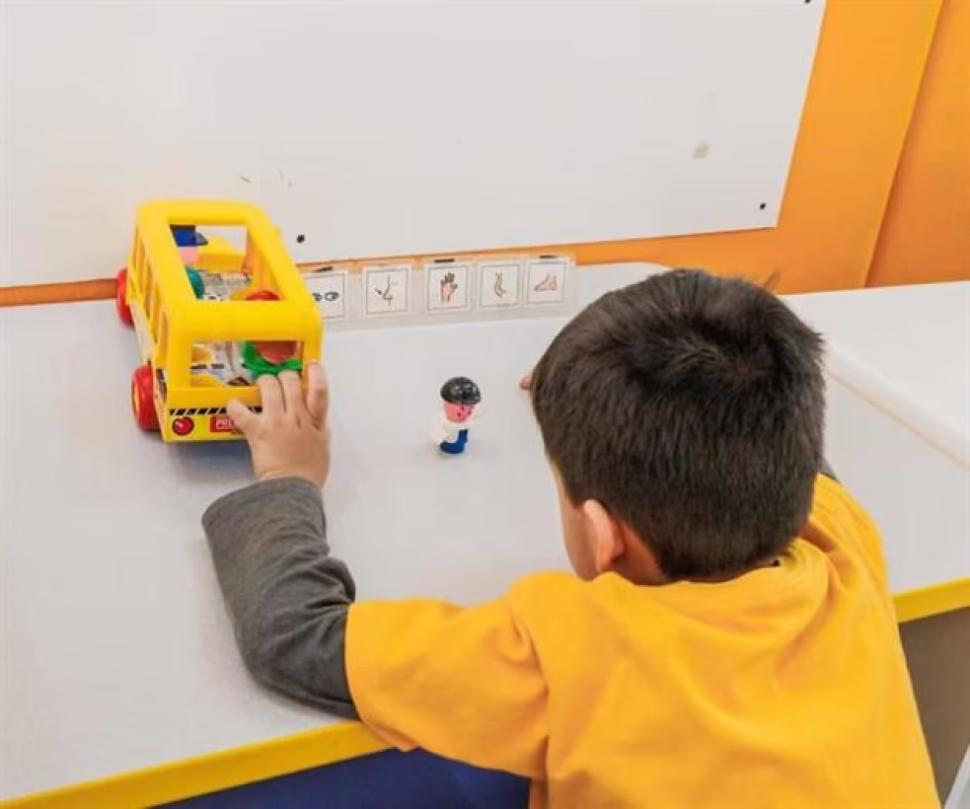
The law exists, but inclusion for autism does not reach

A Senate report reveals the gap between the law and reality for people with autism in Mexico.

The harsh reality behind World Autism Day

Another April 2nd, another official speech on awareness. While politicians take the photo, in Mexico some 400,000 people under 18 years of age with Autism Spectrum Disorder (ASD) wait for the promises to materialize.

Senator Emmanuel Reyes admitted it with that bureaucratic elegance that fascinates me so much: the problem is no longer the norm, it is the implementation. Translation: we have had a nice law since 2015 that no one applies well.

“The main challenge today is not only regulatory, but effective implementation and institutional coordination,” said the senator.

There it is. The official confession. The General Law for the Care and Protection of People with Autism Spectrum Conditions exists on paper. It guarantees timely diagnosis, inclusive education, labor integration. It sounds wonderful until you try to access those rights.

RelatedTrump links Tylenol and vaccines to autism without evidence

The WHO defines autism as a diverse set of conditions. This diversity requires complex and personalized public responses. What we have are institutions that pass the buck while families navigate a labyrinth with no exit on their own.

One in every 115 Mexican children has ASD. That statistic should be a permanent health and social emergency call, not a fact to be mentioned once a year.

Historical memory is cruel with these cases. Do you remember how many progressive laws have died on the altar of poor execution? This could be next if we continue to applaud the intentions and ignore the results.

True inclusion is not decreed, it is built day by day with resources, training and real political will. So far, we’ve only seen the first.

Morena, PT and PVEM prepare political plan for 2027

The three political forces will define their electoral route. Details will be known in the official announcement.

The plan towards 2027

The national leaders of Morena, PT and PVEM are finalizing the details of a Comprehensive Political Plan for the 2027 elections. The document will establish the work route and the electoral agreements between the three forces.

The president of Morena, Ariadna Montiel, reported that the joint strategy will be announced during the official announcement. However, he avoided confirming whether the alliance will compete together in the 17 entities that will renew governorships.

Added to this is that the PVEM senator, Jasmine Bugarín, pointed out that in San Luis Potosí there is still no defined coalition. Negotiations for candidatures, local agreements and distribution of spaces continue in each state.

The three parties have maintained an alliance in recent processes, but pending issues persist that will define their joint strategy for the next electoral process.

Morena, PT y PVEM alistan plan...

Continue reading

SCJN supports autonomy of municipalities in Tlaxcala

The highest court invalidated budget restrictions imposed by the state.

SCJN ruling in favor of Contla

The Supreme Court of Justice of the Nation (SCJN) invalidated several provisions of the Tlaxcala Expenditure Budget for 2026. The decision arose from a controversy promoted by the municipality of Contla.

Minister Yasmín Esquivel Mossa’s project noted that the restrictions imposed by the state government affected the ability of municipalities to contract, manage resources and operate public services.

Additional limits violate the Constitution

During the discussion, Esquivel highlighted that city councils already have control, oversight and accountability mechanisms for public money. Establishing additional and rigid limits was contrary to the constitutional framework.

The resolution of the Plenary Court reaffirmed the importance of the free municipality as a pillar of Mexican federalism. Local governments must have sufficient powers to meet the needs of their communities.

With this ruling, the Court established that federal entities cannot impose measures that unjustifiably reduce municipal powers. This is key to avoiding impacts on the provision of basic services and the quality of life of the inhabitants.

SCJN respalda autonomía de municipios en...

Continue reading

The United States delivers 313 wanted people to Mexico

313 people delivered to Mexico since January 2025. Sheinbaum demands reciprocity in extraditions.

Bilateral cooperation: 313 people delivered to Mexico

The United States ambassador to Mexico, Ronald Johnson, reported that since January 20, 2025, 313 individuals wanted by national justice have been handed over to the Mexican authorities. The figure corresponds to security collaboration during Donald Trump’s second term.

Johnson cited as an example the capture and transfer of a Mexican citizen accused of sexual crimes against a minor. He avoided giving details about the specific charges or operations, pointing out that this information is the responsibility of the US Department of Justice.

The announcement occurs amid bilateral tensions. Washington has singled out Mexican officials, including the governor of Sinaloa on leave, Rubén Rocha Moya, for alleged ties to organized crime. The Mexican government has rejected these accusations, considering that there is insufficient evidence.

For her part, President Claudia Sheinbaum demanded reciprocity: she assured that Mexico has presented 269 extradition requests since 2018 without any having been attended to. Security cooperation continues to be a fragile point in the bilateral relationship.

Continue reading