
Kanye West’s tour sinks in Europe

Kanye West's European tour falls apart after vetoes and cancellations due to his controversial statements.

The map of cancellations

What was going to be a great comeback turned into a disaster. In less than a month, Kanye West’s European tour was filled with holes: cancellations, vetoes and dates in the air.

The first blow came from the United Kingdom. At the beginning of April, the authorities not only doubted his show at the Wireless Festival, but also denied him entry into the country. The reason was clear: his past statements.

The reasons, the authorities explained: the anti-Semitic statements that made West famous for years.

France followed suit. Kanye had to postpone sine die his concert in Marseille after the Interior Minister considered banning it. Poland also joined in, calling the tour “unacceptable” and canceling the show at the Śląski Stadium.

RelatedKanye West appears at Diddy’s sex trafficking trial

Who wants to bear the cost?

The most recent episode was in Switzerland. The FC Basel club made an “internal evaluation” and decided to cut ties with the concert scheduled in St. Jakob-Park. His argument: the artist “does not align with his values.”

All is not lost… technically. The dates in India, Türkiye, the Netherlands, Italy, Spain and Portugal still stand. But the million dollar question is: until when?

Because now his tour no longer depends on him, nor on his followers, nor on sales. It depends on who is willing to assume the political and social cost of letting him act.

Meanwhile, Kanye tries to do damage control. In early 2026 he published a letter taking responsibility for his words, but attributing them to a “poorly managed bipolar disorder.” After the British veto, he said he wanted to meet with the Jewish community to dialogue and show change.

So far, that request has gone unanswered. Silence speaks louder than any apology.
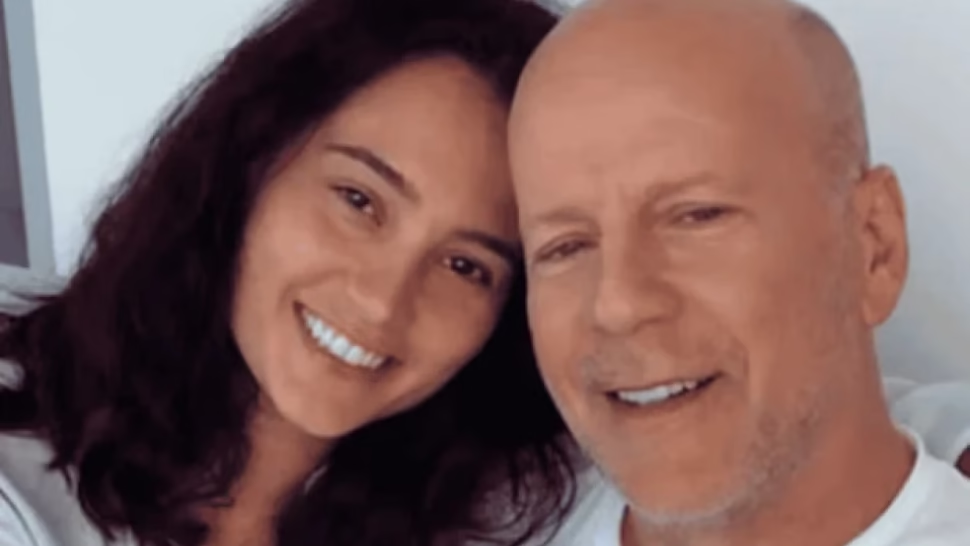
Emma Heming reveals the challenges of Bruce Willis’ dementia

Emma Heming talks about the constant grief she faces as her husband's caregiver.

Emma Heming, wife of Bruce Willis, shared details about the frontotemporal dementia that the actor suffers from. In an interview on The Bosticks podcast, he admitted that he still faces uncertainty about the future.

The variant that affects language

Heming explained that Willis does not have Alzheimer’s, but rather a variant of dementia that impacts language, not memory. “When you think about dementia, you automatically assume memory loss. But it’s a different part of the brain,” he said. The disease was diagnosed in 2023, after a first diagnosis of aphasia.

“I don’t master it perfectly,” he said of understanding the condition.

The actor presents anosognosia, a disorder that prevents him from recognizing his own condition. Heming clarified that not all patients with frontotemporal dementia have this limitation.

Grief and family care

The model described the process as a constant mourning. “You are mourning different losses all the time. The disease progresses slowly, and one lives in permanent mourning,” he said.

To ensure Willis’ well-being, he resides in a separate home with a 24-hour medical team. The decision seeks a quiet environment, since people with dementia require quiet spaces. This also allows their daughters to maintain some normality.

Heming is the primary caregiver, but she recognizes that caregivers often neglect their own health. “Sometimes you focus so much on family that you forget about yourself,” he reflected. Currently, she feels more prepared than at the beginning, although she knows that the path is still unpredictable.

Continue reading

Sabrina Carpenter’s stalker ordered restrained

A judge ordered a man to stay away from the singer for five years after trying to enter her home.

A Los Angeles judge issued a five-year restraining order against William Applegate, 31, for repeatedly trying to enter singer Sabrina Carpenter’s home. The hearing was held on Wednesday.

Applegate argued that he and Carpenter were part of a classified military program that required them to be together for “national and global security.” During the appearance, without a lawyer and dressed in a suit, he admitted having gone to the artist’s residence more than a dozen times.

The facts of the case

Last month, Applegate touched a security guard and was arrested after arriving at the front door of Carpenter’s Los Angeles home. According to the singer’s request, the man entered through a neighboring property. He returned in the following days, leading to a temporary restraining order on May 29.

In his statement, Applegate claimed that Carpenter wanted him to be there, but said he was “more than willing” to stay away if she asked him to personally. The singer, 27, described him as “a complete stranger” with whom she has never had contact.

“She fears for her own personal safety and the safety of her family members,” her attorney, Blair Berk, stated during the hearing. Carpenter was ready to testify remotely, but was not called.

Restrictions and reactions

Judge David L. Wasserman ordered Applegate to stay at least 100 meters from Carpenter, his sister and her partner, in addition to prohibiting him from any communication and the possession of firearms.

“I understand that it is your belief that, to save the world, you and the petitioner must be together. I expect you to obey the order, not what you believe is right,” the judge noted.

Applegate remains under criminal investigation, but no formal charges have been filed. Carpenter, who rose to fame with Disney’s “Girl Meets World,” has established herself as one of pop’s biggest stars with her album “Short n’ Sweet” and hits like “Espresso.”

Continue reading

Grammy 2026: five new categories and changes in best new artist

Five new categories and changes in best new artist set the rules for the next Grammys.

Grammy 2026: new categories and key adjustments

The Recording Academy modified its rules for the 2026 Grammy Awards. It incorporated five new categories and adjusted criteria in others. Among the most notable changes: a category for best Asian pop performance, recognizing releases from K-pop, J-pop, C-pop and similar genres. The prize will be awarded to the performer.

An award was also created for best traditional pop vocal performance. According to the academy, it looks for works that “cannot blend adequately with current forms of pop music.”

Another novelty: the best Latin song will recognize composers for songs recorded predominantly in Spanish. In addition, R&B adds an award for best collaboration or duo/group, while the best solo performance category is reformulated.

Folk was split into two: best contemporary folk album and best traditional folk album, similar to the change applied to country last year.

Best new artist: now with up to four chances

The best new artist category allows an artist to submit up to four times, instead of three. The goal is to reflect a market where success can take longer. There is no maximum limit on previous releases. A committee evaluates whether the artist had already achieved high impact before the year of eligibility. Anyone who has already been nominated for a Grammy is not eligible.

Additionally, certain qualified members will be able to vote in more categories.

“2027 is going to be an incredible year for the Grammy Awards, and one that reflects the extraordinary growth we are seeing in all of music,” said Harvey Mason Jr., CEO of the Recording Academy. “Member-driven changes…represent the breadth of today’s music industry.”

These modifications seek to adapt to the evolution of the global market, with emphasis on Latin and Asian music. The 2027 ceremony (which awards the best of 2026) will be the first to apply the new rules.

Continue reading