The appointment of the Judicial Body of CDMX divides Congress

A key appointment for the capital's justice system generates an intense debate about experience and meritocracy in the appointment.

The appointment of the Judicial Administration Body: An analysis of the dispute

The implementation of judicial reform in Mexico City faces a significant obstacle in the appointment of one of the members of the newly created Judicial Administration Body. This body, which replaces the previous Judicial Council, has among its primary functions the administration and exercise of the financial resources of the local Judiciary. The inability of the Mexico City Congress to reach a consensus on this appointment reveals deep political tensions and questions about the selection criteria for a position of such magnitude.

Composition of the organ and the friction point

The structure of the new administrative entity is defined by five members with a mandate of six years. Three of these positions will be appointed by the Judicial Branch itself, one will be appointed by the Head of Government, and the fifth member must be appointed by the Congress of the capital by means of a qualified majority. It is precisely at this last point where the process is stuck. The lack of agreement between the parliamentary groups of Morena, the PVEM and the opposition parties prevents the completion of the integration process, leaving the full operation of this crucial institution on hold.

RelatedThe Supreme Court appoints its new judicial administration body

The proposal promoted by the majority group of Morena consists of appointing Sara Alicia Alvarado Avendaño. However, this candidacy has encountered firm resistance from the PVEM and the opposition blocs. The central arguments of his opposition are based on the assertion that the professional profile of the proposal does not meet the technical requirements established for the position and lacks the necessary experience to perform such highly responsible functions within the judicial administration.

Political positions and the debate on meritocracy

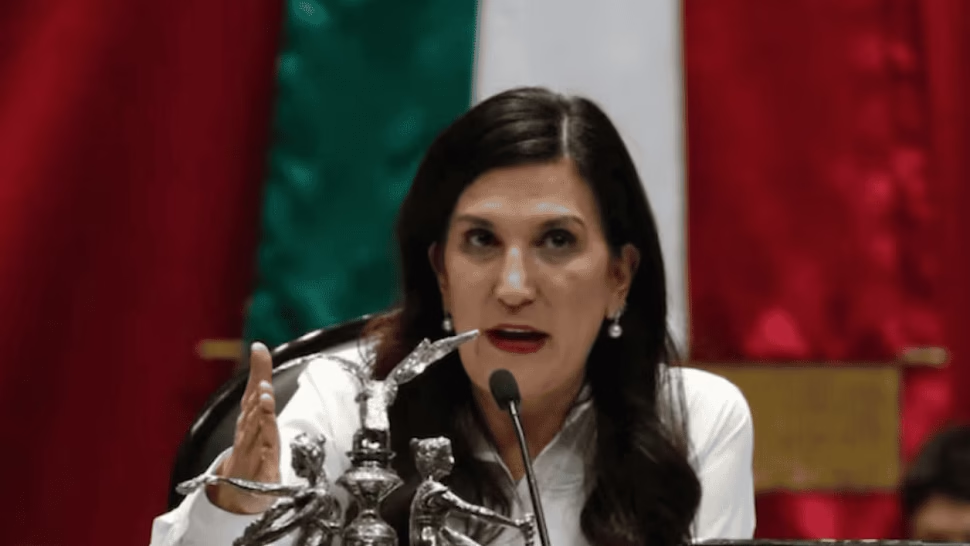
When questioned about objections regarding the candidate’s experience, the parliamentary coordinator of Morena, Xóchitl Bravo, offered a defense based on the principle of opportunity. “We all have the right to learn,” he said, making an analogy with the learning curve of legislators themselves. Bravo argued that part of the spirit of the reform of the Judiciary is precisely to open spaces so that new generations, particularly young women, can join and learn within the judicial structure, trusting that they will fulfill their mandate in an extraordinary way.

In direct contrast, the PAN coordinator, Andrés Atayde, articulated a criticism based on the principles of meritocracy and transparency that, according to his party, should guide the reform. Atayde pointed out the apparent contradiction in the process, indicating that one of the declared objectives of the transformation of the Judiciary was to combat the practices of nepotism and the assignment of positions by political quotas (“cuates y quotas”). From their perspective, the disputed designation blatantly contradicts that objective. Atayde was categorical in expressing that, after reviewing the candidate’s career, his conclusion was that she did not meet the technical requirements essential to be part of an administrative body of such complexity and impact.

This legislative impasse transcends a mere political disagreement; highlights a fundamental tension in the administration of justice: the balance between the opening of opportunities and strict adherence to criteria of suitability and proven experience. The final designation will not only determine the composition of the body, but will also set a critical precedent on the values ​​that will prevail in the governance of the Judiciary of Mexico City in the coming years. The resolution of this conflict will be a clear indicator of the direction that judicial reform will take and its real commitment to efficiency and transparency.

Do you think experience should take precedence over opportunity in key technical positions?Share this analysis on your social networks to expand the debate and explore more content related to the transformation of public institutions on our portal.

Registro obligatorio de prepago: sanciones por no cumplir

No completar el registro de tu línea prepago traerá consecuencias inmediatas en tu conectividad.

¿Qué pasa si no registras tu línea?

La regularización de la telefonía móvil en prepago entra en su fase decisiva. Las autoridades y operadores exigen que todos los usuarios vinculen su número a la CURP y a una identificación oficial vigente. Quienes no lo hagan enfrentarán la suspensión inmediata del servicio.

La Comisión de Regulación de Telecomunicaciones (CRT) busca fortalecer la seguridad y validar la identidad de los titulares. Sin embargo, el incumplimiento tiene efectos concretos: no podrás hacer ni recibir llamadas, ni enviar o recibir mensajes de texto (SMS).

RelatedYour mobile line and mandatory registration: this is what applies

También se bloquearán los datos móviles. Esto impide navegar por internet en espacios públicos o sin Wi-Fi. Aplicaciones como WhatsApp funcionarán de manera parcial, siempre y cuando el dispositivo esté conectado a una red inalámbrica privada.

Pero hay un detalle crítico: plataformas que requieren un SMS de verificación o una llamada de autenticación quedarán inutilizadas. El Centro de Respuesta a Incidentes Cibernéticos advierte que no podrás iniciar sesión ni validar transacciones si tu línea no está registrada.

Proceso de registro

La medida no contempla multas monetarias directas. El castigo es la pérdida del control sobre tu número telefónico. El plazo para registrarse vence el próximo 30 de junio. Los operadores —Telcel, AT&T y Movistar— aclaran que el trámite es gratuito y no genera cargos adicionales.

Para evitar el corte, puedes hacer el registro de forma remota. Usa las aplicaciones móviles oficiales de tu compañía o los portales web de atención al cliente. Ingresa tu CURP y una identificación oficial. Así mantendrás la propiedad de tu línea y la conectividad.

Continue reading

PRI celebra victoria en Coahuila; Moreira llama a alianza contra Morena

Rubén Moreira atribuye el triunfo priista en Coahuila al descontento con Morena y pide una alianza opositora.

El coordinador del PRI en la Cámara de Diputados, Rubén Moreira, celebró el triunfo de su partido en las elecciones de Coahuila, donde obtuvieron “carro completo”. Atribuyó el resultado al mal momento que atraviesa Morena y su gobierno.

“Morena tendrá que hacer una reflexión de por qué lo derrotaron, por qué perdió, por qué tanta gente fue a mostrarles rechazo… un fuerte ingrediente del desastre que tiene Morena de cómo se le está desmoronando el país”, declaró.

Llamado a la unidad opositora

Entrevistado en San Lázaro, Morena insistió en la necesidad de una alianza opositora que compita unida en las elecciones de 2027. Propuso candidaturas comunes, defensa del voto y movimientos estratégicos.

“La oportunidad que se abre frente a México para tener una oposición unida… frenemos a Morena y con ello frenar la destrucción del país”, expuso.

Reacción del PAN

La presidenta del recinto legislativo reconoció que el PAN perderá su registro en Coahuila, pero consideró que la cúpula del partido blanquiazul reflexionará sobre la propuesta. Por lo pronto, adelantó que apostarán por ir en solitario.

“Necesitamos ver pros y contras, que nada está dicho… hoy, lo que es un hecho el PAN le apuesta al PAN”, señaló.

Continue reading

Sheinbaum abandera a la Selección Mexicana rumbo a 2026

Sheinbaum entrega bandera al Tri de cara al Mundial 2026.

La presidenta Claudia Sheinbaum encabezó la ceremonia de abanderamiento de la Selección Nacional de México que competirá en la Copa Mundial de la FIFA 2026.

El acto se realizó en el Centro de Alto Rendimiento de la Federación Mexicana de Futbol (FMF). Ahí, la mandataria entregó la Bandera Nacional al portero Guillermo Ochoa, quien representó a los 26 convocados y al cuerpo técnico.

“La patria confía en que, como buenos y leales mexicanos, sabrán cumplir con su protesta por el bien del pueblo y por el bien de la nación”, expresó Sheinbaum.

Asistentes

RelatedThe Mexican National Team begins its path to the 2026 World Cup

Al evento acudieron directivos de la FMF: Ivar Sisniega (presidente ejecutivo), Mikel Arriola (comisionado) y Duilio Davino (director deportivo). También estuvieron el director técnico Javier Aguirre, los auxiliares Rafael Márquez y Antonio Amor, y el titular de la CONADE, Rommel Pacheco.

El equipo mexicano buscará su sexto título mundial en una Copa que coorganizarán México, Estados Unidos y Canadá.

Continue reading