Jareta and Bundas: the canines that stop drug trafficking in Veracruz

Seven trained dogs detect illicit substances in ports and airports.

Jareta: discipline and training

Jareta, a Belgian Malinois, moves with precision between wooden boxes during an exercise at the Veracruz Naval Air Base. It is part of the seven canines that make up the unit of the First Naval Region. Their training combines play with challenging routines to develop detection skills.

“Due to their operational life and functions for which they are prepared, they are very calm little animals that manage to concentrate on their work,” describes Lieutenant Montserrat Zamora, veterinary doctor of the unit.

RelatedMexico chooses its training base for the 2026 World Cup

The specialist explains that Jareta ignores weapon detonations, explosions and the noise of turbines. When it detects narcotics, it makes a passive alert. “The truth is, it is a great pride because we are a team,” says the officer.

Bundas, forged in trust

At three years old, Bundas reflects inexhaustible energy. He stands out for his obedience and has established a special bond with Second Master Armando Sosa Rojas, in charge of the Canine Department.

“We have created a special bond. I feel a love and an attachment because since he arrived I had to receive him and we are still together,” highlights Sosa.

Bundas is among the unit’s most effective agents. Throughout his service he has contributed to the largest number of seizures through the detection of drug shipments. The teacher remembers that the main objective of the training is that “illicit substances do not reach their destination.”

“I trust my canine a lot, I know him and he is a good asset,” says the officer.

In 2024, the 38 binomials deployed in Veracruz and Tamaulipas secured close to a ton of prohibited substances. The unit operates from the Las Bajadas Aeronaval Base and carries out inspections on vehicles, ships and aircraft.
PRI urges to reinforce prevention in the face of intense rains

PRI senators ask to reinforce warning and preparation for the heavy rain season.

Call from the PRI due to risks of heavy rains

PRI senators requested to strengthen prevention, monitoring and dissemination of early warning actions to face possible emergencies due to heavy rains. The request arises after the failures of federal Civil Protection during Hurricane Otis in Acapulco, where the population and tourists were not adequately alerted.

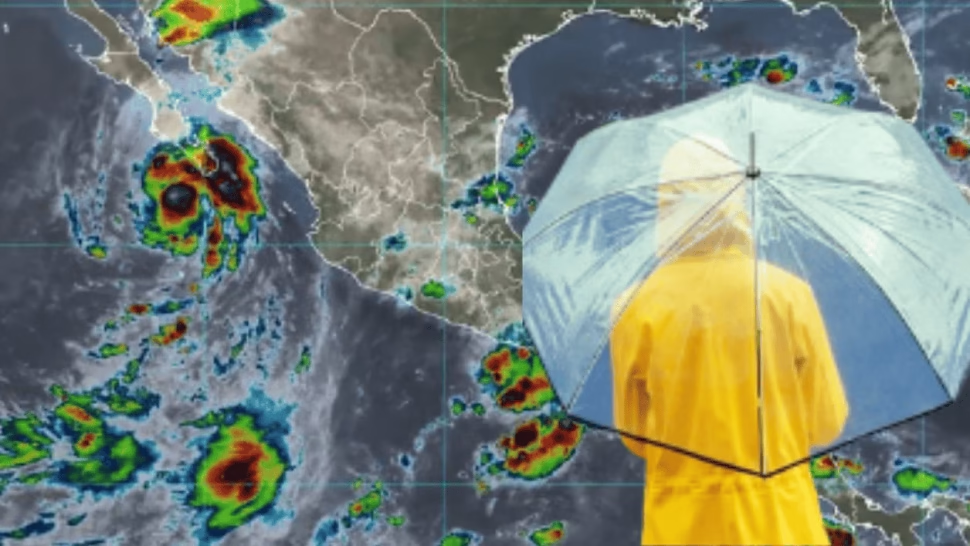
The point of agreement, published in the Gazette of July 22, is based on forecasts from the National Meteorological Service (SMN) of Conagua. For the next few days, the interaction of the Mexican monsoon, low pressure channels, humidity from the Pacific, Gulf of Mexico and Caribbean Sea is expected, in addition to the possible development of cyclonic systems.

These conditions, they warn, will favor intense rains with electric shocks, gusts of wind and high waves. The risk includes urban flooding, overflowing of rivers and streams, landslides in mountainous areas, severe flooding, falling trees and interruptions in communication routes.

Concrete actions requested

The PRI group requests that the National Civil Protection Coordination (CNPC), together with state and municipal authorities with heavy rain forecast, reinforce the identification of vulnerable areas, cleaning of channels, sewers and drainage systems. They also request to enable temporary shelters when necessary and disseminate self-protection measures.

In addition, they propose that the Ministry of Infrastructure, Communications and Transportation intensify the supervision and preventive maintenance of highways, bridges and federal roads susceptible to damage due to rain, floods, landslides or landslides.

Continue reading

Senate will review regulation of militarized schools after fatal cases

Senator promotes review of 1943 regulations after deaths of minors in private military-type schools.

Review of regulations after fatal cases

Given the death of a 13-year-old girl in a private militarized school, Senator Guadalupe Chavira announced that the Senate will review the Regulations for Private Military-Type Academies, in force since 1943. The legislator described the ordinance as anachronistic and incompatible with the current protection of children’s rights.

The regulations allow military instruction from primary to technical levels, including shooting classes in secondary school and the use of grades that grant authority to certain students over others. Chavira pointed out that these are not isolated cases; In 2025, another 13-year-old minor died at the Ollin Militarized Academy, in Morelos, after suffering serious abuse during a camp.

“The tragedy that occurred with Dafne, whose suffocation under water is being investigated, should call us to reflection and action. These schools do not have the power to organize summer camps or to authorize practices such as hazing, which ended in the death of a 13-year-old girl,” declared the senator.

The Ministry of Public Education (SEP) reported that the academy where the case occurred was operating with a 2022 incorporation agreement. After being closed for investigations, the school resumed online classes claiming the students’ right to continue their training. The agency faces at least eight additional complaints of mistreatment.

Chavira demanded a new legal framework that grants the SEP clear regulatory powers, since the 1943 regulation leaves responsibility to the Secretariat of National Defense. Specialists warn that in these private schools discipline is imposed through violence and hierarchical submission, unlike official schools where there are human rights areas and supervision of the CNDH.

Continue reading

Defense distances itself from the academy after death at a young age

The agency cited the Internal Regulations to justify its position

The Secretariat of National Defense (Sedena) disclaimed any responsibility for the “Marina Doenitz” Militarized Academy, in Ciudad Madero, Tamaulipas, after the death of the young Dafne Zapata.

Through a statement, the agency stated that it lacks the power to authorize, supervise, inspect or regulate educational institutions of this type.

“It is reported that the Secretariat of National Defense lacks the power to authorize, supervise, inspect or regulate the operation of educational institutions of this nature, in accordance with the Internal Regulations of this agency, issued by the Presidency of the Republic through its publication in the Official Gazette of the Federation, on December 29, 2008, where any administrative provision that contravenes this order was repealed,” the agency wrote.

He added that, in accordance with these regulations, Sedena “has no relationship with the aforementioned academy, nor with any other establishment of this type.”

No clear supervision

The case has put the operation of private militarized schools under scrutiny. In several states of the country they have proliferated without there being a federal body that explicitly regulates them.

To date, no state or federal authority has assumed the responsibility of supervising these schools. The Tamaulipas Prosecutor’s Office investigates the events.

Continue reading