Drone intercepted near South Korean training in Guadalajara

Unregistered drone was inhibited near the South Korean national team's training camp in Guadalajara.

Mexican military forces intercepted and brought down a drone that attempted to fly over the vicinity of the South Korean national team’s training camp in Guadalajara, a federal official confirmed to the AP.

Security operation

The action is part of the security plan deployed by local military and police forces during the World Cup, which started last week in Mexico, the United States and Canada. Specialized teams detected an “unregistered drone” near the South Korean concentration area and it was inhibited, according to a federal agent who spoke on the condition of anonymity.

RelatedDrone interrupts South Korea’s training prior to duel with Mexico

The official did not specify when it occurred or if there were arrests. He only indicated that in recent days several drones that tried to enter security zones in stadiums in Mexico City, Guadalajara and Monterrey, as well as team concentrations and fan festivals, have been inhibited.

Kukulkan Plan

Mexican authorities announced Plan Kukulkan in March, with some 100,000 federal and local military and police forces. It includes early warnings, perimeter security in stadiums, airports, roads and hotels, and protection for delegations and attendees.

International context

Canada banned unauthorized drones over World Cup stadiums and training centers in Vancouver and Toronto until July 7. The measure was adopted after an incident at the Paris Olympics, when the Canadian women’s team was accused of using a drone to allegedly monitor a New Zealand training session.

That case led to the suspension of two members of the coaching staff and the dismissal of coach Bev Priestman. The team, the current Tokyo champion, was deducted six points in the group stage in France. The Canadian Soccer Federation considered that it was not an isolated error, but part of a pattern of insufficient oversight.
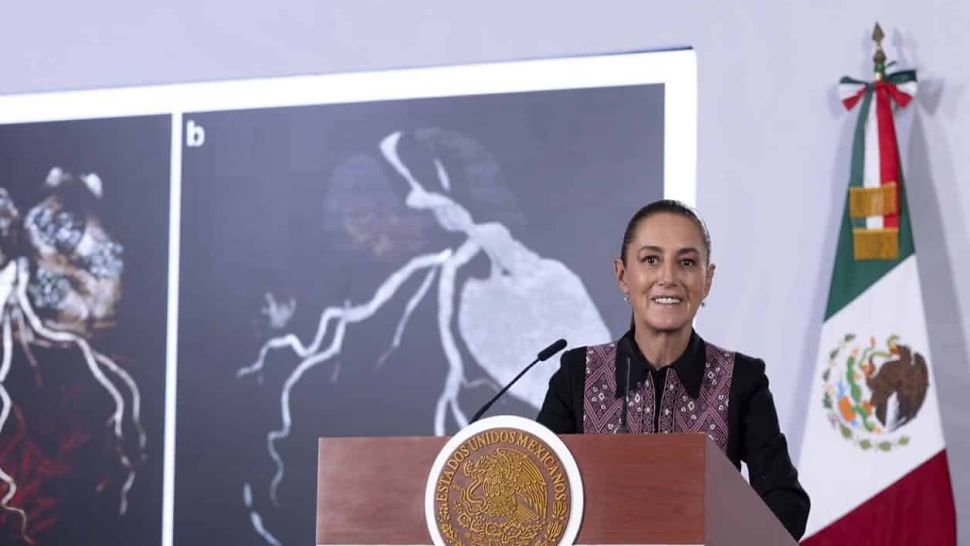

Sheinbaum announces 42 CT scanners and telemedicine to strengthen health

The president detailed investments in medical equipment, telemedicine and improvement of clinics.

President Claudia Sheinbaum reported on advances in the public health system, with investments in equipment, telemedicine and improvement of clinics. He affirmed that the State must guarantee access to health from prevention to care for complex diseases.

“We are compensating for the profound damage that neoliberalism caused in the health system,” he said at the morning conference.

Equipment and telemedicine

The IMSS installed 42 state-of-the-art CT scanners in 40 hospitals in 19 states. Of these, 41 are from 256 cuts. They allow early detection of tumors and bleeding, perform up to 50 studies per day and reduce waiting times. They were acquired for 29 million pesos each, below the 40 million in the past.

The ISSSTE expanded telemedicine from 239 to 859 units. It offers consultations in 15 specialties, such as cardiology and dermatology, from 118 second and third level units to 741 first level.

The Clinic is Ours

The La Clínica es Nuestra program delivered 4,608 million pesos in 2025 to 8,483 medical units, with the participation of 67,864 people. 42 thousand improvement actions were carried out in infrastructure and equipment. The 2026 call will begin in July, including for the first time 153 units from Yucatán with 80 million pesos.

Sheinbaum added that progress is being made in the House to House Health program, with more than 20 million consultations with older adults and people with disabilities. Starting in August-September, you will be able to collect medications at Farmacias del Bienestar, health centers and a network of pharmacies. Next year the Universal Health Service will begin with a single credential.

Continue reading

Massive security reinforcement and alcohol ban at the Azteca

56,000 police officers and alcohol restriction for the game at the Azteca.

Measures for the Mexico-Czech Republic match

The government of Mexico City announced an unprecedented security operation for this Wednesday’s game at the Azteca stadium. 56,000 personnel will be deployed, five times more than the 11,219 employed last week.

The decision responds to the celebrations of the previous Thursday, when some 700,000 people gathered in the capital after Mexico’s victory over South Korea. Although there were no injuries, nearly 40 tons of garbage were collected in the Ángel de la Independencia and the Zócalo.

The Secretary of Security, Pablo Vázquez, detailed that 7,500 police officers will guard the Azteca stadium. Another 3,275 will be in the Zócalo and 4,200 on Reforma Avenue. The objective is to protect players, referees, authorities and fans.

In addition, the Secretary of Government, César Cravioto, reported that starting at 3 p.m. on June 24, a ban on the sale of alcohol will take effect for sixteen hours. Applies to the Historic Center and five neighborhoods of Cuauhtémoc.

Sales will only be allowed in restaurants, hotels and private clubs, accompanied by food. Convenience stores and supermarkets are excluded. The fines for non-compliance amount to up to 293,275 pesos (about $17,251).

The Mexican Alliance of Transporters Organization (AMOTAC) called for mobilizations on highways in the 32 states and blockades in the capital to protest against the violence. The operation also considers these protests.

Continue reading

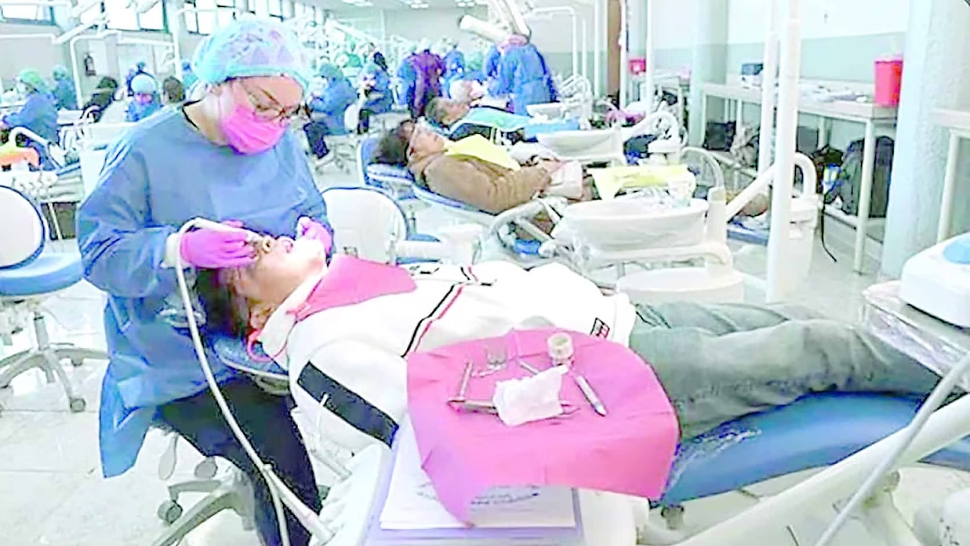
UNAM, new WHO collaborating center in oral health

The WHO recognizes UNAM as a reference in oral health and aging.

International recognition for UNAM

The World Health Organization (WHO) designated the Department of Oral Public Health of the UNAM Faculty of Dentistry as a Collaborating Center in Oral Health and Aging. The distinction is valid for four years.

With this appointment, the highest educational institution consolidates itself as a regional reference in the comprehensive care of older adults.

Implications of the appointment

The recognition will allow university specialists to participate in the development of public policies focused on improving the quality of life of the elderly.

In addition, they will promote strategies to promote among older adults and caregivers the importance of maintaining adequate oral health as an essential part of general well-being.

The designation places UNAM on a level of technical cooperation with the WHO, which opens opportunities to influence global guidelines on aging and oral health.

Continue reading