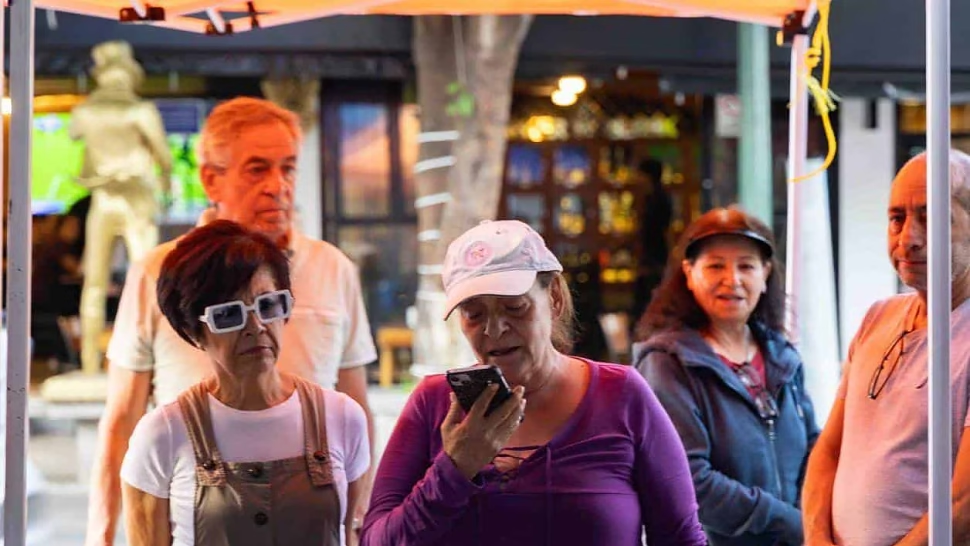
Inflation in Mexico rebounds to 3.8% annually, exceeding forecasts

The strongest monthly rebound of the year drives the general indicator, with electricity and food as the main upward pressures.

Inflation in Mexico exceeds expectations with a significant rebound

The inflation outlook in Mexico showed unexpected dynamism in November, registering an annual increase of 3.8%, according to official data published by the National Institute of Statistics and Geography (Inegi). This figure not only exceeds the 3.57% observed in October, but was above the projections of financial sector analysts, whose median was 3.68%. The National Consumer Price Index (INPC) experienced a monthly increase of 0.66%, marking the most pronounced advance so far this year and the highest rate for a month of November since 2021.

Key factors behind the price increase

The behavior of the general indicator was driven by specific pressures in certain areas. The factor with the greatest impact was the price of electricity, which shot up by 20.70% monthly due to the end of the warm season rate program in eleven cities. In the food sector, products such as serrano chili (+24.76%), zucchini (+17.05%) and tomato (+14.34%) showed considerable increases. Also contributing to the rise were professional services (+10.93%), collective transportation (+4.9%) and prices in food establishments such as loncherías, inns and taquerias (+0.82%).

RelatedInflation drops but services remain very expensive

On the contrary, some products attenuated the general increase with reductions in their prices. The lemon (-7.46%), avocado (-7.28%), rum (-5.43%) and orange (-3.97%) stood out.

Analysis of core and non-core inflation

Core inflation, considered a better indicator of the medium-term trend when excluding high volatility products, also showed a worrying rebound. Its annual rate was 4.43%, above the 4.28% in October, with a monthly increase of 0.19%. When disaggregating this index, the prices of services increased by 0.39% monthly (4.49% annually), while commercial goods registered a slight monthly contraction of 0.03%, although they maintain an annual rate of 4.43%.

For its part, the Non-Underlying Price Index, which groups together agricultural and energy products, presented a considerable monthly advance of 2.28%, taking its annual rate to 1.73%. Within this category, energy prices and rates authorized by the government rose 2.97% in the month. Finally, the Minimum Consumption Basket Price Index, which measures 176 basic products and services, registered an annual variation of 3.93%, indicating persistent pressure on the purchasing power of households with lower incomes.

This joint rebound in the general and underlying indicators suggests that inflationary pressures in the Mexican economy are broader and more persistent than anticipated, a fact that will undoubtedly be carefully analyzed by the monetary authority for its next policy decisions.

Share this economic analysis on your social networks and explore more specialized content on finance and the national economy on our site.
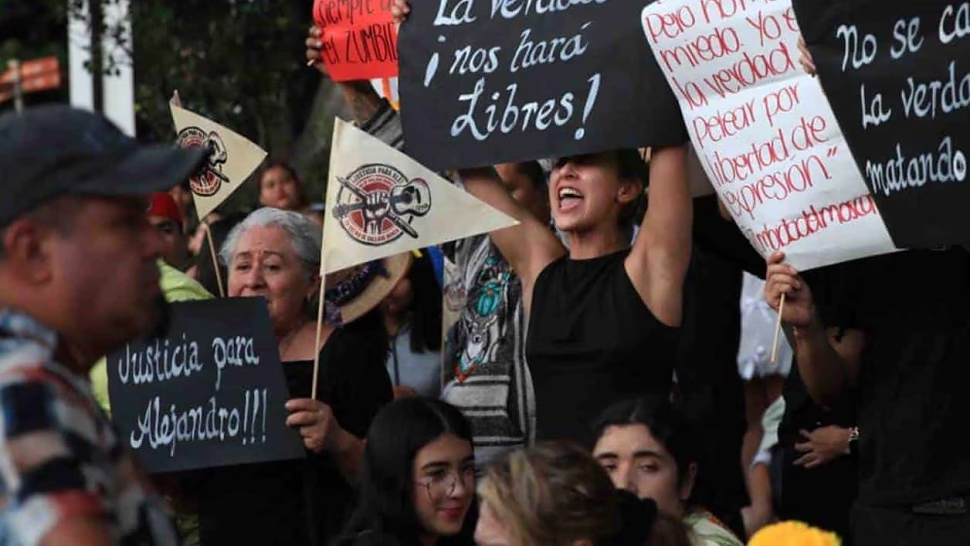

They demand justice for a journalist in Oaxaca; colleague receives threats

Threats against journalist in Oaxaca after the murder of Alejandro Leyva; protest in the Guelaguetza.

Threats against correspondent

After the murder of Francisco Alejandro Leyva Aguilar, Proceso‘s correspondent in Oaxaca, Pedro Matías Arrazola, was intimidated through social networks. They warned him that he would be next.

Organizations such as Reporters Without Borders and the UN demanded that the threats be investigated and security guarantees granted. The Oaxaca Prosecutor’s Office deployed two agents to protect him, and the state police carry out patrols near his home.

“I didn’t find out until they told me about Reporters Without Borders and then the UN, but I didn’t pay much attention to it (…). Better to keep a low profile,” declared Matías.

The journalist explained that he avoided spreading the threats so as not to divert attention from Leyva’s case. However, colleagues advised him not to minimize the risk, in a context of growing attacks against the press.

Two years ago, individuals threw Molotov cocktails with nails at his home, without causing any injuries. That attack forced him to leave the country for six months. Sixteen years earlier he was kidnapped and tortured.

“I am not afraid. I am a believer. I have a mission in this life and it will be until God decides,” he stated.

Matías filed a complaint for threats with the State Prosecutor’s Office. Its incorporation into the federal protection mechanism began.

“If we remain silent, they will have achieved their purpose. In recognition of Alejandro Leyva, I will continue along the same critical line,” he said.

Protest in Guelaguetza

Relatives and friends of Alejandro Leyva protested during the Guelaguetza delegation parade. With tarps, banners on the roof of a house and dressed in black, they demanded justice.

“We are Alejandro’s family and we ask for justice for my uncle. We know the situation in the country. It is not just Oaxaca, it is the entire country. Please join our cause,” expressed the protesters.

Continue reading

Sheinbaum announces border reopening for Mexican cattle

Gradual reopening of the US border to Mexican cattle at the end of August.

New stage for national livestock farming

President Claudia Sheinbaum confirmed that the United States border will gradually reopen at the end of August for the export of Mexican livestock. The measure represents economic relief for the country and for thousands of families dedicated to livestock farming.

Both nations suffered losses during the shutdown, caused by the presence of the screwworm. Sheinbaum acknowledged that the coordinated work between governments and producers for more than a year made it possible to contain the pest.

“You know that we have been working on the issue, both with all the livestock organizations and with the governors, to contain the screwworm,” said the president from Cuautla, Morelos.

As part of the strategy, a plant to produce sterile flies is already operating in Chiapas. In addition, Cofepris is analyzing a new strain that would make the process more efficient.

Sheinbaum explained that the effort is carried out in conjunction with the governments of Mexico, the United States and Panama. This articulation created the conditions for the US authority to authorize the opening of the border.

Continue reading

Del Valle residents propose law against property dispossession

After four days of sit-in, neighbors demand legal protection and a table with a prosecutor.

Proposed neighborhood law

Neighbors of the Del Valle neighborhood, in the Benito Juárez mayor’s office, announced that they will promote a bill to strengthen the protection of property owners. The proposal is inspired by the case of Doña Carlota, who in Chalco, State of Mexico, used a weapon to defend her home and caused the death of two people.

After holding a four-day sit-in at the intersection of Matías Romero and Coyoacán Avenue, where they reported alleged looting, the neighbors obtained a work table. The meeting will be next Wednesday in the Bunker of the Attorney General’s Office of Mexico City (FGJ CDMX) with the prosecutor Bertha Alcalde Luján and the Secretary of Government, César Cravioto.

Alicia Camp, member of the Community Participation Commission (Copaco) of Valle Centro, stated that they will present files from affected neighbors throughout the capital.

“This is not a unique and isolated case as the prosecution wants to believe; it is a recurring event, not only in Benito Juárez, but throughout the City,” he declared.

Camp called on those who have investigation files for invasion or dispossession to join the table to demonstrate the magnitude of the problem. He warned that, if there is no concrete progress, the next protest will close the intersection of Insurgentes Sur and Eje 6 Sur.

“I want to believe the word of the people who govern us, but if this is not resolved satisfactorily, we will go out again to demonstrate,” he said.

Regarding the initiative, Camp explained that they seek to avoid extreme situations to recover properties and strengthen legal mechanisms. The reform would contemplate the Public Property Registry and notaries to make fraudulent operations more difficult.

In June 2025, the Congress of the State of Mexico toughened the penalties for dispossession: from five to 10 years in prison, and up to 25 years and six months if public servants or notaries participate. The law considers aggravating factors such as physical violence, breaking locks, or when the victim is over 70 years old, a minor, a pregnant woman, a disabled woman, or belonging to an indigenous community.

Continue reading