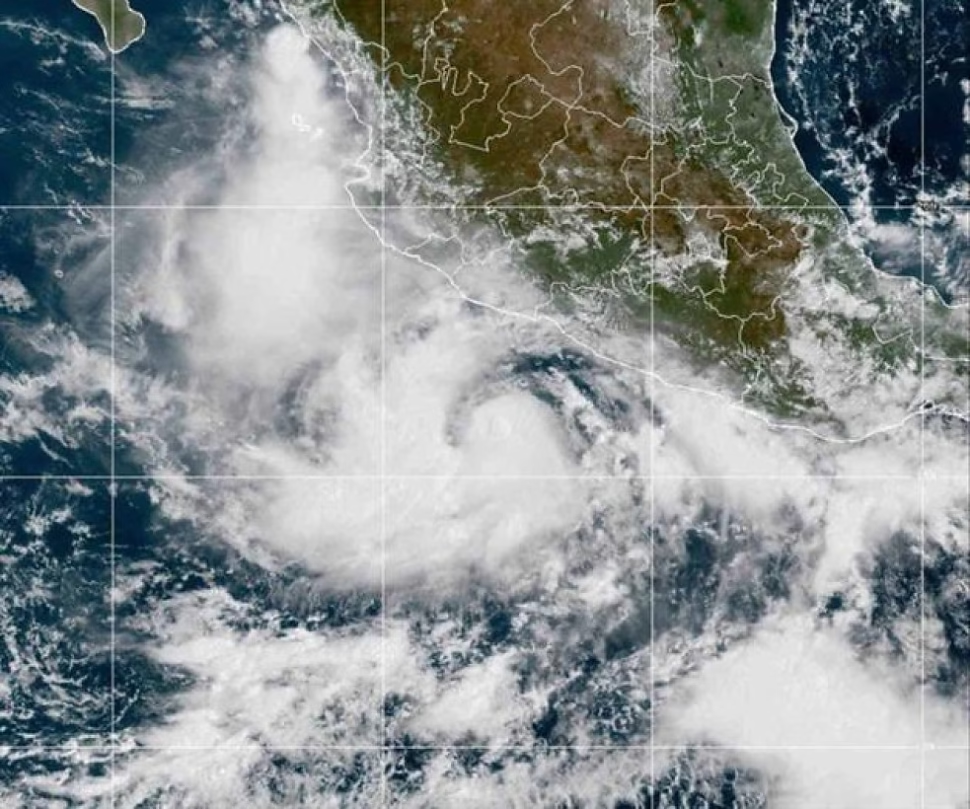
Hurricane Gabrielle warning active for the Azores islands

The Portuguese archipelago is preparing for a direct impact with extreme conditions starting Thursday, while the system generates dangers thousands of kilometers away.

Maximum Alert in the Azores Archipelago

The Azores Islands, an autonomous Portuguese archipelago in the North Atlantic, are in a hurricane alert state due to the imminent approach of Hurricane Gabrielle. According to the latest reports from the National Hurricane Center (NHC) of the United States, based in Miami, the meteorological phenomenon is moving through the open waters of the ocean with a trajectory directed directly towards the island territory. The alert was officially issued by the Portuguese Meteorological Service (IPMA), activating emergency protocols in the region.

At the end of Wednesday, Gabrielle was categorized as a category 3 tropical cyclone on the Saffir-Simpson hurricane scale, presenting maximum sustained winds of 185 km/h (115 mph). Its movement was recorded in an east-northeast direction, with a center located approximately 2,189 kilometers (1,360 miles) west of the Azores. Although forecast models indicate progressive weakening, it is anticipated that the system will maintain hurricane intensity at the time of its closest proximity to the archipelago during Thursday night and early Friday.

RelatedHurricane Gabrielle is heading towards the Azores at high speed

Expected Impact and Associated Hazards

Gabrielle’s approach carries a combination of hazardous conditions that will last through Friday. Forecasters are predicting significant coastal flooding and large destructive waves posing a serious threat to security and infrastructure in coastal areas. It is estimated that accumulated precipitation could reach up to 127 millimeters (5 inches) in the central and western islands of the archipelago, increasing the risk of landslides and flash floods.

A critical aspect of this event is the large-scale waves generated by the hurricane. These powerful storm surges are already affecting distant areas such as Bermuda, the entire East Coast of the United States—from North Carolina northward—and the Atlantic Coast of Canada. Authorities have warned of the high probability of deadly rip currents along these coasts, an underestimated but extremely lethal danger for swimmers and boaters. The hurricane’s energy spreads hundreds of kilometers from its center, demonstrating the extensive reach of these weather systems.

Situation in the Pacific Ocean: Hurricane Narda

At the same time, in the Pacific Ocean basin, Hurricane Narda has shown a different evolution. This cyclone intensified on Tuesday, reaching category 2 with maximum sustained winds of 169 km/h (105 mph). However, unlike Gabrielle, Narda is moving westward, progressively moving away from the Mexican coast. In its last report, the system was located about 869 kilometers (540 miles) south of the southern tip of the Baja California Peninsula. As it does not represent a direct threat to the mainland, no coastal warnings or alerts have been issued, and it is expected to continue its trajectory out to sea.

The simultaneous analysis of both phenomena highlights the unpredictability and diversity of behavior in the hurricane season. While Gabrielle heads towards a direct impact with a populated territory, Narda follows a route that minimizes its danger. This technical comparison is crucial to understand that the trajectory, rather than the initial intensity, is the determining factor in risk assessment.

For the Azores, the immediate priority is preparation. Residents and authorities should focus on securing properties, review evacuation plans and stay informed through official IPMA and NHC channels. The time window to make these preparations is limited, so quick and decisive action is essential to mitigate the effects of the hurricane.

Did you find this detailed analysis useful?Share this crucial information on your social networks to keep your community informed and explore our weather section for more real-time updates.


Begoña Gómez, on trial for influence peddling in Spain

The wife of the Spanish president will face trial for alleged corruption crimes.

Court order against Sánchez’s wife

An investigating judge in Madrid ordered that Begoña Gómez, wife of the president of the Spanish government, Pedro Sánchez, sit in the dock for alleged crimes of influence peddling and corruption. The resolution includes the delivery of his passport and the obligation to appear in court every two weeks.

Judge Juan Carlos Peinado argued that there is a risk of flight. A trial date has not yet been set. The court decision has intensified the political debate in Spain.

Reactions and context

The opposition has demanded a response from the socialist government. Several political leaders consider that the case affects the integrity of the executive. For now, Sánchez maintains his support for his wife and has reiterated his confidence in justice.

The process continues and it is expected that the coming weeks will define the judicial calendar.

Continue reading

Train collision in England: one dead and 9 in critical condition

Nine passengers in critical condition and the driver died after a nighttime crash.

Train collision in central England

Nine people were in critical condition Saturday following a collision between two passenger trains that occurred the night before in central England. The driver of one of the locomotives died in the incident, police reported.

More than 80 people received medical attention

The head of the British Transport Police, Lucy D’Orsi, said that more than 80 people were treated in hospitals after the crash, which occurred late on Friday. A day later, 28 of them were still hospitalized. Authorities continue to investigate the causes of the accident.

Continue reading

Colombia votes between progressive continuity and conservative turn

Colombia defines its future between two opposite poles: the continuity of Petro or a conservative turn.

Two visions, one country on the limit

Colombians go to the polls this Sunday for the closest presidential second round in years. The progressive Iván Cepeda, an ally of Gustavo Petro, faces the conservative Abelardo de la Espriella, an outsider who surprised by leading the first round with 43.73% of the votes.

“I am concerned about the extreme polarization. There are two very opposing sides and the violence worries me,” lawyer John Manrique told The Associated Press from Bogotá. “I hope we accept the result and seek a social consensus.”

The ghost of polarization

Glaeldys González, analyst at the International Crisis Group, warns that the levels of polarization are “extremely high” and that the electorate is looking for a real solution to violence, health, corruption and finance in both poles.

De la Espriella, known as “El Tigre”, promises a tough hand: mega prisons like Bukele’s and confronting illegal groups. He received the endorsement of Donald Trump. Cepeda, philosopher and former communist, promises to deepen Petro’s social reforms and maintain peace talks. This week, 100 members of armed groups demobilized thanks to this policy.

Allegations of fraud and call for calm

The second round has tense the atmosphere. Cepeda admitted that Petro did not recognize the preliminary count, although he later accepted the official count. The Ombudsman’s Office asked candidates and leaders to promote trust in institutions and avoid unsubstantiated allegations of fraud.

González pointed out that Crisis Group views possible outbreaks of post-election violence with concern, but trusts that international institutions and observers will help contain them.

Yamile Guevara, a retired teacher, criticized the historical distrust of the left: “The left has always been seen as something negative. People forget history.”

On Sunday, Colombia decides between two opposite paths, with democracy and peace as a backdrop.

Continue reading