How to use your cell phone to find hidden cameras

Your phone can be your best tool for detecting hidden recording devices in seconds.

Your phone already has everything you need

The idea that someone could be recording you in a hotel or vacation rental is disturbing. Although it is not common, it happens. And the worst thing is that many of these devices are designed to go unnoticed.

But here’s the trick: your cell phone can see what your eyes can’t.

RelatedHow to format your cell phone correctly and without risks

Three methods that really work

First, the camera. Turn off all the lights, close curtains and open the camera app. Many recording devices use infrared light to film in the dark—invisible to us, but not to the phone’s sensors.

Visit strategic points: smoke detectors, plugs, clocks, mirrors. If you see little bright spots where nothing should be… that’s your first sign.

“If you see small bright spots or flashes that cannot be seen with the naked eye, they could correspond to a hidden infrared camera”

Second method: the flashlight and the reflection. Turn off the lights, turn on the flashlight, and point it at suspicious objects while looking through the camera. Camera lenses reflect light in a particular way—a small but bright flash.

It works best on phones with good sensors, but with patience you can try it on almost any device.

Third: Scan the WiFi network. Many modern devices connect to the internet for streaming. Apps like Fing or Network Scanner show everything connected to the network.

Connect to the location’s WiFi and check if generic names such as “IP Camera” or “Webcam” appear. It is not definitive proof, but it is a warning to investigate further.

Two additional tricks (lesser known)

Interference in calls. Some cameras emit signals that interfere with your phone. Make a call and walk around the room—if you hear strange noises in specific areas, check those spots.

And basic visual inspection: objects that point directly to the bed or bathroom. Alarm clocks, chargers, decorative stuffed animals. Look for small holes or illogical locations.

For mirrors: finger test. Place a finger on the glass; If there is no space between your finger and its reflection, it could be a two-way mirror.

If you find something…

Do not touch anything. Document with photos, inform the administration immediately and request a room change. If you don’t get an adequate response, report it to authorities—recording without consent violates your privacy.

In public spaces, first check if it is part of authorized security.

Most importantly: this takes minutes. You arrive at the hotel, do the quick check-in and that’s it—tranquility guaranteed during your stay.

Satellite Internet, the bet to close the digital divide in Mexico

Mexican geography limits fiber deployment, but low orbit satellites are emerging as an alternative.

Satellite internet as a solution to the digital divide in Mexico

Mountains, jungles and deserts make Mexico one of the countries with the most complex orography in Latin America. Bringing fiber optics to isolated communities implies an investment that is difficult to recover with few users. As a result, one in five households still lack internet access or receive poor service.

Faced with this scenario, low orbit (LEO) satellite internet is emerging as a strategic alternative. “Deploying physical infrastructure in Mexico is expensive due to geography. In many cases, satellite internet represents the most viable option to connect areas where fiber will not reach in the short term,” explains Ernesto Piedras, director of The CIU. Companies like Starlink, with more than 10,300 active satellites, already operate in the country. Since May 2021, it obtained a concession and closed 2024 with 160,631 subscriptions, making Mexico its second Latin American market, only behind Brazil. Starlink has signed contracts with CFE Telecomunicaciones for up to 1,556 million pesos to connect remote communities.

However, cost remains a barrier. While a fiber optic plan costs an average of 544 pesos per month, satellite internet starts at 899 pesos, plus equipment and installation. “Commercially it is still not as viable because it is still more expensive and requires purchasing an antenna whose price remains high,” says Fernando Esquivel, from The CIU. The service makes economic sense when it is shared between communities or companies, and with the support of public policies.

Experts agree that this technology will not replace fiber optics, but will complement it. “Terrestrial services are faster and have lower latency. Satellite communication reaches areas that fixed internet would not reach,” says Hugo Simg, from MediaTek. Deployment also requires regulation and coordination between governments and companies. The race to connect Mexico is no longer only being fought underground, but from space, where a new generation of satellites promises to reduce the digital divide that keeps millions out of the digital world.

Continue reading

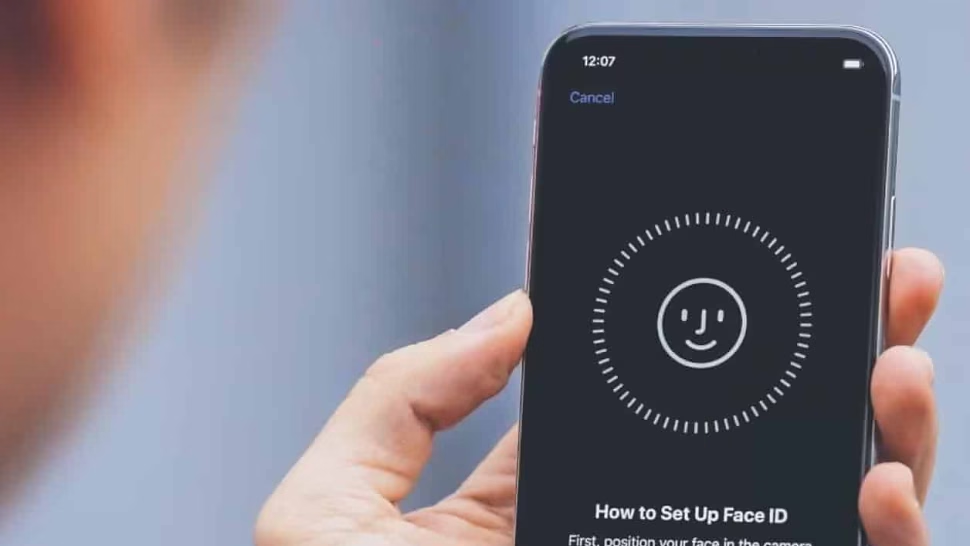
Banks prepare for biometric facial controls in October

Banks claim to be ready for facial biometrics in branches since October.

The main banking institutions in the country claim to be prepared for the new regulations on facial biometric controls when opening accounts, which will come into force next October.

What did the banks declare?

Marcos Ramírez, general director of Grupo Financiero Banorte, pointed out that the institution has made progress to reinforce the identification and security of its users. “We are in time and form with everything established by law and a little ahead, with the prudential limits of the law,” he indicated.

These measures will strengthen control over customer identification. Since 2018, by regulation, fingerprint biometrics are already required to open accounts.

Implementation details

On July 1, the National Banking and Securities Commission (CNBV) incorporated facial biometrics into the regulation for multiple banking in customer identification and authentication. Institutions that opt ​​for this mechanism must comply with technical, operational and security requirements.

Continue reading

AI detects breast cancer with 90% accuracy

An autonomous model analyzes thermographs and classifies tissues without human intervention.

An artificial intelligence model developed by Raúl Castro Ortega, a researcher at the Polytechnic University of Tulancingo, manages to identify breast cancer with an accuracy of 90%. The results were presented during the SPIE Photonics Europe 2026 International Congress, in Strasbourg, France.

How the system works

The system uses convolutional neural networks with attention mechanisms to analyze breast thermographs. Unlike traditional methods, the model autonomously learns the patterns of healthy and diseased tissue, without a specialist previously defining the characteristics of the images. This reduces processing time and improves consistency of results.

The study, titled “Breast thermography analysis using convolutional neural networks with attention mechanisms,” uses an algorithm based on the heat diffusion equation. This approach focuses analysis on thermogram regions of interest and classifies tissues with high levels of sensitivity and specificity.

Impact on early detection

The accuracy achieved represents a significant advance for the early detection of breast cancer, which can improve survival rates and facilitate timely treatment. The researcher highlighted that the system does not replace the specialist, but rather works as a support tool for faster and more consistent diagnoses.

Continue reading