Hit against drug traffickers: Semar secures 904 kilos of cocaine in Chiapas

Marina secures almost a ton of cocaine on the high seas; They arrest six foreigners.

The sea is not always an ally of crime

Elements of the Semar, in coordination with other authorities, dealt a good blow to drug trafficking. They intercepted a boat with three engines – suspicious movements, no civil navigation – and found 18 packages with 904 kilos of cocaine. Yes, almost a ton.

Six people from Ecuador and Guatemala ended up handcuffed. They were read their rights and placed at the disposal of the Public Ministry. We’ll see what happens with them, because here the processes are sometimes diluted like sugar in coffee.

“This represents an impact of 349 million pesos and prevents thousands of doses from reaching the streets,” said the Security Cabinet.

Nice speech. But what matters is that the drugs did not circulate. The SSPC and the FGR also participated. Coordinated operation, monitoring via maritime surveillance system and aerial deployment. The complete paraphernalia.

RelatedHit against drug traffickers: Marina secures a ton of cocaine in Chiapas

What they don’t say

Whose shipment was it? Exact route? Ground connections? Those questions remain floating. The institutions assure that they will maintain operations in national waters to guarantee the rule of law. It sounds good, but you already know: this is a game of cat and mouse. Today we win, tomorrow they look for another route.
Budget cut to agri-food health worries after false positive in the US

Agri-food sector asks for more budget for health after false positive in the US.

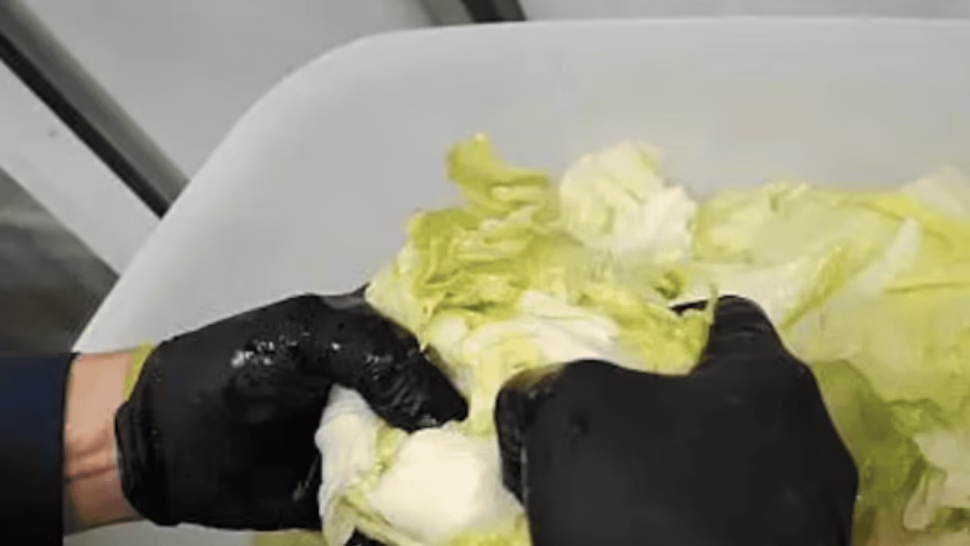
The false positive for Cyclospora in Mexican lettuce, reported by the FDA and later denied, revived the debate about the resources allocated to agri-food health in Mexico.

The budget of the National Agri-Food Health, Safety and Quality Service (Senasica) went from 6,884 million pesos in 2018 to 5,086 million in 2026. This represents a reduction of 26.1%, without considering inflation. The sector warns that this trend compromises the ability to respond to health alerts.

A week ago, the FDA flagged Taco Bell’s chopped lettuce, produced by Taylor Fresh Foods in Guanajuato, for allegedly containing Cyclospora. Hours later, he retracted it: the sample gave a false positive. Mexican lettuce exports—97% of 153 thousand tons annually go to the US—come mainly from Guanajuato, Zacatecas, Puebla, Aguascalientes and Sonora.

Authorities from the Ministry of Health and Senasica analyzed 14 samples of lettuce and water, and ruled out the presence of the parasite.

The Agricultural Market Consulting Group (GCMA) described the situation as worrying:

“While health risks, commercial exchange and international demands increase, the resources allocated to Senasica have been reduced.”

He added that health and safety should be treated as matters of national security, not subject to insufficient budgets.

Jorge Esteve, president of the National Agricultural Council, pointed out that in the last ten years the health budget was reduced by more than 50%, while agricultural and livestock production grew. “You cannot provide complete surveillance,” he stated.

The sector demands that health alerts be handled with rigor and proportionality to avoid harm to producers. Bilateral coordination based on scientific evidence made it possible to clarify this case, but the lack of resources remains a latent risk.

Continue reading

US General visits Veracruz to reinforce bilateral security

General Greg Guillot met with Mexican military commanders to discuss joint strategies.

Bilateral military cooperation in Veracruz

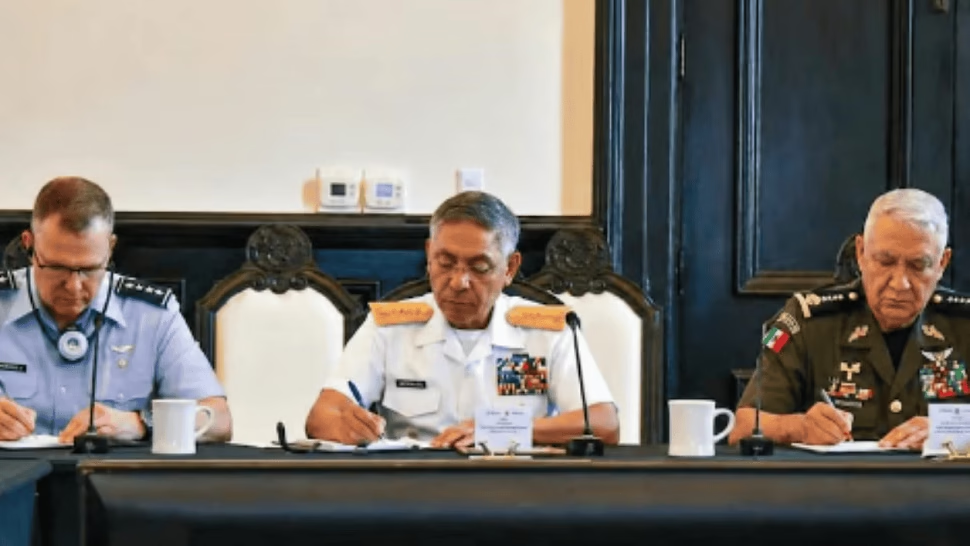
The US embassy confirmed that General Greg Guillot, commander of the North American Aerospace Defense Command and Northern Command, visited Veracruz on July 22. The objective of the meeting was to review strategic security issues.

During his stay, General Guillot met with the head of the Secretariat of National Defense, General Ricardo Trevilla, and with Admiral Raymundo Pedro Morales, Secretary of the Navy. Both sides hailed the meeting as a milestone in the bilateral defense relationship.

“The leaders addressed key strategic issues, such as specialized special operations and counter-cartel training, information sharing and force protection cooperation regarding unmanned aerial systems and the best ways to counter them,” the Northern Command said in a statement.

The North American Maritime Security Initiative and other regional initiatives were also reviewed. The Northern Command highlighted that senior commanders have transformed a professional collaboration into a personal bond that lays the foundation for expanding cooperation.

“The security of North America depends on the strength of alliances and our ability to operate with a common purpose,” declared General Guillot. “The meetings here in Veracruz demonstrate our deep mutual trust and our commitment to addressing complex regional challenges together with our Mexican partners.”

Both parties reiterated their commitment to strengthen cooperation to defend North America, with respect for sovereignty, territorial integrity, and shared and differentiated responsibility.

Continue reading

SLP search rescues lions, jaguars and Bengal tigers

Graciano Sánchez's operation in Soledad secures five live animals and four taxidermies.

Operation in Soledad of Graciano Sánchez

The Federal Attorney General’s Office for Environmental Protection (Profepa) and the Attorney General’s Office (FGR) carried out a search of a property in the municipality of Soledad de Graciano Sánchez, San Luis Potosí. During the investigation, they seized five live specimens of wildlife and four pieces of taxidermy.

Animals found include:

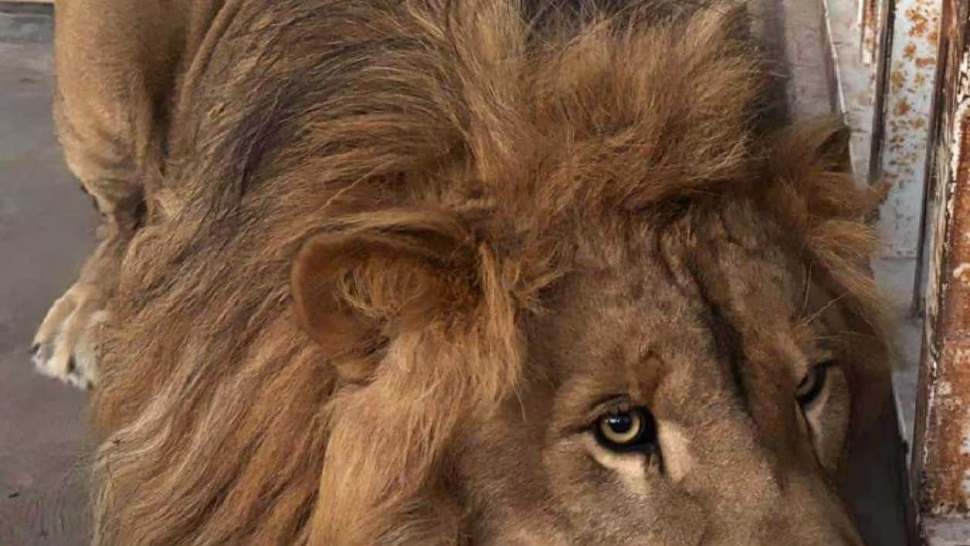
  • Two African lions: a one-year-old male and a six-year-old female.
  • A six-year-old male jaguar.
  • A Bengal tiger.
  • A one-year-old female coyote.

All of them appeared to be in good health, according to Profepa.

In addition, three full-body taxidermies were located: a Barbary goat, two black bears and a tanned black bear skin. The pieces remained under the protection of Profepa.

The live specimens were transferred to specialized centers: the jaguar and the coyote to San Luis Potosí; the lions to Nuevo León; and the Bengal tiger to Hidalgo.

The FGR began an investigation folder for the crime against biodiversity, typified in article 420 of the Federal Penal Code. Profepa collaborates in the investigations. It should be noted that the jaguar is listed as an endangered species, while the jaguar and the Bengal tiger appear in Appendix I of CITES; the African lion is in Appendix II.

Continue reading