Historic investment in scholarships: Sheinbaum’s educational plan

The government announces a record investment in student scholarships, tripling what was allocated in the previous 18 years.

One trillion pesos for education: the government’s strong bet

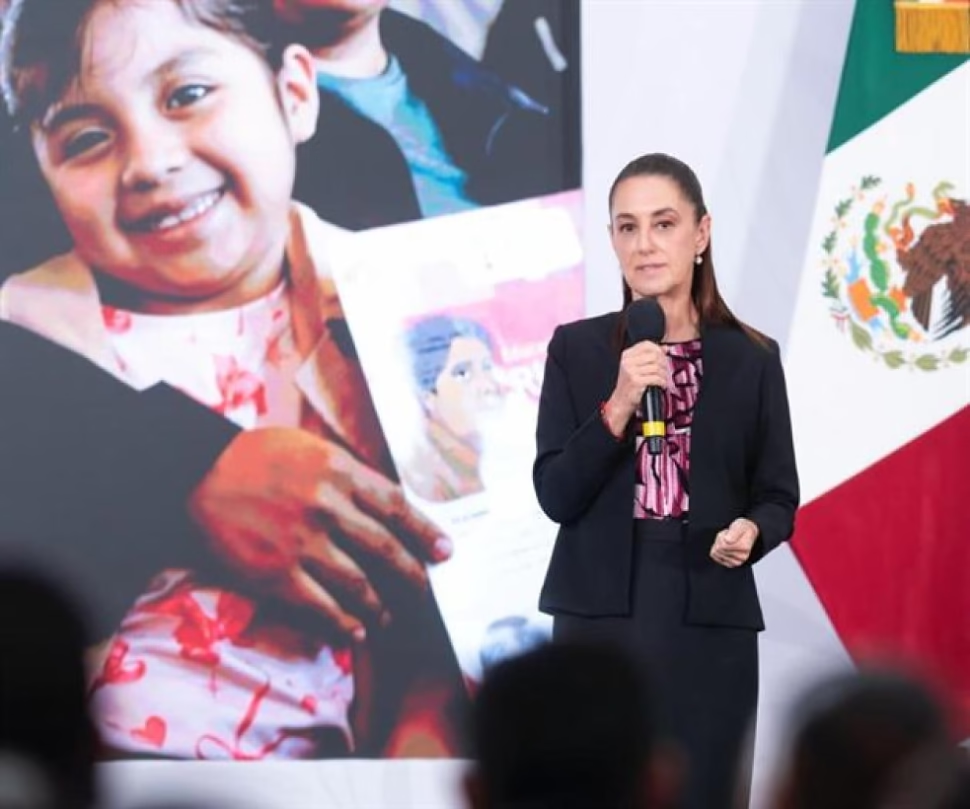
President Claudia Sheinbaum said it clearly in her morning conference. Public education is the priority and they are going to put their money where their mouth is. We are talking about a projected investment of one trillion 136 billion pesos for the Scholarships for Wellbeing program towards 2030.

“It is a historic investment that we are making in public education, because giving a scholarship to a boy or girl is an investment, it is not an expense,” said Sheinbaum.

To put it in perspective, the Secretary of Education, Mario Delgado, explained that this figure will be almost three times greater than what was allocated in the full 18 years of what they call the ‘neoliberal period’. It is a budgetary change of direction that seeks to change the rules of the game.

RelatedGovernment allocates trillion pesos to social programs by 2026

The real impact behind the numbers

They are not just figures on a piece of paper. According to the authorities, with this injection of resources it is estimated to deliver 129.5 million scholarships to students from primary school to university. Julio César León Trujillo, national coordinator of the program, gave the current breakdown: more than 7 million in primary school, more than 8 million in universal basic education and around 4.2 million in high school.

The government’s central argument is that this comprehensive support is yielding tangible results. Sheinbaum highlighted that school dropouts for economic reasons have decreased, especially at the high school level, where many young people are forced to leave school to work.

“Education, the teachers say, ‘is the center of transformation, without education there is no transformation’, and we agree,” added the president.

In addition to direct support for students, the plan includes improving infrastructure, increasing the number of high schools and universities, and improving teacher salaries. It is a move that seeks to attack the problem from all fronts.

Meanwhile, payments continue. This week the dispersions for high school and high school scholarships began according to the first letter of the last name. A constant flow of resources that is intended to be more than temporary support; It wants to be the basis for an entire generation.
Imports of Mexican cattle to the US resume

Following a health agreement, the US will reopen the port of Douglas, Arizona, for Mexican cattle.

President Claudia Sheinbaum reported that the United States will resume importing Mexican cattle starting the last week of August. The decision came after an official communication from the US Secretary of Agriculture, Brooke Rollins.

Reopening schedule

The reopening will begin at the border port of Agua Prieta, Sonora, linked to the Douglas crossing, Arizona. August 24 will be the first date of operation. Later, two additional points will be enabled in Chihuahua, subject to compliance with the Joint Action Plan against screwworm.

Sheinbaum instructed federal agencies to accelerate coordination with US authorities. He highlighted the work of the Secretary of Agriculture, Julio Berdegué, and the director of Senasica, Columba López, to strengthen health measures.

  • The animals will enter with complete inspections to verify that they do not show signs of the plague.
  • Later, the opening of the ports of Santa Teresa and Columbus, in New Mexico, will be evaluated.

The president described the news as positive for Mexican ranchers, who for months contained the spread of the screwworm. He appreciated Rollins’ willingness to maintain an institutional relationship.

Rollins, for his part, stated that the protection of the US livestock industry remains a priority and that the temporary closure of crossings was necessary to reduce risks. The reopening is possible thanks to binational collaboration.

Continue reading

More than eight million apocryphal cigarettes seized in Manzanillo

Joint operation in Manzanillo detected shipment of counterfeit cigarettes.

Operational in the port of Manzanillo

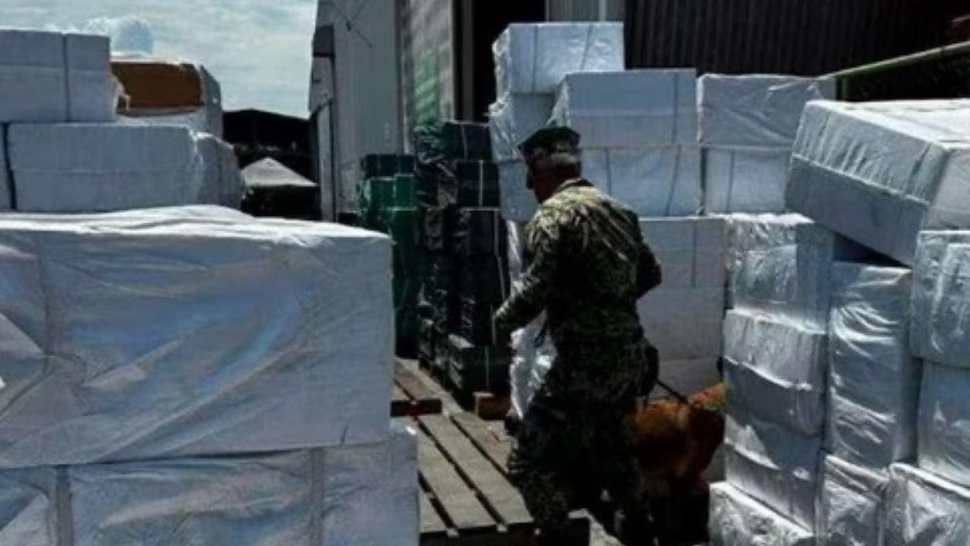
Federal authorities seized more than eight million allegedly apocryphal cigarettes in the port of Manzanillo, Colima. The operation was coordinated by agencies of the security cabinet and the National Customs Agency of Mexico (ANAM).

Personnel from the ANAM and the Administrative Unit of the Manzanillo Customs detected inconsistencies in an operation to import cigarettes from abroad. This led to a specialized review.

As a result of the inspections, the authorities located 8 million 436 presumably counterfeit cigarettes. The merchandise was insured with the support of the Secretary of the Navy (Semar).

The ANAM reported that this type of operations are part of the permanent mechanisms of operational intelligence, risk management and strategic analysis. The objective is to strengthen security in foreign trade operations and detect documentary irregularities or goods of illicit origin.

The comprehensive analysis of the operation made it possible to reinforce documentary traceability, operational review and validation of commercial profiles. The authorities maintain surveillance at entry points into the country to combat illegal trade.

Continue reading

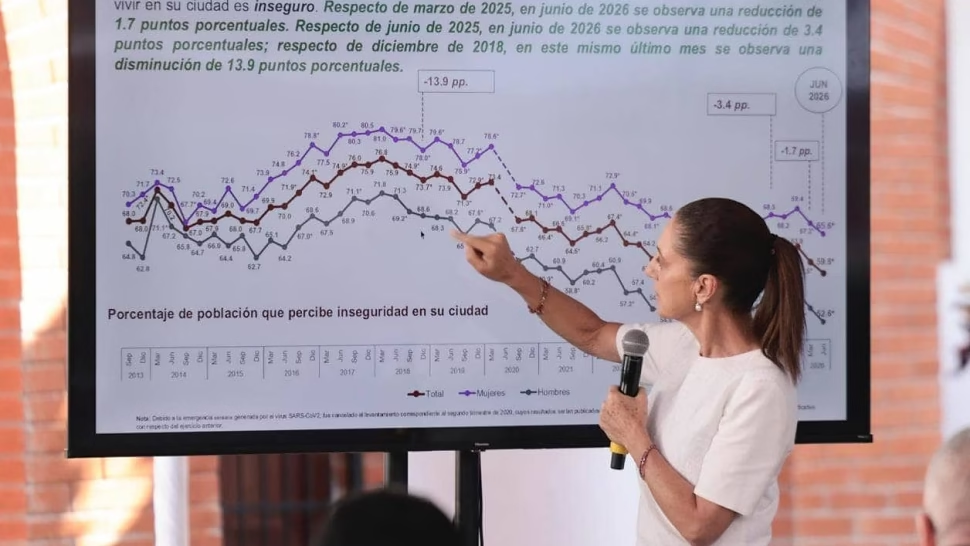
Perception of insecurity drops to 59.8%: Sheinbaum

Perception of insecurity in Mexico drops to 59.8%, the lowest figure since 2018.

ENSU results

President Claudia Sheinbaum reported that the perception of insecurity in urban areas fell to 59.8% in June 2026, according to the National Urban Public Security Survey (ENSU) of the INEGI. In December 2025 it was 63.8%, which represents six consecutive months of decline.

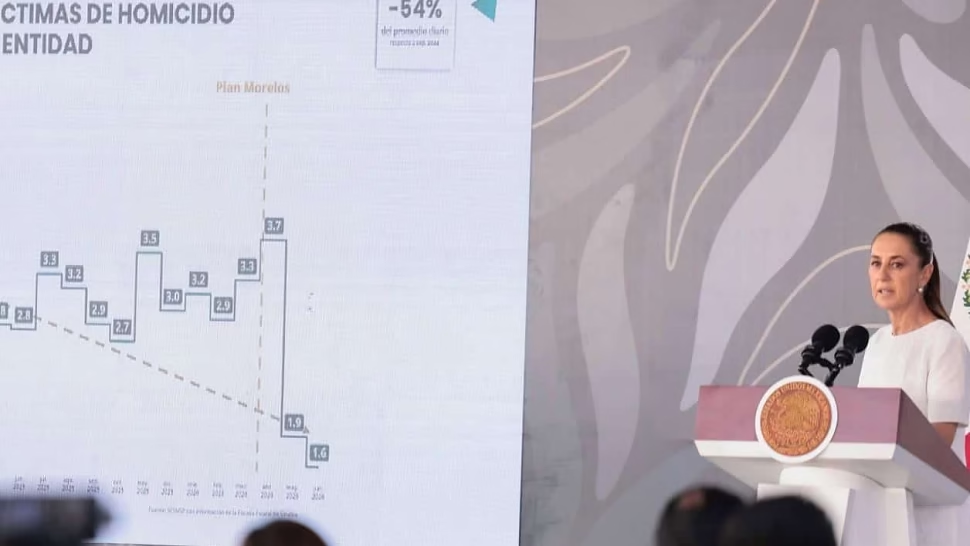
“The important thing here is that we are giving results in the security indicators and people are beginning to notice this decrease,” he said during the morning conference in Cuernavaca, Morelos.

Historical comparison

Sheinbaum recalled that in December 2018, under the government of Andrés Manuel López Obrador, the perception of insecurity was 73.7%. The previous lowest point was reached in September 2024 at 58.6%. The president attributed the improvement to the National Security Strategy.

The ENSU measures citizens’ feeling of insecurity in their environment. Recent data reflects a positive trend, although the challenge remains to maintain the reduction in crime. The authorities continue to implement actions to consolidate these results.

Continue reading