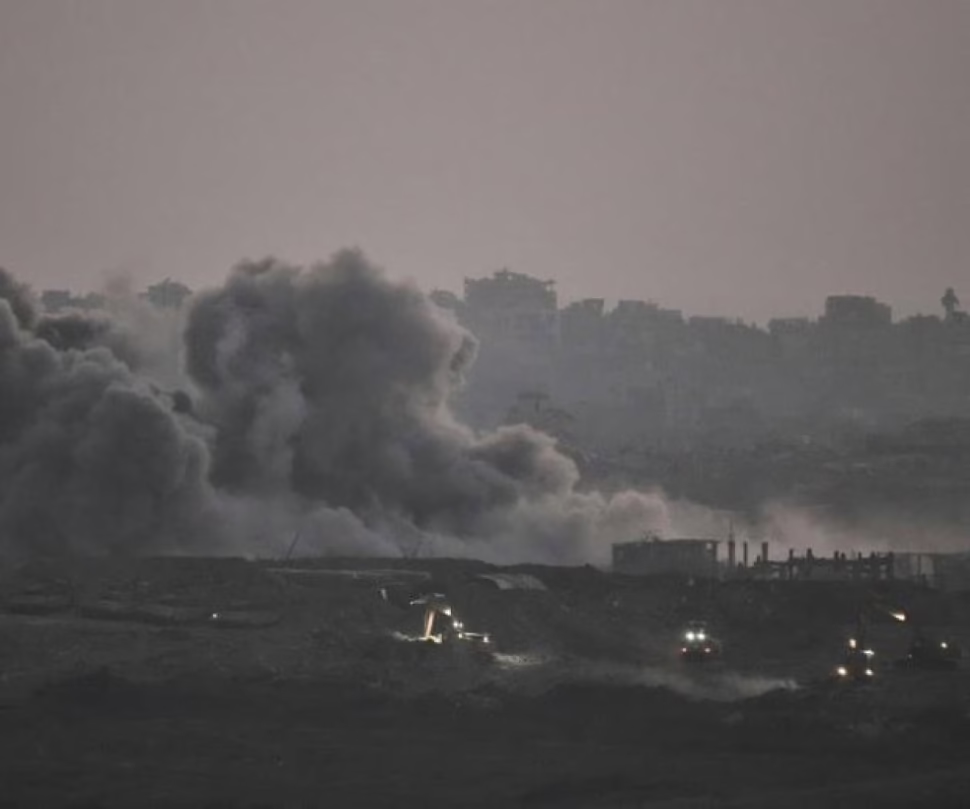
Hamas mulls truce proposal as Gaza deaths escalate

Progress in peace negotiations while civilian victims increase in the midst of the humanitarian crisis.

A ray of hope in the midst of the crisis

In the midst of the complex situation in the Gaza Strip, a possibility for change arises. Hamas is actively analyzing a ceasefire proposal put forward by international mediators, a crucial step toward the peace we all long for. Meanwhile, local people demonstrate inspiring resilience in the face of extremely difficult circumstances.

The humanitarian urgency that calls us to act

Recent incidents near aid distribution points remind us of the importance of redoubling humanitarian efforts. According to reports, at least 20 people lost their lives while waiting for life-saving assistance, a situation that calls us to reflect on the value of each human life. The Gaza Humanitarian Foundation, together with international organizations, works tirelessly to bring hope to those who need it most.

RelatedIsrael orders total evacuation of Gaza and Hamas analyzes Trump proposal

The UN has documented more than 600 tragic incidents in the last month, numbers that drive us to seek creative and compassionate solutions. As a global community, we have the power to transform these statistics into stories of improvement. Every gesture of solidarity, no matter how small, contributes to building a better future.

Ravina Shamdasani, human rights spokesperson, emphasizes the need for transparency in the investigation of these events. Their call to action inspires us not to remain indifferent: “The information keeps coming and this situation is unacceptable.” These words resonate as a reminder of our collective power to create positive change.

Towards a future of reconciliation

The recent dialogues between Palestinian factions and the mediation of Egypt and Qatar represent a historic opportunity. As former President Donald Trump pointed out, preliminary agreements exist and it now depends on the will of all parties to turn this possibility into reality. Every day of peace gained is a victory for humanity.

The figures from the Gaza Ministry of Health, although alarming, should not paralyze us but rather motivate us to act. Behind every number there are dreams, families and human potential. The majority of victims are women and children, reminding us of our shared responsibility to protect the most vulnerable.

As negotiations progress, local witnesses continue to document situations that require our immediate attention. The Israeli army claims to be investigating these incidents and maintains its position on the use of warning shots. This critical moment demands transparency and genuine commitment to human rights by all parties involved.

History teaches us that even the most deep-rooted conflicts can find a solution when the will to dialogue prevails. Every gesture of goodwill, every hour of truce, every life saved is a step towards the peace that Gaza deserves.

Your voice can make a difference! Share this message of hope on your social networks and let’s help make visible the importance of the peaceful solution. Together we can inspire positive change. What other initiatives do you think could help alleviate the humanitarian crisis? Explore more content on international diplomacy and peacebuilding on our site.
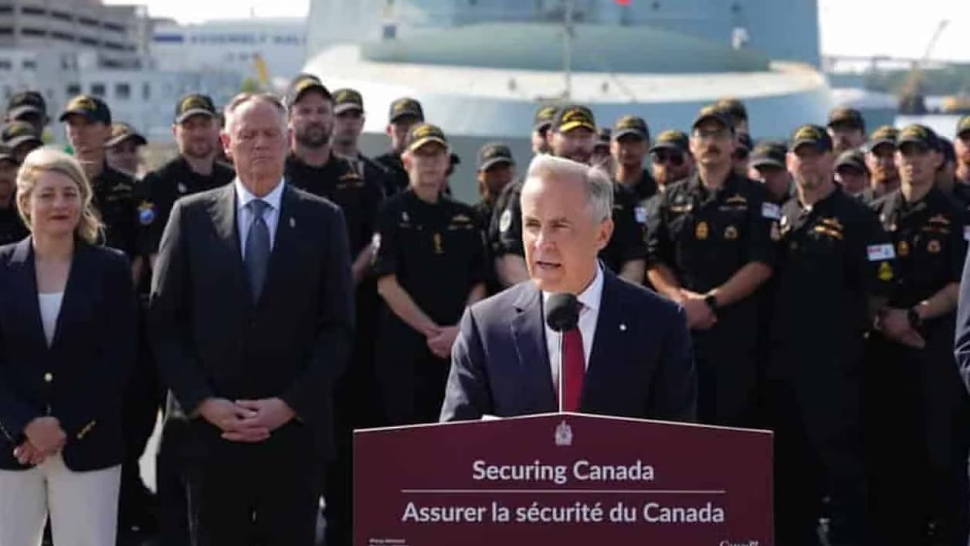
Canada chooses Germany for its largest military purchase: 12 submarines

Canada appoints German firm to build up to 12 submarines, the largest military acquisition in its history.

Canada chooses ThyssenKrupp for its largest military acquisition

Canada selected the German company ThyssenKrupp Marine Systems (TKMS) as a preferred supplier for the construction of up to 12 submarines. Prime Minister Mark Carney called the operation the largest military acquisition in the country’s history.

The announcement comes days before Carney attends a NATO summit, where allies face pressure to increase their defense spending. The president affirmed that the TKMS platform is optimal for Arctic waters and for the alliance.

“The submarine is proven and capable,” declared Carney.

TKMS supplies submarines to more than a third of NATO members. Carney declined to reveal the exact price, but said it will involve an investment of “tens of billions of dollars.”

German Chancellor Friedrich Merz thanked Carney and stressed:

“This is a strong signal for our transatlantic and European alliance.”

The German company beat the South Korean Hanwha Ocean. ThyssenKrupp said its submarines will strengthen interoperability, as many NATO allies already operate conventionally powered vessels.

Canada has committed to increasing its military spending after years of lagging behind NATO goals. Carney promised to raise defense spending to 5% of GDP by 2035, after reaching 2% of GDP this year, the alliance’s previous goal. The Canadian fiscal plan foresees spending reaching 4% of GDP by 2030.

Germany and Norway, countries that design the submarines together, will open production spaces to speed up deliveries. Canada would receive four submarines by 2034, two years earlier than projected. The new fleet will replace the four Victoria-class submarines, purchased second-hand from the United Kingdom in the late 1990s.

No American company submitted a bid, as the United States only builds nuclear-powered submarines, while Canada was looking for conventional vessels.

“The sovereignty of our country, bounded by three oceans and the longest coastline in the world, depends on our maritime capabilities,” concluded Carney.

Continue reading

China launches ballistic missile from nuclear submarine in the Pacific

Test with dummy warhead draws criticism from Australia, Japan and New Zealand.

Ballistic missile test from nuclear submarine

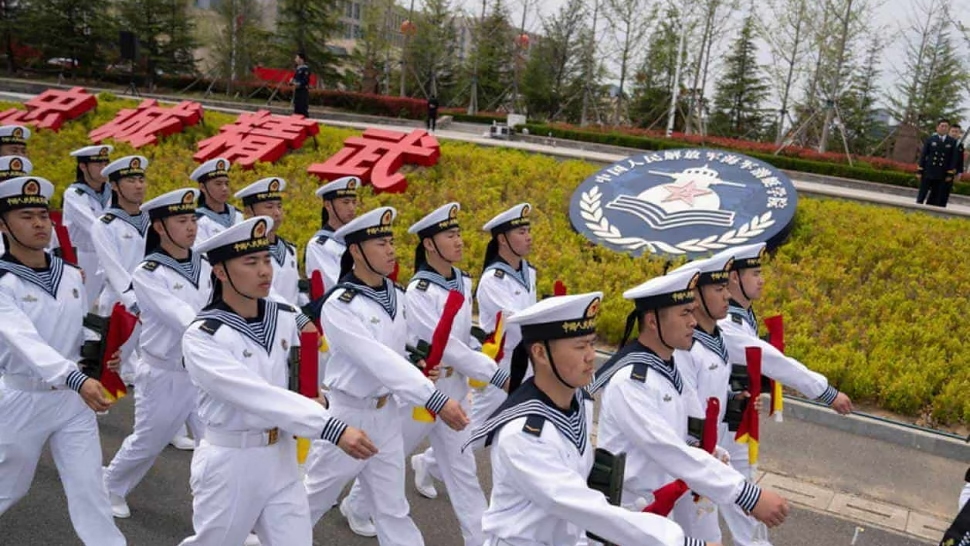
China’s military on Monday test-launched a long-range ballistic missile from a nuclear-powered submarine in the South Pacific Ocean. The warhead was fictitious, according to the official Xinhua agency. The launch, at 12:01 local time, was part of routine annual training and was not directed against any country, said a brief Xinhua statement republished by the Ministry of Defense.

Australia, Japan and New Zealand protested. New Zealand Foreign Minister Winston Peters declared:

“It appears that, despite our long-standing concerns about this type of activity, China carried out the test within hours of informing us.”

The test occurred on the same day that Australia and Fiji signed a mutual defense treaty, in a gesture to counter Chinese influence. Australian Foreign Minister Penny Wong said:

“Australia has been clear with China that we consider this to be destabilizing for the region.”

Japan expressed concern. Chief Cabinet Secretary Minoru Kihara said:

“China’s military activities, combined with its lack of transparency, have become a serious concern for Japan and international society.”

Beijing dismissed the criticism. A Foreign Ministry spokesperson stated: “We hope relevant countries will avoid overinterpretation.”

The United States also reacted. State Department spokesman Thomas Pigott said:

“Beijing’s rapid and opaque buildup of nuclear weapons is of grave concern to the region and the world.”

Experts pointed out the lack of transparency. Drew Thompson, a researcher at Nanyang Technological University, commented: “China’s modernization and military buildup have occurred without parallel increases in openness and transparency.”

Lyle Morris of the Asia Society Policy Institute noted that it is the first publicly acknowledged test of a dummy warhead from a nuclear submarine traveling so far in the Pacific. Morris stressed that Japan, New Zealand and Australia received notifications, but not the United States.

China maintains a “no first use” policy on nuclear weapons, but modernizes its arsenal. According to the Pentagon, China had about 600 warheads in 2024 and projects more than 1,000 by 2030.

Continue reading

Italy opts for silence in the face of Trump’s new criticism of Meloni

Rome remains silent after Trump's new attack on Meloni in the middle of the NATO summit.

Official silence in the face of Trump’s disqualification

The Italian government decided not to respond to the latest message from Donald Trump, who launched a direct criticism against Prime Minister Giorgia Meloni. The position seeks to prevent the episode from overshadowing the NATO summit in Ankara, Türkiye, where both leaders will meet.

Sources from the Chigi Palace indicated that Meloni dedicated the previous hours to preparing the work agenda, without referring to the American president. The atmosphere, however, became tense after Trump spread a meme about an alleged harassment restraining order, weeks after accusing Meloni of having “begged” him for a photo during the G7 summit.

These accusations have eroded mutual trust and buried the “special relationship” that both leaders exhibited a year ago at the NATO meeting in The Hague.

Internal reactions and bipartisan support

The tension escalated to the point that, according to internal versions of the Italian Executive, the participation of officials in the official reception of the American embassy was reconsidered. Washington’s version of Meloni’s alleged unfulfilled commitments causes confusion in Rome; Some leaders close to the prime minister have questioned Trump’s state of health to explain what they describe as “disconcerting statements.”

However, government sources assure that both the State Department and the Pentagon reiterated their willingness to maintain bilateral cooperation.

Deputy Prime Minister and Foreign Minister Antonio Tajani—who will meet with Secretary of State Marco Rubio—said that Trump’s statements speak for themselves and that the transatlantic relationship goes beyond a single person. The Defense Ministers, Guido Crosetto, and Deputy Prime Minister Matteo Salvini avoided delving into the controversy to preserve the strategic alliance.

Internally, Meloni received the support of the president of the Senate, Ignazio La Russa, and the leader of the Chamber of Deputies, Lorenzo Fontana, who condemned the disqualification and demanded a dialogue based on mutual respect.

Continue reading