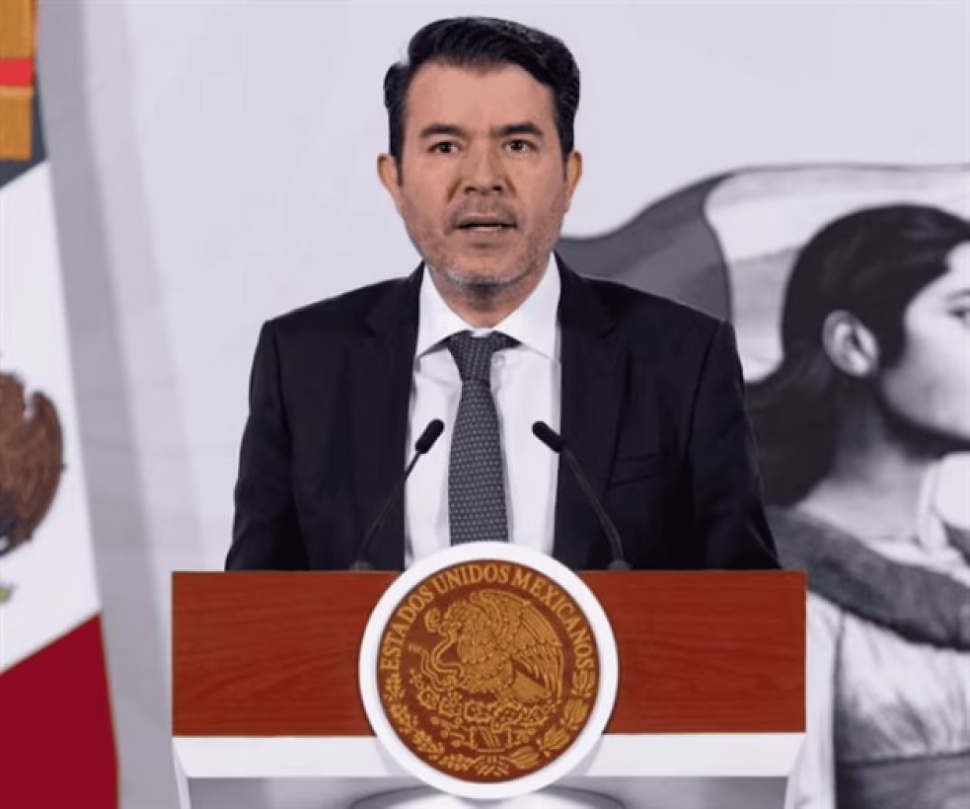
Government promises new stage in search for missing persons

The government announces a new stage in the search for the missing, while updating its strategy and promising justice.

Advances or more of the same?

Arturo Medina Padilla, the Undersecretary of Human Rights, came on stage in the morning of Sheinbaum. Its topic: updating the Missing Persons Search Strategy. The priority, he said. Truth and justice, he promised. Including Ayotzinapa.

But here we are, again. Hearing the same words in a room named Treasury. How many strategies do we already have? Memory is fragile, but files are not.

RelatedAyotzinapa at eleven years, a wound that remains open

History that repeats itself

Medina traced two historical moments: the Dirty War and Calderón’s “irresponsible war against drugs.” An official recognition of the disaster, late but there it is.

Then came the inevitable point: Ayotzinapa. The undersecretary called it “painful” and a “injury that requires the highest priority attention”. It sounds good until you remember that that wound has been bleeding for almost a decade.

He highlighted the role of family groups. It was they who pushed the General Law against disappearances. The State, as usually happens, arrived later with the sealed paper.

There was a revealing moment. He talked about the old search platform where “anyone could feed information… without methodology or clear guidelines”. A digital chaos that reflects real chaos.

New promises, old problems

From AMLO, says Medina, a National Strategy was implemented that allowed “to update the records”. Now, with Sheinbaum, “a new stage to guarantee truth and justice” begins.

The obvious question: what was the previous stage? The numbers remain a national nightmare.

“With the government of President Claudia Sheinbaum we begin a new stage to guarantee truth, justice and the search,” declared Medina Padilla.

He mentioned the findings of Rancho Izaguirre in 2025 as a turning point. From there came the presidential instruction to strengthen the National Search Commission and reform the laws.

Among the specific announcements are a national search alert, the obligation to open a file upon the first report and a single identity platform. They sound like necessary technical measures. But in this country, between the decree and reality there is usually a chasm.

The press conference ended. The cameras were turned off. The families are still waiting. And we journalists continue to take note, comparing these promises with previous ones. Time will tell if this time is different.

García Harfuch: fighting crime is not a finished task

García Harfuch and Sheinbaum present advances in security and criticize previous governments.

Results of the security strategy

The Secretary of Security, Omar García Harfuch, acknowledged that the fight against organized crime is far from over. During the morning conference, he highlighted the arrests of members of different criminal groups.

“It is difficult to talk about collusion or an omission on the part of the government when there are these results. The results in terms of security are very measurable.”

García Harfuch mentioned that in the previous six-year term there were actions against organizations in Sinaloa, Jalisco, the Gulf and Guanajuato. He noted that one of the leaders of the ‘Chapitos’ faction was captured and extradited to the United States.

“It is not a finished task… there is still a lot to do, a lot of people to arrest and laboratories to destroy.”

For her part, President Claudia Sheinbaum assured that the phrase “hugs, not bullets” does not mean inaction. He reported that in the previous government there were 95,019 people arrested, 39 of them considered relevant.

“This narrative that there was collusion. But also, said by those who did have collusion, because the collusion that existed in the Calderón period with García Luna is public and notorious.”

Sheinbaum also indicated that, if a judge grants a suspension that benefits criminals, an investigation will be requested from the Judicial Disciplinary Court.

Continue reading

Sheinbaum confirms probable meeting with King Felipe VI

Sheinbaum plans to meet with the king of Spain during his visit to Mexico in June.

President Claudia Sheinbaum stated that the probability of meeting with King Felipe VI during the monarch’s visit to Mexico is high. The reason for the royal trip is the friendly match between the Spanish and Uruguayan national teams, scheduled for June 26 in Guadalajara.

“Yes, it is likely so. He is still in Foreign Relations with the Foreign Ministry of Spain, the representation of the Spanish State. And I already believe that tomorrow or the day after we will inform him,” Sheinbaum responded from his morning conference.

The president announced that the meeting would take place in Mexico City, not in Guadalajara, where the match is played. Diplomatic talks between both foreign ministries continue to define the details.

Bilateral context

If it takes place, it would be one of the highest level meetings between Mexico and Spain in the midst of the redefinition of the bilateral relationship promoted by the Sheinbaum administration. It is worth remembering that the president recently traveled to Barcelona to participate in a summit of left-wing countries, where she met with the president of the Spanish government, Pedro Sánchez.

Continue reading

CJNG maintains operation with regional structure after death of El Mencho

García Harfuch explains that regional leaders avoided a violent escalation after the kingpin's death.

Almost four months after the death of Nemesio Oseguera Cervantes, alias “El Mencho”, the Secretary of Security, Omar García Harfuch, affirmed that the Jalisco New Generation Cartel (CJNG) has sustained its operation through already established regional leaders. That structure, he said, prevented an escalation of violence.

CJNG operation after the death of ‘El Mencho’

During the morning conference at the National Palace, the official explained that the authorities identified a clear territorial division within the group.

“They have very identified regional leaders, with very marked territories. That also allowed in one way or another that there was no lack of control or excessive violence,” he noted.

García Harfuch indicated that after the death of Oseguera Cervantes, the federal forces continued with operations and captures of relevant members.

“Subsequently, there continued to be arrests by the Security, Defense and Navy Cabinet, and regional leaders continue to have arrest warrants; some for extradition purposes,” he explained.

Regarding the links with the Sinaloa Cartel, the secretary maintained that the main connection was “Mencho” himself with one of its factions.

“Mainly it was the leader himself, the main leader, who was the direct link with a faction of the Sinaloa Cartel, specifically with Los Chapos. We have not identified that at the moment,” he stated.

Asked if Juan Carlos Valencia González, stepson of Oseguera Cervantes, assumed leadership – as reported by an American media in April – García Harfuch recognized him as one of the most relevant commanders.

“He is definitely one of the strongest regional leaders that the criminal group has,” he said.

The secretary also presented an assessment of the security operation for the World Cup. He said that it has worked successfully throughout the country, with coordinated work with the federal entities. “At the moment we are doing well in all the states of the Republic and we will continue that way,” he concluded.

Continue reading