Government will build 50 new hospitals by 2030

National plan adds 9 thousand beds in six years with an investment of 181 thousand million pesos.

Historic growth in hospital beds

President Claudia Sheinbaum announced that the National Hospital Infrastructure Plan—with 181 billion pesos—will allow the number of beds to go from 96,966 to 106,105 in six years. It is the largest increase since records began.

The plan includes 152 projects: 50 new hospitals, 47 expansions and 55 replacements or major improvements. The IMSS will have 13,300 new beds, which seeks to reverse the backwardness of the neoliberal period, when in 36 years only 4,300 beds were built.

RelatedSheinbaum presents hospital plan with 152 works and 181 thousand million pesos

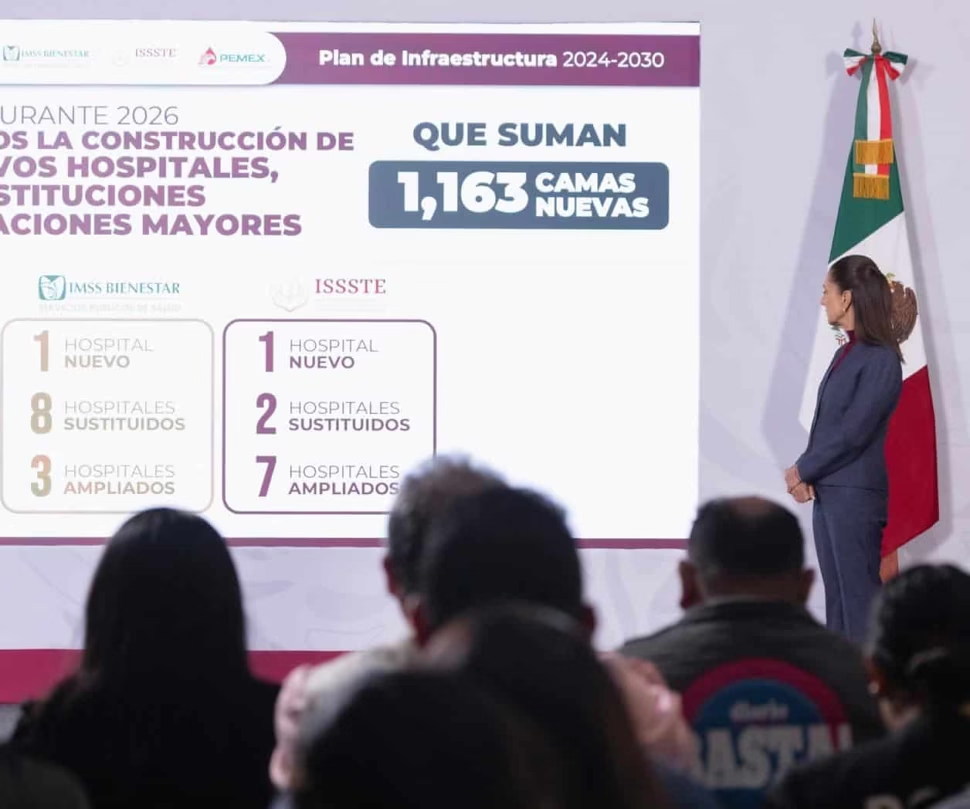
Eduardo Clark, Undersecretary of Sectoral Integration, explained that 30 projects with 1,474 beds in operation have already been completed: seven IMSS hospitals, 19 from IMSS Bienestar and four from ISSSTE. During 2026, 33 more projects will be added, with 1,163 beds, reaching 29 percent of the six-year goal.

Progress by institution

The director of ISSSTE, Martí Batres, reported that 20 hospitals will be rehabilitated during the six-year period. Four have already been inaugurated; nine are in process, including the General Hospital of Tampico (98 percent progress) and the Regional High Specialty Hospital of Oaxaca (55 percent).

Zoé Robledo, from the IMSS, pointed out that by 2030 47 hospitals will be operational. Seven are already operating and 21 are under construction; of these, ten will open in the next ten months.

Alejandro Svarch, from the IMSS Bienestar, detailed an investment of 46.8 billion pesos for 87 projects: 43 hospitals—eight new and 35 replacements—21 rehabilitated and 23 expanded health centers. In addition, 8,483 units will be modernized with the “The Clinic is Ours” program.

Sheinbaum added that the Universal Health Service will be implemented to guarantee care regardless of eligibility, along with the hiring of more specialist doctors.

US Commander meets with Sedena and Semar in Veracruz

Senior military commanders of Mexico and the United States review joint strategies against organized crime.

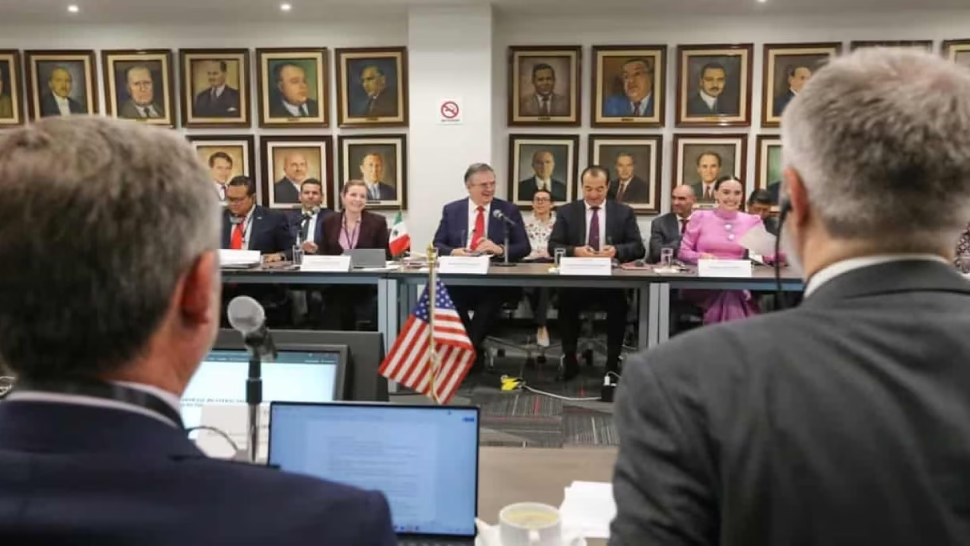
The commander of the United States Northern Command, General Greg Guillot, visited Mexico to meet with senior officials from the Secretariat of National Defense (Sedena) and the Secretariat of the Navy (Semar). The meetings occurred on July 22 in Veracruz.

Bilateral security cooperation

Guillot met with the head of the Sedena, General Ricardo Trevilla, and with the Secretary of the Navy, Admiral Raymundo Pedro Morales. The US embassy described the meetings as progress in the defense relationship between both countries.

Among the topics addressed are specialized training in special operations and against organized crime, the exchange of information, and cooperation to counter unmanned aerial systems. The North American Maritime Security Initiative was also reviewed.

“The security of North America depends on the strength of its alliances and the ability of its members to act with common objectives,” said General Guillot.

Both nations reiterated their commitment to expanding cooperation, respecting sovereignty, territorial integrity and shared responsibility for security.

Continue reading

T-MEC negotiations: tariffs and regional content on the table

Third round of dialogue between Mexico and the US addresses labor mechanisms and strategic rules.

Key points from the third round

Between July 21 and 23, Mexico and the United States held the third round of negotiations towards the review of the T-MEC. The central issues were tariffs, labor mechanisms, regional content and rules for sectors such as automotive, steel and aluminum.

The president of the Business Coordinating Council (CCE), José Medina Mora, explained that it was proposed to modify the Rapid Response Labor Mechanism to make it reciprocal. Currently, the investigations only apply to companies in Mexican territory.

“It is necessary that the mechanism be applied equitably between both countries,” said Medina Mora.

Another point of discussion was the United States’ intention to increase American content in products made in the region. Mexico defends the concept of regional content and rejects changes that reduce trilateral integration.

The leader added that the seasonality of agricultural products and the impact of tariffs on steel, aluminum and the automotive industry were also reviewed. Some US automakers in Mexico face higher export costs compared to competitors from Japan, Korea and Europe.

For his part, the president of Coparmex, Juan José Sierra, expressed uncertainty regarding the possibility of annual reviews of the treaty, but valued the dialogue between the partners. He indicated that Mexico requires strengthening legal and energy security and the conditions to attract investment.

“It is positive that communication continues, but we need certainty for investors,” said Sierra.

Concamin pointed out that the joint statement between the Secretary of Economy, Marcelo Ebrard, and the US trade representative, Jamieson Greer, confirms that both countries maintain an institutional work path.

Continue reading

Registration of Housing for Wellbeing 2026 begins

Conavi opens registration in 2026 for subsidized housing in 26 states.

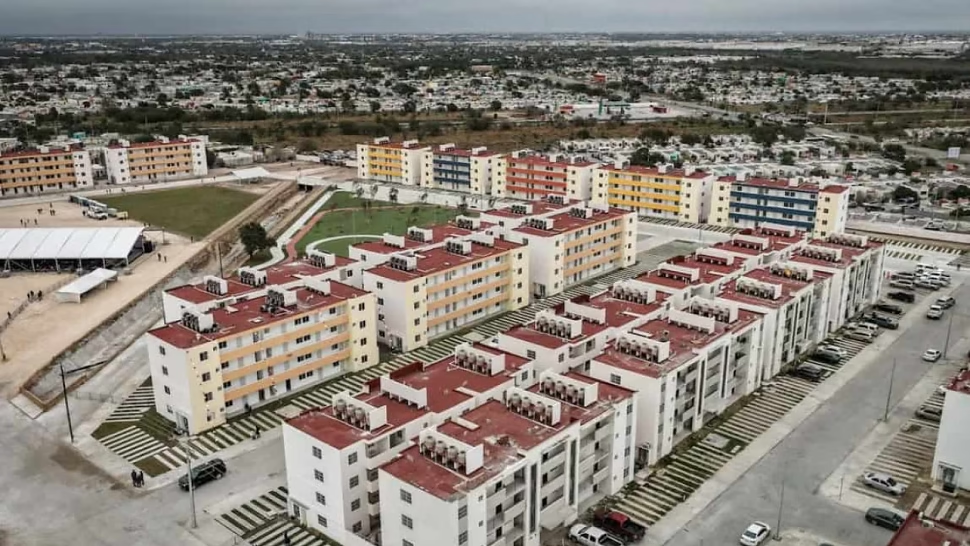
The National Housing Commission (Conavi) launched the 2026 call for the Housing for Well-being Program. The objective: to facilitate access to a decent home for low-income families. Registration will be from July 20 to August 2, in modules installed in 26 entities.

Requirements and financing

The scheme adjusts the monthly payments to the family income, so that the payments are accessible. It is aimed at those who cannot access traditional mortgage loans. Those interested must comply: not have their own home, not have current credit from Infonavit, Fovissste or another institution, and receive less than 17,800 pesos per month. Official identification, CURP, proof of address and income are also required.

Participating municipalities

The modules will only be in locations where Conavi will build projects in 2026. Among them: La Paz (Baja California Sur); Champotón (Campeche); Tapachula and Tuxtla Gutiérrez (Chiapas); Aquiles Serdán (Chihuahua); Piedras Negras and San Pedro (Coahuila); Gómez Palacio (Durango); Axapusco and Cuautitlán Izcalli (State of Mexico); Comonfort, Dolores Hidalgo, Pénjamo, San Diego de la Unión, San Luis de la Paz and Tarimoro (Guanajuato); Acapulco de Juárez, Chilpancingo de los Bravo, Coyuca de Benítez and Técpan de Galeana (Guerrero).

The list also includes municipalities of Hidalgo, Jalisco, Michoacán, Nayarit, Oaxaca, Puebla, Querétaro, Quintana Roo, San Luis Potosí, Sinaloa, Sonora, Tabasco, Tamaulipas, Tlaxcala, Veracruz, Yucatán and Zacatecas. Tepic, Xalisco, Puebla, Tehuacán, Tulum, San Luis Potosí and Valladolid stand out.

The program seeks to serve those who need it most, in a context where access to housing continues to be a challenge for millions of Mexicans.

Continue reading