Administrative restructuring in Morelos: end to the Women’s Institute
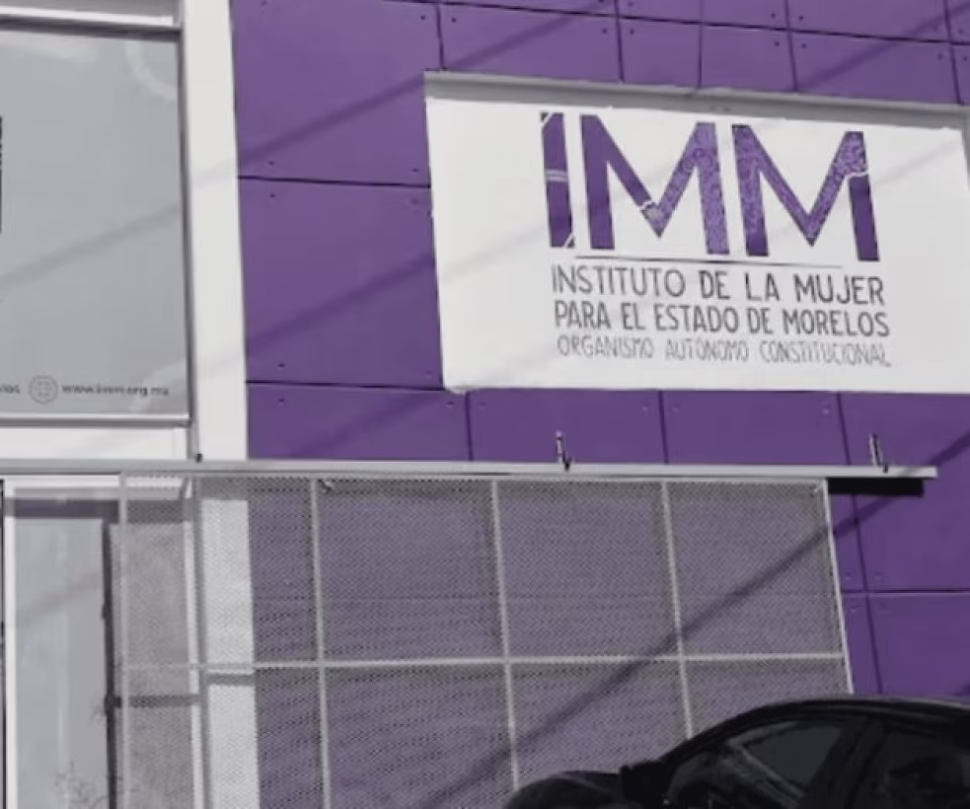
The state president Margarita González Saravia confirmed the elimination of the Morelos Women’s Institute (IMM), arguing that its functions are covered by the Women’s Secretariat. This measure is part of a comprehensive reform of the Organic Law of the State, which will also affect the Morelense Institute of Public Information and Statistics (IMIPE).
Technical basis for the decision
As the governor explained, the IMM—created 25 years ago—lacks operational justification, since federal resources are channeled directly to the secretariat. “There is an institutional overlap that dilutes effectiveness,” he declared during his weekly conference, emphasizing that the new structure seeks to optimize public management.
The parliamentary coordinator of Morena, Rafael Reyes, supported this position by pointing out that the September 2024 reform prioritized the creation of secretariats with greater executive capacity. “Social programs must be centralized to avoid budget dispersion,” added the legislator.
Criticism and defense of the organization
Isela Chávez Cardoso, president of the IMM, described the measure as a historic setback. He highlighted specific achievements of the institute, such as the External Care Centers (CAE), which have attended to more than 3,000 cases of gender violence annually. “Dismantling this structure eliminates proven protection mechanisms,” he warned.
Analysts in public administration point out that the debate reflects tensions between two models: one based on autonomous organizations and another on hierarchical structures. Data from INEGI show that 68% of state women’s institutes collaborate with secretariats, but only 12% have been completely absorbed.
Experts in gender policies warn about potential risks:
- Loss of specialization in victim care
- Excessive centralization of decisions
- Possible discontinuity in local programs
Budgetary and legal implications
The transition will require modifying 7 articles of state law and redistributing an annual budget of $18.7 million pesos. Official documents obtained by this means detail that 70% of these funds will be allocated to prevention programs, while 30% will cover operational costs of the secretariat.
What’s next? The local Congress has 60 business days to approve the reform. Feminist groups announced mobilizations to demand gender impact studies prior to any decision.
Share this information on your social networks and join the debate about the future of public policies for women. Explore more analysis on administrative restructuring in our government section.