Gangs control aid in Gaza as famine worsens

The diversion of food in Gaza reveals a black market where survival has an unattainable price.

The dark side of humanitarian aid: when solidarity becomes business

Imagine this: you are in Gaza, with a salary that no longer exists, a bank that is basically a memory and a pantry emptier than the politicians’ commitment to peace. Now, he adds that the only flour available costs $60 per kilo (yes, the same as a *triple A* video game). The reason? Unscrupulous gangs and merchants have turned humanitarian aid into their personal startup, because nothing says “predatory capitalism” like profiting from the hunger of others.

From the UN to the black market: the journey of a sack of flour

Bags with logos of the UN or the Gaza Humanitarian Foundation (GHF, for the *cool kids*) are everywhere… but not in the hands of those who need them. Instead, they end up at street stalls where a kilo of lentils costs $35 (more expensive than an *avocado toast* in Brooklyn). Who sells them? Nobody knows, because, like in an espionage *thriller*, the trail of help is lost in the chaos. “The strongest take everything,” says Mohammed Abu Taha, who lives in a tent and is as likely to get food as you are to understand *Gen Z* *memes*.

RelatedGaza experiences a crucial truce with hopes for peace and aid

Israel, under international pressure, promised to facilitate more aid deliveries. Result? Prices went down… a little. Like when they tell you “there are discounts” and it’s only 5% on socks. Meanwhile, Gaza remains on the brink of famine, with people spending their last savings on food that should be free. Irony level: “gift with conditions.”

Moral? In the midst of war, even solidarity has *spoilers*: if you are not part of a gang or a merchant with contacts, your menu of the day is… air. And no, air is not on sale.

Are you outraged by this situation? Share this article and spread the reality behind the crisis in Gaza. Explore more stories about how the conflict affects civilians in our current affairs section.

Sweltering Europe: France on red alert due to extreme heat

France activates alerts and restrictions in the event of temperatures exceeding 40°C in the midst of an exceptional heat wave in Europe.

France is facing an exceptional heat wave that has forced the cancellation of trains, concerts and sporting events, in addition to restricting alcohol consumption in areas under red alert. Almost a third of the country is at that level, with thermometers reaching 40°C. An even hotter Monday is forecast.

Authorities installed misting stations at the Eiffel Tower and other points in Paris to cool the population. However, drownings are increasing: French media reported four deaths of minors on Saturday, while swimming to beat the heat. In Germany, a man lost his life in the Rhine River and three people are still missing. Health authorities warn that these incidents worsen during periods of high temperatures.

Measures and concerns

The government banned drinking alcohol outdoors in areas under red alert and asked the organizers of Music Day – a festival that brings together crowds throughout the country – to limit alcohol consumption to “preserve emergency services and allow medical personnel to concentrate on caring for the most vulnerable.”

“In this heat, it’s the only way to have fun going out,” swimmer Nicolás Cruz told The Associated Press, while splashing in the Saint Martin Channel.

Zouzou Hobbs, initially skeptical about swimming in the murky urban canal, decided to take a chance: “But it’s hot. I’m going to take my chances. We need to cool off before tonight, when we’re going to be dancing.”

The authorities are especially attentive to homeless people and older adults. Some 15,000 older people died in the 2003 heat wave in France, prompting national reflection. This year, the government mobilized emergency services and armed forces to prepare for wildfires, imposed surveillance on water supplies for nuclear reactors and ordered the closure of 845 schools on Monday.

The heat spreads across Europe

Spain began the summer with much of the country on alert, with temperatures around 40 °C, even in the interior of the Basque Country. Outdoor sports and cultural activities have been suspended. In Italy, eight cities extended heat advisories (“red flags”), with temperatures in the 30s and 40s. In Milan, farm owners installed fans and sprinklers for cows, while Fashion Week attendees fanned themselves under umbrellas.

Germany expects up to 39C on Wednesday, and the UK has issued an “extreme heat” warning for southern England and Wales, with highs of 38C possible. The British Met Office recalled that the record for June is 35.6 °C since 1976. Thunderstorms threaten Germany and Poland.

French Prime Minister Sébastien Lecornu called a crisis meeting and ordered planning for better adaptation to heat waves “through air conditioning, if necessary.” The World Health Organization said more than 200,000 people in Europe died from heat-related causes in the last four years, most of them preventable.

Continue reading

Begoña Gómez, on trial for influence peddling in Spain

The wife of the Spanish president will face trial for alleged corruption crimes.

Court order against Sánchez’s wife

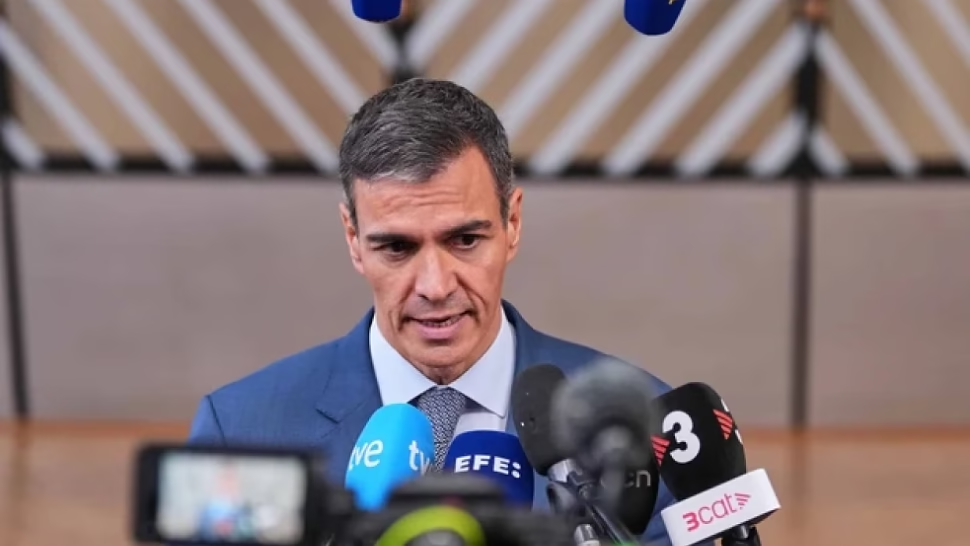
An investigating judge in Madrid ordered that Begoña Gómez, wife of the president of the Spanish government, Pedro Sánchez, sit in the dock for alleged crimes of influence peddling and corruption. The resolution includes the delivery of his passport and the obligation to appear in court every two weeks.

Judge Juan Carlos Peinado argued that there is a risk of flight. A trial date has not yet been set. The court decision has intensified the political debate in Spain.

Reactions and context

The opposition has demanded a response from the socialist government. Several political leaders consider that the case affects the integrity of the executive. For now, Sánchez maintains his support for his wife and has reiterated his confidence in justice.

The process continues and it is expected that the coming weeks will define the judicial calendar.

Continue reading

Train collision in England: one dead and 9 in critical condition

Nine passengers in critical condition and the driver died after a nighttime crash.

Train collision in central England

Nine people were in critical condition Saturday following a collision between two passenger trains that occurred the night before in central England. The driver of one of the locomotives died in the incident, police reported.

More than 80 people received medical attention

The head of the British Transport Police, Lucy D’Orsi, said that more than 80 people were treated in hospitals after the crash, which occurred late on Friday. A day later, 28 of them were still hospitalized. Authorities continue to investigate the causes of the accident.

Continue reading