France gives the green light to assisted dying for incurable patients

France approves medical assistance in dying: 291 votes in favor in a historic session.

France approves assisted dying for terminally ill patients

France’s National Assembly gave final approval to a project that allows adults with incurable diseases to receive medication to induce death. The vote was 291 in favor and 241 against, after three previous readings. President Emmanuel Macron recalled his 2022 commitment:

“With seriousness, with humility, and with total respect for our democracy, that commitment has been fulfilled.”

What changes with this law?

RelatedUnited Kingdom approves assisted dying amid tears and bureaucracy

Assisted dying is now available to some 300 million people in the world, in different formats. France, a country with a Catholic tradition, had a law that allowed terminal patients to be sedated, but without active assistance in dying. Now, adults with incurable diseases will be able to request lethal medication, as long as they meet the medical requirements.

The legislative debate

Yael Braun-Pivet, president of the National Assembly, called the discussion “the longest since the 1980s.” Many French people traveled to neighboring countries where these practices were legal. The new law seeks to avoid these trips and offer an option within the French health system.

Reactions and context

The debate about the end of life is also advancing in the United Kingdom. A bill to legalize assisted dying in England and Wales will return to Parliament on September 11, five months after time ran out in the previous session. France, with an aging population and a growing number of chronic patients, thus joins the countries that regulate this option.

The official number of deaths from earthquakes in Venezuela rises to 5,346

5,346 dead and 16,740 injured: new official balance after the earthquakes of June 24 in Venezuela.

The Venezuelan authorities updated this Tuesday the official balance of the double earthquake registered on June 24. The death toll rises to 5,346 after adding 68 additional deaths in the last few hours.

Jorge Rodríguez, president of the National Assembly, reported that the injured remain at 16,740. A total of 17,265 people remain homeless, while 23,122 victims remain housed in 107 temporary camps. So far, authorities have provided care to 128,324 affected families.

Material damage and disappearances

The official report registers 856 buildings damaged and 190 collapsed. Civil society organizations estimate 29,460 people missing under the rubble, a figure that the government has not officially confirmed.

This new count is released 27 days after the earthquakes that generated a large-scale humanitarian emergency in the country. Rodríguez disseminated the data through his Telegram channel, where he detailed the progress in the care work for those affected.

The authorities maintain active search, rescue and humanitarian assistance tasks in the impacted areas. Thousands of people continue to depend on state aid and international cooperation to face the consequences of the tragedy.

Continue reading

The skeleton of a Triassic giant is restored in Poland

Volunteers restore a 6-meter-long prehistoric amphibian skeleton in Warsaw.

Volunteers restore the fossil of a prehistoric colossus in Warsaw

At the Copernicus Science Center in Warsaw, a team of more than 2,000 volunteers is working on restoring the skeleton of a Mastodonsaurus, a giant amphibian that lived 240 million years ago. With chisels, brushes and protective glasses, they remove the rock that covers the bones millimeter by millimeter.

Visitors watch through a window as the work progresses. The skeleton measures almost 6 meters and weighs 1,300 kilograms. It will be the largest of its kind displayed in a museum in the world, according to Tomasz Sulej, a paleontologist at the Polish Academy of Sciences.

An experience open to citizens

The volunteers are not scientists, but managers, cleaning staff and tattoo artists, among others. They receive training and protective equipment before supervised two-hour sessions. “I imagine that those bones were underground for 240 million years and I am the first human being to touch them,” commented Tatyana Kozyk, team coordinator.

The specimen was discovered in southern Poland in 2023 by Sulej and Wojciech Pawlak. Unlike other finds in Germany and Russia, which measure 2 to 3 meters, this specimen offers new information about the species. “The structure of the body is different from what we knew,” Sulej said.

A message of natural resilience

Dorota Serafín, a 51-year-old manager, described the experience as “relaxing and philosophical, even mystical.” The Mastodonsaurus lived after the largest mass extinction on the planet, just before the rise of the dinosaurs. For Sulej, his story sends a message of hope in the face of climate change: “Nature and life always find ways to survive.”

The restoration will be completed in October or November. The skeleton will then be displayed to the public at the same center.

Continue reading

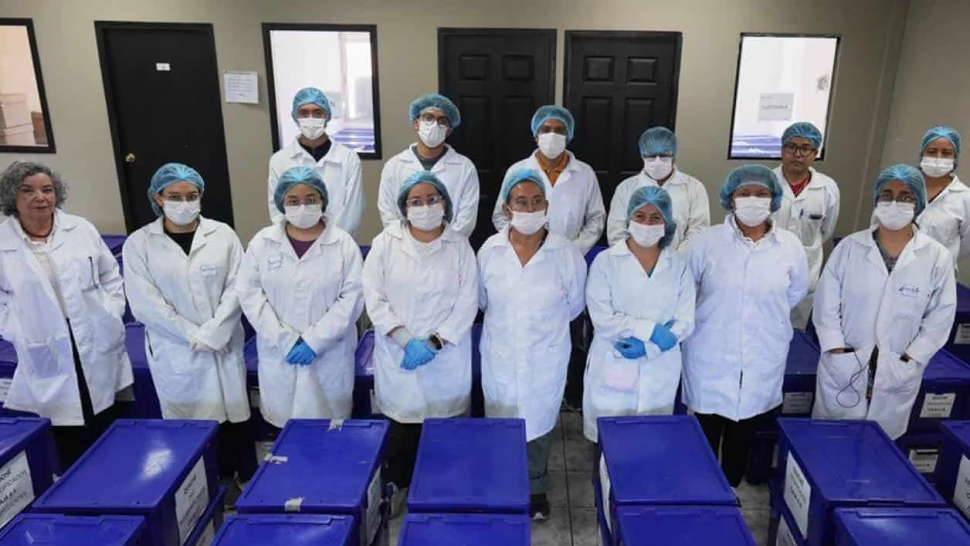
Guatemala races against time to save 60 thousand testimonies

60 thousand files of victims at risk due to abandonment by previous governments.

Rescue of historical memory

Guatemala faces a race against the clock to protect some 60,000 files of victims of the internal armed conflict (1960-1996). The documents, compiled over a decade by the National Reparations Program (PNR), seek to compensate those who suffered abuse. The government of President Bernardo Arévalo has until January 2028 to achieve this.

The PNR was born in 2003 after the 1996 Peace Accords, but during the governments of Jimmy Morales (2016-2020) and Alejandro Giammattei (2020-2024) the program became inactive and its liquidation was ordered. The testimonies were abandoned.

Workers from a UNESCO-funded project try to recover the archive. Erick Briones, archive assistant, described the conditions: “Damp boxes, piled up, incomplete, broken files.” The goal is for this collection to be declared the world’s documentary heritage.

Among the cases is that of Manuel Botom Uz, who at the age of 4 was disappeared in 1982. According to testimony, he and his four brothers were attacked in Quiché by members of the army and civil patrolmen. His brothers were handed over to relatives, but Manuel disappeared. Twenty years later, his body was located and identified in a clandestine grave.

Elvin Díaz, presidential commissioner of Human Rights, said: “There was an intention by the Morales and Giammattei governments to erase collective memory.” He also explained that the purpose of the PNR was humanitarian aid, but the files contain “relevant information for a criminal investigation.”

The files detail homicides, forced disappearances, sexual assaults and forced recruitment. According to reports, the conflict left some 200,000 dead and 45,000 missing.

Future project plans to digitize the archive for universal access. A UN report on forced disappearances, issued last month, indicated that during the Morales and Giammattei governments “a systematic policy of dismantling institutions for peace and justice” operated.

The files will go to the Reparation and Dignification Plan for victims announced by Arévalo. This seeks to centralize the dispersed information to continue compensation and include cases of disappearance in the Humanitarian Search Mechanism.

Continue reading