Prosecutor’s Office searches the home of the influencer murdered in Temixco

The investigation is advancing with the forensic review of the home to clarify the motives for the crime that is shocking the networks.

Legal Procedure at the Crime Scene

The State Attorney General’s Office carried out an exhaustive search of the property where the content creator Camilo Ochoa Delgado, known in the digital sphere as “El Alucín”, was deprived of his life. This judicial procedure, formally authorized by a judge, had as its primary objective the meticulous collection of forensic evidence and ballistic elements that allow establishing the corresponding lines of investigation. The victim died due to a firearm attack perpetrated on Saturday afternoon inside his residence, located in the Lomas de Cuernavaca neighborhood, in the municipality of Temixco.

In accordance with the protocols of the Criminal Investigation Agency (AIC), the procedure was carried out on Sunday morning, once the perimeter was secured. The operation not only involved the review of the main scene, but also the seizure of personal objects belonging to the deceased, among which a firearm was found that is part of the set of evidence that the experts will analyze.

RelatedYouTuber linked to the Sinaloa Cartel murdered in Morelos

Reconstruction of the Initial Facts and Findings

The preliminary reports provided by witnesses and the first investigations indicate that the perpetrator of the homicide entered the residential complex wearing a cap that would make his immediate identification difficult. The individual entered the subdivision without complications, went directly to the victim’s home, rang the doorbell and, immediately afterwards, broke in violently. It is presumed that his journey from the entrance of the complex to the door of the house could have been captured by the video surveillance systems installed in several of the neighboring homes, audiovisual material that is considered of high evidentiary value for the investigation.

Neighbors of the place provided crucial statements to the authorities. They mentioned that the main door to the home showed no signs of bullet impacts, which suggests that there was no struggle or attempted forced entry at that initial point. However, they reported hearing a succession of detonations. The ministerial agents who carried out the first reconnaissance located the lifeless body of Camilo Ochoa in the bathroom of the house, a room whose door, according to the testimonies collected, had more than ten bullet impacts, indicative of an extremely violent and targeted attack.

Contrary to the number of shots fired at the door, unofficial information obtained on site by ministerial personnel indicates that the victim’s corpse only had two bullet holes. This disparity between the shots fired and those that hit the victim is a key aspect that investigators analyze to reconstruct the dynamics of the event.

Regarding the suspect’s escape, witnesses in the area confirmed having seen an individual leave the crime scene aboard a compact vehicle, model Chevrolet Sonic, which became the object of an immediate search by security corporations. The prompt identification of the car makes it possible to activate location protocols and check security cameras on nearby roads.

This case has once again put the vulnerability of public figures and the escalation of targeted violence in the spotlight, generating widespread commotion in digital communities where the influencer was widely recognized. The investigation continues its course actively, combining field work with technological and forensic analysis to find those responsible.

Do you find this type of case crucial to understanding security in your region? Share this analysis to raise awareness and explore more related content on our portal.
Dentist’s widow demands justice in Veracruz

Seven months without progress: Luis Almanza's widow protests in front of the Government Palace.

The case of Luis Almanza

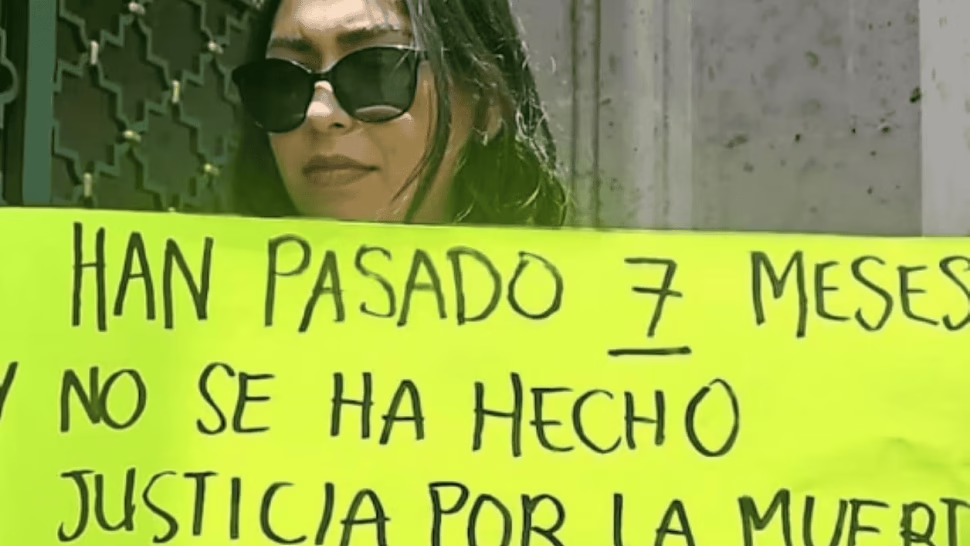
Karen Valeria Cano Vásquez, widow of dentist Luis Almanza Dauzon, demonstrated outside the Government Palace of Veracruz. She demanded that the State Attorney General’s Office advance the investigation into her husband’s death.

The protest occurred while Governor Rocío Nahle García offered a conference inside. The widow’s banner read: “7 months have passed and no justice has been done for the death of my husband Luis Almanza Dauzón.”

A hole without signs

In November of last year, Almanza was traveling by motorcycle on the Coatepec-Xalapa highway. He found a hole in the asphalt layer without marking. The work was carried out by a company contracted by the Ministry of Infrastructure and Public Works.

The victim was going to buy a New Year’s gift for her son. The lack of signs caused discomfort among citizens.

Lack of fiscal action

The widow denounced that the Prosecutor’s Office has not given her the investigation file. Nor has he received testimonies nor have ministerial proceedings been carried out. The file accumulates delays.

Ministerial personnel have excused themselves, arguing lack of personnel and vacation periods. Seven months after the accident, there are no responsible parties.

Karen Valeria Cano Vásquez maintains her demand: justice and accountability for the omission that cost her husband his life.

Continue reading

Government defends forgiveness to Spain in indigenous law

The government defends pardoning Spain as a pillar of the new indigenous law to combat racism.

Forgiveness and multiculturalism: keys to the new indigenous law

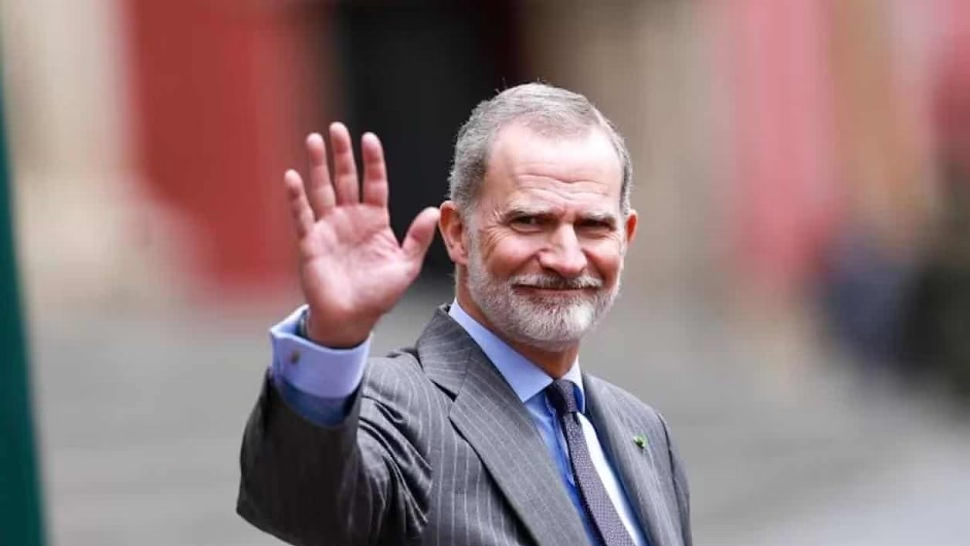
Within the framework of the presentation of the General Law on the Rights of Indigenous and Afro-Mexican Peoples, the federal government insisted on the importance of historic forgiveness towards Spain. During the morning conference at the National Palace, King Felipe VI was recognized for his statements about the abuses during the Conquest.

“Forgiveness magnifies the people. The most important thing for Mexico is the identity that the recognition of the people represents,” stated official spokespersons.

The discussion focused on the need to overcome a Eurocentric vision. The authorities pointed out that without this change, racism and classism will continue to be promoted.

“If we do not recognize the vision of the great civilizations and the value that the people have given to the collective identity of Mexico, we will continue to promote racism and classism,” they warned.

After 300 years of colony and 200 years of independence, 20% of the Mexican population identifies as indigenous. The government called for recognizing this multiculturalism as part of the national identity.

The law seeks to guarantee rights and combat the structural discrimination that these communities still face.

Continue reading

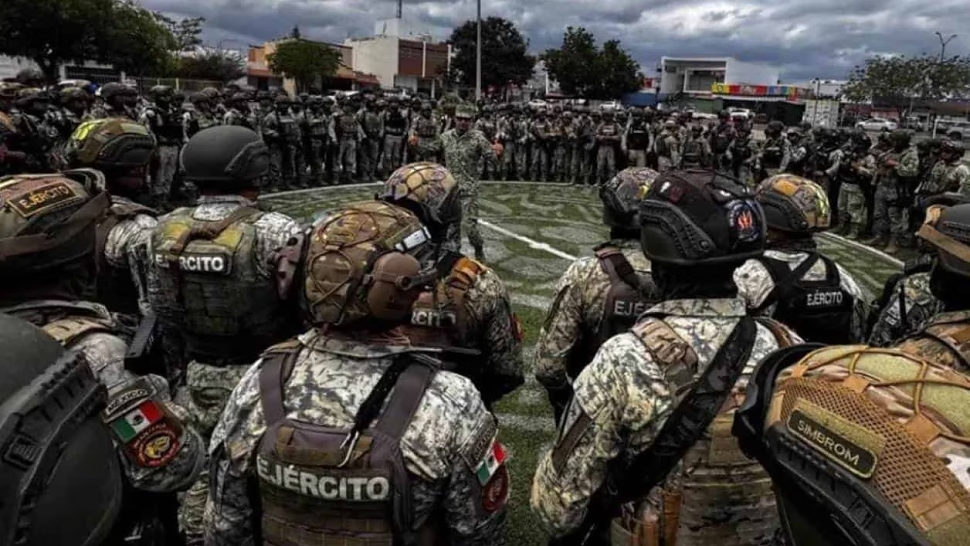
Army and police, the institutions that generate the most trust in Mexico

The OECD reveals that Mexicans trust the armed forces and police more than the government.

Trust in institutions: Mexico’s ranking

The Organization for Economic Cooperation and Development (OECD) published a survey on the factors that determine trust in public institutions, carried out in 36 countries. In Mexico, the three institutions that generate the most trust are the armed forces, international organizations and the police.

The study details that the population trusts the Army and the police more than the Judiciary and the federal government. On the overall scale, the national civil service ranks fourth, followed by the regional civil service, the national government, the media, the Court and the Judiciary, state governments, local authorities, Congress and, lastly, political parties.

A particularity detected by the OECD in Mexico, Japan, Korea and the Slovak Republic: trust in legislators increases among the population with a lower educational level. On the other hand, citizens with university or postgraduate studies show less credibility towards their congress.

Main concerns

For Mexicans, crime or violence, inflation and corruption are the biggest concerns. They are followed by employment, health services, inequality, housing, climate change, national security and migration. At a global level, the OECD average places inflation as the main concern, then crime and inequality, while corruption is in ninth place.

Satisfaction with public services

Mexico surpassed the OECD satisfaction average in education: 66% compared to 60%. In health it tied with 54%. Additionally, 72% of Mexicans who recently completed an administrative procedure reported being satisfied, exceeding the 68% average for the organization.

“In the midst of economic, sociodemographic and technological transformations and with limited fiscal space, democratic governments face challenges in meeting people’s growing expectations and needs. A healthy level of trust in public institutions is essential to implement reforms,” ​​the OECD concluded, warning that government actions are limited by slow internal processes and difficulties in reaching consensus.

Continue reading