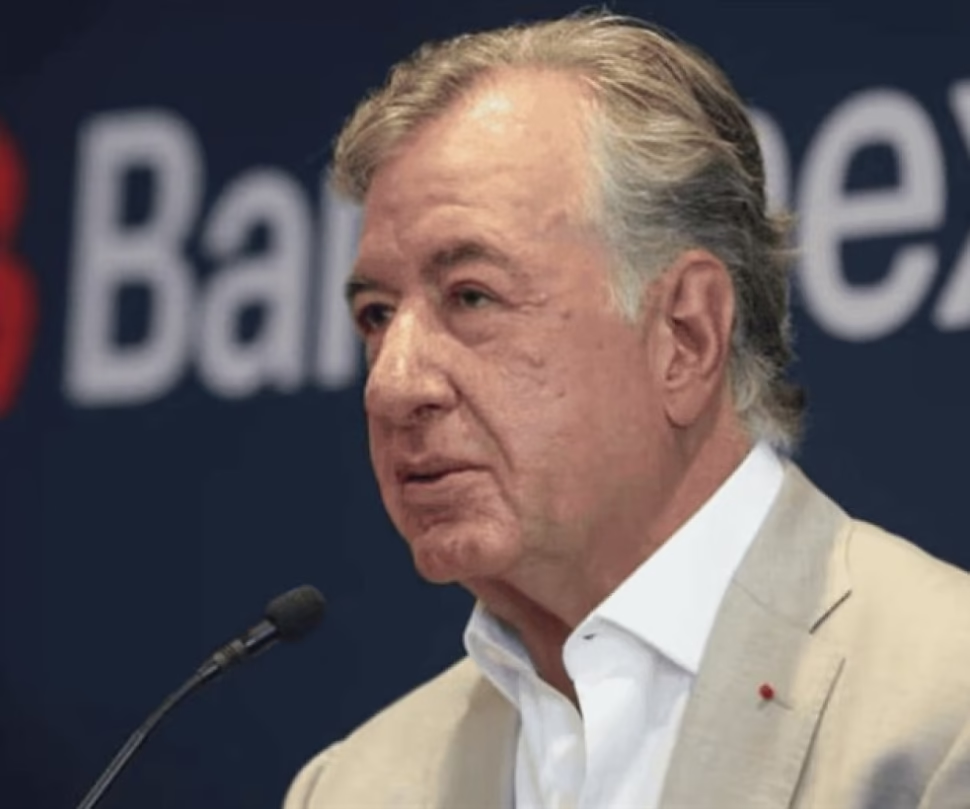
Fernando Chico Pardo resigns from BBVA after acquiring Banamex

A strategic decision reconfigures the national financial board after the historic purchase of 25% of Banamex.

A Strategic Resignation in the Mexican Banking Sector

Mexico’s financial environment is experiencing a significant reconfiguration following the decision of businessman Fernando Chico Pardo to present his resignation as alternate director of BBVA México. This corporate move occurs in a particularly relevant context: the formal announcement of the acquisition by Chico Pardo of twenty-five percent of the capital of Banamex, an operation valued at 42 billion pesos and publicly communicated on September 24, 2025. The resignation was formalized before the Mexican Stock Exchange on June 26, 2025, although Its effect was scheduled for October 28 of the same year, according to the official documentation distributed by the banking institution.

Meticulous analysis of this sequence of events reveals a carefully orchestrated financial strategy. The release of responsibilities and the granting of a “broad settlement” by BBVA México suggests a professionally managed transition, minimizing operational frictions. At the same time, the immediate appointment of Rafael Salinas Martínez de Lecea as alternate director demonstrates the institutional preparation for this eventuality, ensuring continuity in the corporate governance of the financial group.

RelatedFernando Chico Pardo acquires a 25% stake in Banamex

The Competitive Context: Competing Offers and Strategies

The transaction with Banamex has not been free of competitive developments. A week after the initial announcement, Grupo México, a conglomerate led by tycoon Germán Larrea, presented an alternative offer for the entirety of Banamex. This proposal included an explicit invitation to Chico Pardo to remain in the banking operation as a minority shareholder, an approach that would have substantially altered the terms of the original acquisition.

However, the American parent company Citi exercised its strategic prerogative by formally rejecting Grupo México’s offer. The financial institution based its decision on a comparative analysis that privileged the path towards an initial public offering as the most profitable mechanism for its shareholders. The corporate position was explicit: “We firmly believe that the transaction announced on September 24, 2025 and the planned IPO will allow us to complete the divestiture of Banamex in a responsible manner and maximize value for our shareholders.” This statement underscores the preference for a structured and predictable divestiture process over an alternative private transaction.

The outcome of this corporate bid consolidates Fernando Chico Pardo as the majority shareholder of Banamex and designates his future role as president of the board of directors of the National Bank of Mexico once the transition process is concluded. This trajectory demonstrates a planned transition from a position of influence in a financial institution to absolute leadership in another banking institution of historical relevance in the country.

Chico Pardo’s resignation from BBVA México represents, therefore, a calculated move within a broader rearrangement of the Mexican banking landscape. This episode illustrates the complex interconnections between commercial banks, business groups and transnational disinvestment processes, where individual decisions of key actors can substantially alter the competitive dynamics of the sector.

Did you find this analysis of the financial movement revealing? Share this article on your social networks to expand the conversation about the transformation of the banking sector and explore more content related to corporate strategies on our platform.
CNTE raises a sit-in after 20 days of protest in the Zócalo

The dissident teachers left losses of 410 million pesos and freed up spaces in the Historic Center.

End of the CNTE sit-in

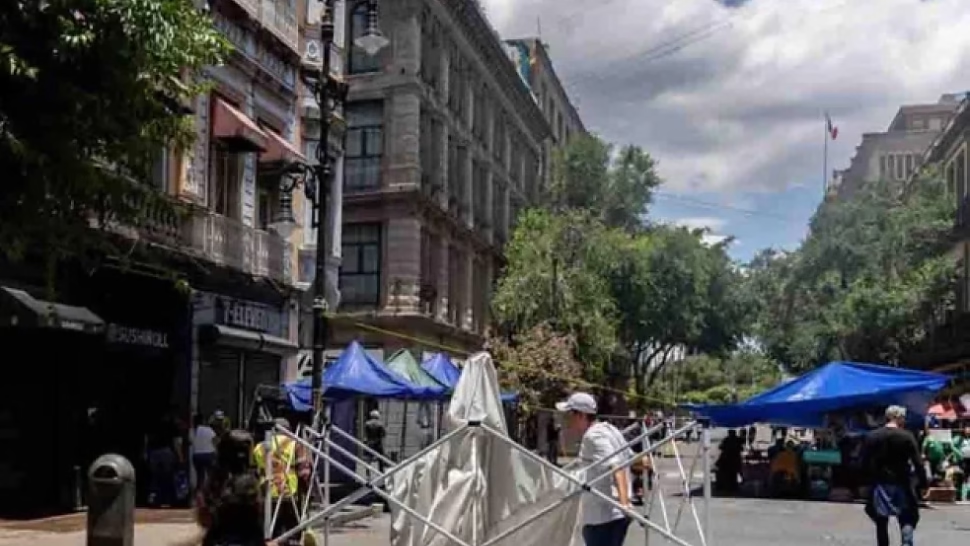
The National Coordinator of Education Workers (CNTE) ended its national strike this Saturday. For 20 days, the mobilizations and the camp in the Historic Center of Mexico City generated losses of more than 410 million pesos to established businesses, according to sector estimates.

Although it did not achieve the repeal of the ISSSTE Law of 2007 or the repeal of the educational reform, the CNTE obtained commitments, financial resources, places, recategorizations and support for education workers in several states.

The leaders assured that the withdrawal is not a defeat. They advanced a stage of reorganization to strengthen the movement and prepare new actions. They insisted that the federal government did not present a proposal to eliminate the ISSSTE Law of 2007 or to reverse the educational reform, demands that will remain in force.

Starting this Monday, around 1.4 million students who remained without classes will be able to return to classrooms in the entities where the CNTE had suspended activities.

Space release

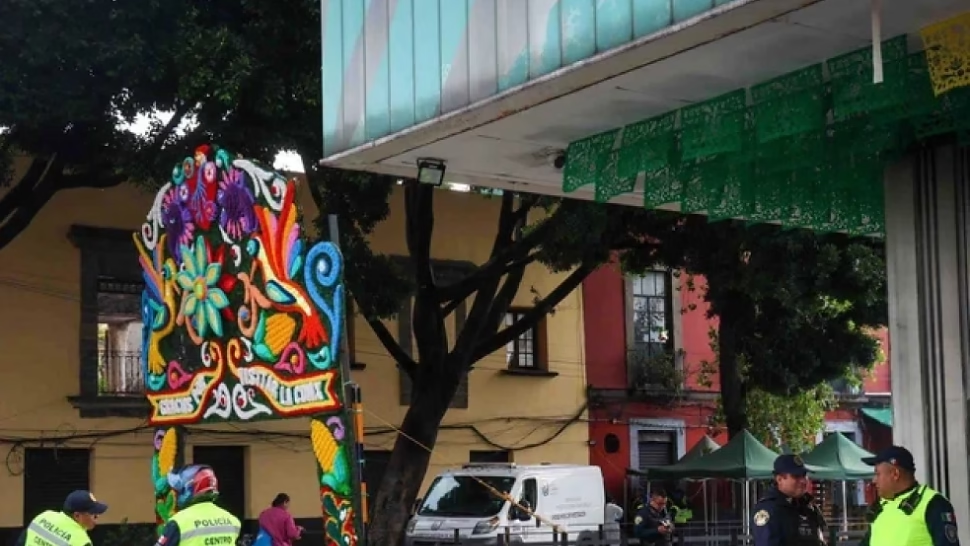
Public space has been gradually freed up. Cleaning workers from the Government of Mexico City removed garbage in streets such as 5 de Mayo, Belisario Domínguez, 20 de Noviembre and República de Cuba. In some areas, the withdrawal was almost total; In others there were still tarps and tents.

A teacher from section 34 of Zacatecas declared: > “We are going to clean it, don’t say that we are going to leave it dirty.”

Merchants expressed relief at the departure of the teaching profession. A worker at the La Blanca restaurant, on May 5, commented: > “It’s good that they’re leaving, it was a very hard month; here we had like a 90% drop in customers.”

A snow seller on the same street indicated that they expected higher sales with the FIFA Fan Fest in the Zócalo, but the arrival of the CNTE reduced their income by 50%.

For his part, the Secretary of Education, Mario Delgado, rejected that the government had “bribed” Section 22 of Oaxaca to hold the sit-in.

Continue reading

Five deaths in bars in CDMX during the early hours of the morning

Two attacks in bars in the capital leave five dead and six arrested.

The early morning left two violent episodes in different parts of the capital

A man lost his life from gunshots outside a bar located in Plaza Garibaldi, Cuauhtémoc mayor’s office. According to the Secretariat of Citizen Security (SSC), the victim was attacked directly in the Lázaro Cárdenas Central Axis and the Republic of Honduras. After the attack, he ran inside the establishment, where he died.

The suspects fled in a gray car, but later returned to the scene along with a blue truck and a subject on a scooter. Agents approached and, after a search, they found packages with one and a half kilos of marijuana and a firearm. They were arrested.

In another incident, an alleged fight inside a bar in the Álvaro Obregón mayor’s office left four people dead and two arrested. One of them was taken to a hospital injured.

Data from the SSC indicate that several people began arguing inside the establishment, in the San Bartolo Ameyalco neighborhood. One of the subjects pulled out a firearm and shot several people. The detainees were placed at the disposal of the authorities.

Continue reading

Rita Cetina Scholarship will benefit 9 million students

Claudia Sheinbaum begins delivery of cards for uniforms and supplies in Tijuana.

Start up in Tijuana

President Claudia Sheinbaum led the start of the Rita Cetina Scholarship card delivery in Tijuana, Baja California. The subsidy covers uniforms and school supplies for public elementary students.

The program plans to benefit nearly 9 million students nationwide. The support will be dispersed from August through the Banco del Bienestar.

Support details

Sheinbaum recalled that this scholarship complements other programs of the Fourth Transformation: the scholarship for secondary school, the Benito Juárez for high school and the Gertrudis Bocanegra for higher education. The objective is to reduce the financial impact of registration, footwear and materials at the beginning of the school year.

The Secretary of Public Education, Mario Delgado Carrillo, pointed out that more than half a million students in Baja California will receive some federal stimulus. He also encouraged parents to enroll their children in the “Live Healthy, Live Happy” program, which offers nutritional counseling, dental care and free glasses.

The national coordinator of Scholarships for Wellbeing, Julio César León Trujillo, explained that 291,036 primary school students will be added to the 292,392 current scholarship recipients in the state in August. Governor Marina del Pilar Ávila Olmeda and a beneficiary student thanked the extension of this social right, which strengthens the family economy and school permanence.

Continue reading