Female domestic work is equivalent to 24% of GDP

A monumental economic contribution, equivalent to almost a quarter of the national GDP, remains invisible in households.

An Invisible Economic Force that Moves Mexico

Have you ever thought about the monumental economic power that is generated within homes? Prepare to be inspired, because data is a transformative revelation. In 2024, the economic value of domestic and care work, that unpaid work that sustains daily life, will reach the astonishing figure of 8 trillion pesos. Visualize it: this contribution, mostly made by women, is equivalent to 23.9% of the national Gross Domestic Product (GDP), according to the National Institute of Statistics and Geography. It’s an incredible demonstration of how the foundations of care and home are actually the foundations of our collective prosperity!

Now, let’s delve into this transformative energy. Of that colossal amount, women contributed 72.6%, while men contributed 27.4%. This means that, with their dedication to household and care work, women generated an economic value 2.7 times greater for their families than that of men. Every meal prepared, every space cleaned, every care provided, is one more brick in the construction of our national well-being. It is time to recognize and celebrate this silent but powerful impact.

RelatedWomen dedicate 21 more hours per week to unpaid work

The Composition of an Extraordinary Contribution

The population that carried out this unpaid work was made up mostly of women, with 53.9% of the total, compared to 46.1% of men. However, the true magnitude of their contribution is revealed when measuring not only participation, but also time and value generated: women contributed almost three-quarters of the total of this fundamental activity. This is a lesson in how consistency and dedication turn the ordinary into something extraordinary. Every hour spent at home is an investment in everyone’s future.

To further dimension this feat, the value generated by unpaid household work as a percentage of GDP exceeded that of giant economic activities such as the manufacturing industry, which participates with 20.1%, and commerce, which contributes 18.7%. Imagine the potential if we manage to fully make this force visible and value. It invites us to reflect: true progress is measured not only in factories and stores, but also in the warmth and functioning of each home.

States that Lead by Example

This positive energy is distributed throughout the country, with some entities standing out as true drivers of this care economy. The states that contributed the highest levels of economic value of unpaid household work were: the State of Mexico, with an impressive 11.6%; Mexico City, with 6.7%; Jalisco, with 6.6%; Veracruz, with 6.3%; and Nuevo León, with 5.6%. Each one of them demonstrates the power of community and teamwork from the family nucleus to society.

These figures are not just numbers; They are a testimony to the transformative power and resilience that lives in Mexican homes. They show us that economic growth and social stability owe a debt of gratitude to the often invisible efforts of millions of people. Recognizing this contribution is the first step to building a more just, equitable and aware society that each action of care, no matter how small it may seem, has incalculable value and a multiplying effect on our economy and collective well-being.

It’s time to give this news the visibility it deserves! Share this revelation on your social networks so that more people understand the true value that is created in the home and explore more content that inspires you to see the world with eyes of possibilities and recognition.
Former Pemex director investigated for alleged assault on his wife

The Morelos Prosecutor's Office is investigating Víctor Rodríguez Padilla for alleged assault on his wife.

Investigation in progress

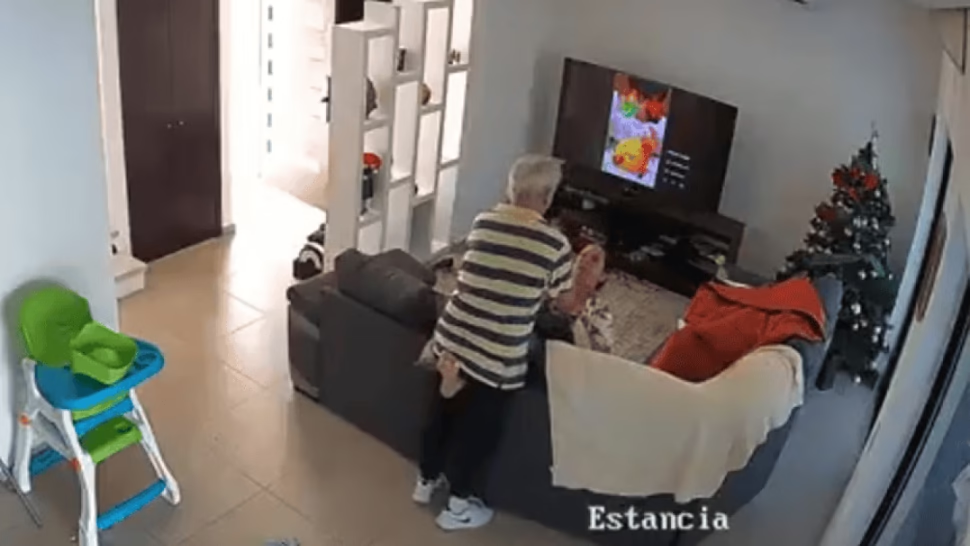
The Attorney General’s Office of the State of Morelos initiated an investigation file against Víctor Rodríguez Padilla, former director of Petróleos Mexicanos, after the dissemination of a video in which he is seen allegedly attacking his wife, María Felicia Jiménez. The recording, which circulates on social networks, shows Rodríguez Padilla repeatedly hitting the victim inside a home in the municipality of Emiliano Zapata, adjacent to Cuernavaca. According to the metadata of the video, the attack occurred on March 15.

The state agency reported that since Friday it has been exchanging information with the Women’s Secretariat of the Government of Mexico to guarantee the protection of the victim.

“The Attorney General’s Office of the State of Morelos initiated an investigation folder for the probable criminal acts derived from the dissemination of a public complaint through a video, where an act of violence against a woman is seen,” cited the FGE.

Protection actions

The Morelos Prosecutor’s Office specified that the investigation was opened in full respect for the rights of women, girls, boys and adolescents. The statement indicates that the events probably occurred on March 15 inside a home in Emiliano Zapata, with the alleged participation of a former federal official.

The institution assumed the commitment to exhaust all measures to determine responsibilities and guarantee a life free of violence for the victim. So far, no precautionary measures have been reported against Rodríguez Padilla, and the investigation is still ongoing.

Continue reading

Sheinbaum supervises progress of IMSS-Wellbeing with governors

Sheinbaum leads meeting with 23 governors to evaluate progress in the health system.

Advances in public health

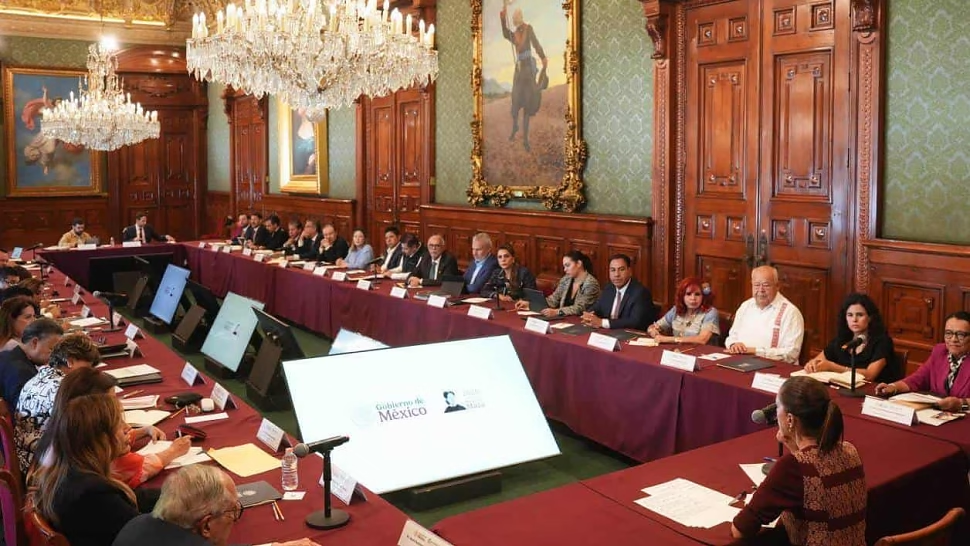
At the National Palace, President Claudia Sheinbaum led a follow-up meeting on the IMSS-Wellbeing model. Governors of the 23 entities integrated into the program participated.

“The objective is to guarantee quality, universal and free medical care for the people of Mexico.”

The federal cabinet was attended by Rosa Icela Rodríguez (Government), David Kershenobich (Health), Luisa María Alcalde (Legal Department), Eduardo Clark (Undersecretariat of Health), and the directors of IMSS-Bienestar (Alejandro Svarch), IMSS (Zoé Robledo) and Issste (Martí Batres).

The state leaders present were: Marina del Pilar Ávila (Baja California), Víctor Castro (Baja California Sur), Layda Sansores (Campeche), Eduardo Ramírez (Chiapas), Clara Brugada (CDMX), Indira Vizcaíno (Colima), Delfina Gómez (State of Mexico), Evelyn Salgado (Guerrero), Julio Menchaca (Hidalgo), Alfredo Ramírez (Michoacán), Margarita González (Morelos), Miguel Navarro (Nayarit), Salomón Jara (Oaxaca), Alejandro Armenta (Puebla), Mara Lezama (Quintana Roo), Ricardo Gallardo (San Luis Potosí), Yeraldine Bonilla (Sinaloa), Alfonso Durazo (Sonora), Javier May (Tabasco), Américo Villarreal (Tamaulipas), Lorena Cuéllar (Tlaxcala), Rocío Nahle (Veracruz), Joaquín Díaz (Yucatán) and David Monreal (Zacatecas).

The meeting is part of the periodic supervision to consolidate free coverage of health services in the country.

Continue reading

Morena dismisses youth commissioner after attack

Morena removed Jaime Castillo from his position after a video that shows him attacking a driver.

The National Executive Committee of Morena announced the dismissal of Jaime Castillo Castillo, who served as Youth Commissioner in Zacatecas. The decision was made after a video linked him to an act of violence against a driver during the celebrations for the victory of the Mexican National Team.

Facts and reaction

The images, spread on social networks, show the now former leader attacking the woman while his vehicle was surrounded by fans in the Historic Center of Zacatecas. The victim has already filed a complaint with the State Prosecutor’s Office.

In a statement, the party stated that in the movement “there is no place for any form of violence,” especially against women. Morena described the separation as an act of congruence and supported the actions of the state committee.

Castillo’s departure seeks to reinforce the institutional position against conduct that violates third parties, in a context where gender violence continues to be a sensitive issue in the public sphere.

Continue reading