Explosion kills officer in retaliation for criminal leader’s death

A captain of the National Guard dies after the explosion of a prepared vehicle in Jalisco, in a new violent escalation.

The response of the CJNG: a bomb and a dead officer

Captain Leonel Cardoso Gómez will no longer coordinate security on the roads of Aguascalientes. His life ended on Sunday in San Juan de los Lagos, Jalisco, when an abandoned vehicle exploded when he approached to inspect it.

The official version says that he was part of the operations after the death of the criminal leader known as “El Mencho.” Three of his companions were injured.

“Elements of the National Guard detected a suspicious abandoned truck; when Cardoso approached to inspect it, the explosive charge detonated”

And here comes the pattern that everyone seems to forget every six months. A leader falls and his organization responds with fire and fury to show that they are still in charge. Blockades, attacks, fires… and now, car bombs.

RelatedAguascalientes unleashes a revolution in medical tourism with a council that promises to change the destiny of health

Institutional memory is shorter than a tweet. How many times have we seen this same movie? The promise is always to “strengthen security”, but the script repeats itself: escalated violence, firm statements and then… silence until the next chapter.

Meanwhile, one less coordinator, three injured national guards and an uncomfortable question floating in the air: what comes next in this cycle that we already know too well?


Court analyzes whether decree on Frida Kahlo violates private property

The SCJN will review whether the 1984 decree that protects Kahlo's works is constitutional.

The SCJN reviews the decree that protects Frida Kahlo

The Supreme Court of Justice of the Nation (SCJN) will analyze the legality of the 1984 presidential decree that prevents the definitive export of works by Frida Kahlo. The plenary session admitted an injunction from the Ve por Más bank, owner of the oil painting Self-portrait with medallion, painted in 1948. The dispute pits the protection of cultural heritage against the right of private property.

Magistrate Giovanni Azael Figueroa promoted the case to establish whether the restrictions exceed the powers of the Executive. The Court will determine if the decree is constitutional.

Background: the Gelman collection

The review occurs in the midst of the debate over the Gelman collection, which includes 11 works by Kahlo loaned to Banco Santander. The Court’s resolution will set limits for future disputes over cultural property.

The ruling will be key to defining to what extent the State can intervene in the ownership of works considered national heritage.

Continue reading

IMSS and Fonacot update agreement to improve services for workers

IMSS and Fonacot renew their alliance until 2030 to streamline procedures and protect labor rights.

Strategic alliance for labor rights

The Mexican Social Security Institute (IMSS) and the National Fund for Workers’ Consumption (Fonacot) signed a collaboration agreement that updates their exchange of information and services. The objective: respond to the current operational, technological and regulatory needs of both agencies.

The agreement was signed by Wendolyne Retana Alarcón, general director of Fonacot, and Luisa Obrador Garrido Cuesta, director of Incorporation and Collection of the IMSS. It will be valid until September 30, 2030, with the possibility of extending it for two more years.

The relationship between both institutions dates back to 2007. Since then they have maintained a constant flow of data to facilitate procedures and guarantee better credit and social security conditions for working people.

With this update, the aim is to streamline processes, reduce response times and strengthen the protection of the rights of the country’s formal workers.

Continue reading

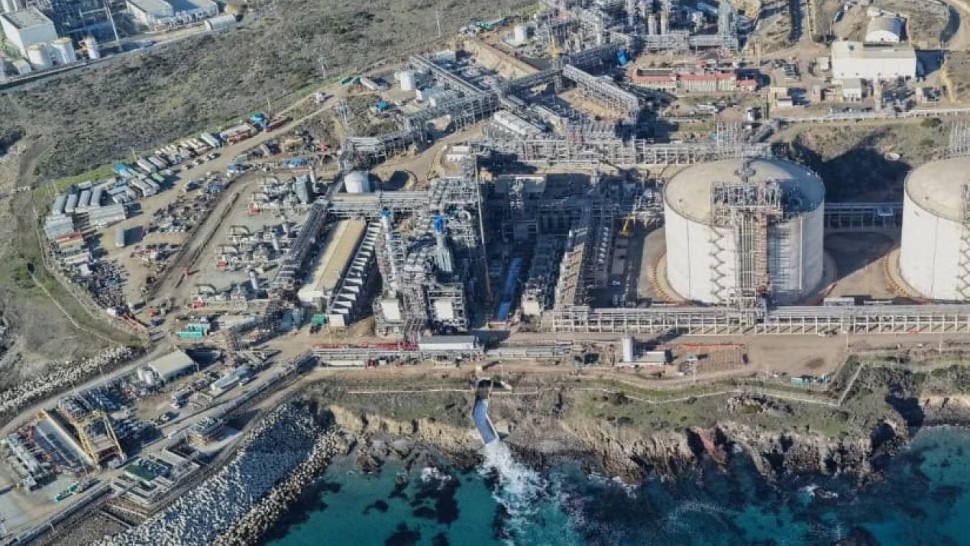
Energía Costa Azul makes first shipment of LNG in the Pacific

First shipment of liquefied natural gas from the Mexican Pacific marks an energy milestone.

The Energía Costa Azul project, in Ensenada, Baja California, completed the first shipment of liquefied natural gas (LNG) from the Mexican Pacific coast. The Sempra Infrastructure company confirmed that the shipment is part of the tests prior to the start of commercial operations.

International context

This movement occurs in a context of high demand for energy security. Tensions in the Strait of Hormuz, through which nearly 20% of global LNG trade passes, have accelerated the search for new supply routes.

Strategic advantage

Sempra Infrastructure noted that phase 1 of the project will connect North American gas with Asian markets, taking advantage of the strategic location of the Mexican Pacific coast. Researcher Adrián Duhalt highlighted that the proximity to the gas-producing basins of the United States represents a competitive advantage for Mexico.

Continue reading