Expert warns about risk of US intervention in Mexico after action in Venezuela

An expert warns about the dangerous precedent that military action sets and its possible replicas in the region, beyond Caracas.

And now what? The precedent that has us all on high alert mode

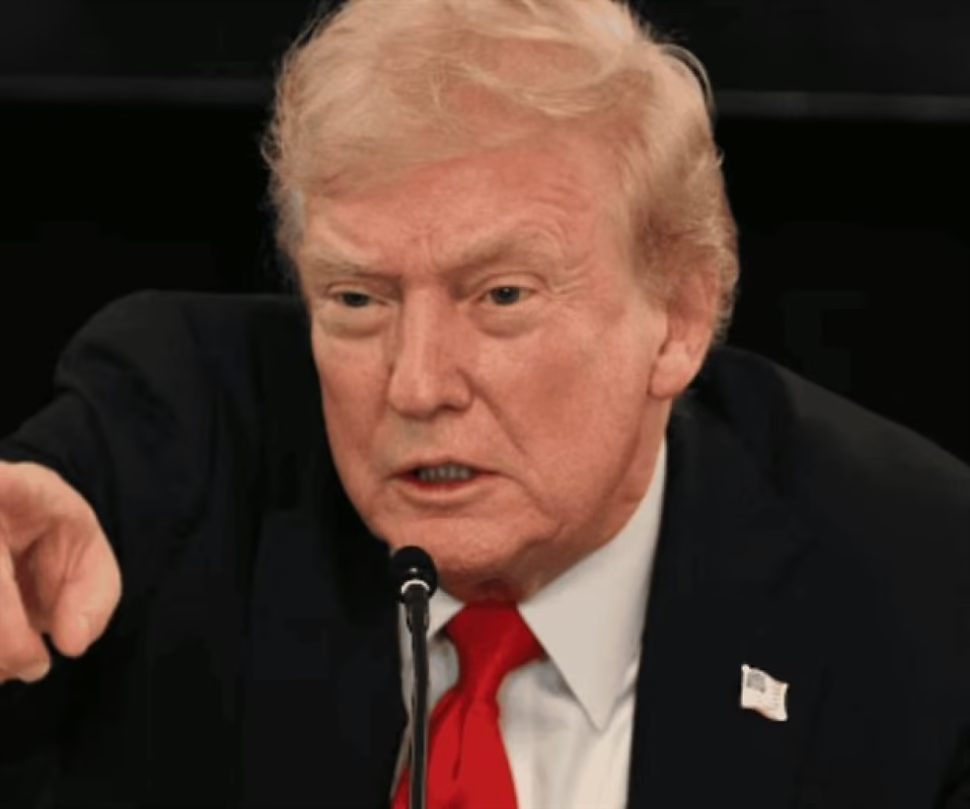
Well, the world woke up this Saturday to news that seems straight out of a particularly chaotic season of House of Cards: The United States, under the orders of the always unpredictable Donald Trump, decided that international norms were a suggestion and intervened militarily in Venezuela. Yes, you read that right. And according to Arlene Ramírez Urestitrailer of what could happen here.

In a talk with EL UNIVERSAL, the Forbes Mexico columnist also dropped the bomb: what happened in Venezuela sets a “quite complex” precedent. I mean, basically, the superpower just threw the diplomacy manual out the window and said “I play by my own rules.” For her, and be careful here, no country in the region is safe, including, of course, our beautiful and beloved Mexico. Trump’s constant threat to “help” with drug trafficking stopped being an angry tweet and became a real possibility. Spoiler: their “help” does not usually include prior consultations.

RelatedThe United States carries out a military operation and captures Maduro in Venezuela

International Law, that uncomfortable detail that Trump ignored

The most serious thing? That this movement ignored International Law and Article 2 of the UN Charter as if nothing had happened. “It opens the door for the US to move the chess pieces completely outside the regulatory framework,” explained Ramírez Uresti with a calm that we envy. In Christian: he skipped all the protocols. And when he was asked directly about the possibility of a frontal attack on the Mexican cartels, his response was worthy of a thriller: “Donald Trump is totally unpredictable.” He has just shown that he is willing to recover his political capital at any cost, even if that means invading the sovereignty of another country.

But, what about Maduro? Contrary to what many believe, the expert denies that the Venezuelan regime is completely overthrown. As long as Vice President Delcy Rodríguez, the right hand of Nicolás Maduro, is still in the game, the matter is on hold. The next few hours will be key to see if she takes office or decides that the chapter of the dictatorship has come to an end. A real-time drama that has more twists than a 9 o’clock soap opera.

And the sanctions? Forget it, the system is broken

Here comes the part where reality surpasses fiction: there will hardly be international sanctions against the United States. The reason? The international system is, to use his words, “very weakened.” The US is one of the five permanent members of the UN Security Council and has a veto power that makes it practically immune. Bringing the International Court of Justice to the country that has just invaded another is, according to her, “very complicated.” Basically, it’s like wanting to sue the neighborhood bully when he’s the one who makes the rules. Ironic, right?

To make matters worse, Trump needs to keep the flame of Trumpism alive, and that, my friends, is what should have us all on high alert. “He can be capable of anything,” said the analyst. His logic is simple: if he already did it once, ignoring all conventions, what would stop him from repeating the move in another scenario, such as the “war on drugs” in Mexico? Nothing. Absolutely nothing.

In short, the geopolitical chessboard has just received an epic shake-up. The intervention in Venezuela is not an isolated event; It is a message in giant letters for the world. And Mexico, due to its proximity and the constant rhetoric of the American president, is in the first row of the possible “next ones.” The “America First” doctrine translates, in practice, into unilateral actions where the right to intervention seems to prevail over the right to sovereignty. A panorama that requires more than ever to be informed and vigilant.

Are you concerned about how these geopolitical tensions may affect the region? Share this analysis so that more people are aware of the real implications of these actions. Explore more content on international politics on our site.
UK shares electronic warfare technology with Ukraine

Zelensky visits London and receives Stone Cloak technology to confront Russia.

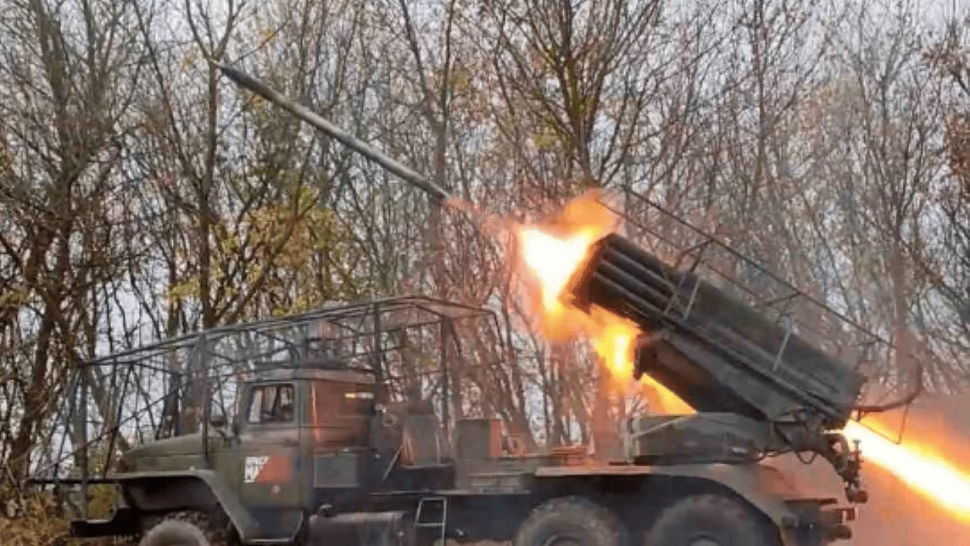
Ukrainian President Volodymyr Zelensky made a whirlwind visit to London on Monday. There he met with the new British Prime Minister, Andy Burnham, the fifth tenant of Downing Street since the beginning of the conflict with Russia. Burnham ratified “unwavering” support for kyiv and announced the transfer of intellectual property for advanced electronic warfare technology.

The Stone Cloak System

The main agreement was to share Stone Cloak technology, a portable electronic jamming system designed to protect Ukrainian drones. London presented the device as a tool to increase the effectiveness of unmanned vehicles, not just as a defensive shield. The meeting took place at the Portsmouth naval base, where both leaders boarded the Queen Elizabeth aircraft carrier.

Zelensky also met with Ukrainian military personnel participating in the Sea Breeze exercises. The meeting occurs before another key meeting with Donald Trump, and in the midst of an escalation of attacks with Russia that has increased the number of civilian deaths in the last month.

British support seems solid despite changes in government. Zelensky highlighted that the strategic agreement signed last year made bilateral relations “the strongest in history.” For future cooperation, he mentioned three priorities: air defense, maritime security and joint weapons production.

Continue reading

Milei accuses Brazil, Mexico and Democrats of campaigning against Argentina

Milei pointed out Brazil, Mexico and US Democrats without presenting evidence.

Milei’s accusations

The Argentine president, Javier Milei, accused the governments of Brazil and Mexico, as well as the Democratic Party of the United States, of financing an alleged campaign against Argentina. He did so during an interview with Radio Miter, without providing evidence.

According to Milei, the Brazilian government would have contributed 25% of the resources for that campaign. “Who invested the most money in this anti-Argentine campaign? The Brazilian government,” he stated. “And then they talk about interference,” he added.

Diplomatic tension on the rise

The statements occur in a climate of growing bilateral friction. Hours earlier, Brazil called its ambassador in Buenos Aires for consultations, in response to what it described as “offensive statements” by Milei. The Brazilian annoyance originated from comments by the Argentine president during an event in support of Flávio Bolsonaro, ahead of the presidential elections in October.

Milei also mentioned Mexico and the United States Democratic Party as alleged funders of the campaign, but did not offer concrete evidence. The episode deepens the distance between Argentina and Brazil, two key partners in Mercosur.

Continue reading

US and Iran resume talks mediated by Oman

Dialogue intensifies after military pause in the Strait of Hormuz.

Pause in military actions

The United States and Iran maintain a de facto truce for the second consecutive day. The ceasefire was not officially announced by Washington, but the US ambassador to the UN, Mike Waltz, indicated that it seeks to give space for diplomatic efforts. Tehran also confirmed the suspension of its operations during the same period.

Negotiations in progress

Both parties are trying to resume the provisional agreement reached in June. The talks, mediated by Oman and other actors, focus on ensuring safe transit through the Strait of Hormuz, a key route for the global oil trade. Differences persist over the Iranian nuclear program.

Uncertainty extends to other routes such as the Bab al-Mandeb Strait, due to threats from the Houthis against Saudi maritime transport. The US Navy maintains surveillance in the area to protect commercial traffic.

Meanwhile, Israeli Prime Minister Benjamin Netanyahu will travel to Washington to meet with Trump. Netanyahu backed the diplomatic efforts, although he warned that he would respond firmly if Iran or its allies attack Israel.

Continue reading