UNAM students mobilize help after gas explosion

The university community demonstrates its power of organization and giant heart to support the victims of the tragedy.

The Chaos of Tragedy and the Order of Millennial Solidarity

Imagine this: an ordinary Wednesday in Mexico City, where traffic and memes are the only things that usually explode. But life, in its unpredictable Netflix plot, decided that a gas pipe on the Pont de la Concorde would be the tragic plot twist of the day. Without spoiling too much, the result was chaotic. However, in the midst of the disaster, an army of anonymous heroes, armed with backpacks, notes and a connection to Instagram, decided that hopelessness was not an option. Students from UNAM, the highest educational institution (and the most decent chilaquiles in CU), organized with a speed that would put Amazon Prime logistics to shame.

The spark was lit, like everything nowadays, on social networks. From the indignation and sadness in the Instagram stories, the donation boxes emerged. There was no need to wait for an influencer with a blue check to request it; the university community, in its collective wisdom, was already on the move. It was a masterful example that when it comes to helping, young people are not the generation of glass, but the generation of action.

RelatedUNAM activates support network after gas explosion

The Logistics of Empathy: From Faculties to Hospitals

At the Law Faculty, the debate was not about articles of the constitution, but about articles of first necessity. The students temporarily swapped penal codes for cases of bottled water and non-perishable food, organizing a supply chain of solidarity that任何跨国公司would envy. Diego Méndez, law student, explained that working together was the key. There were no fights over jurisprudence, just a healthy competition to see who donated the most.

Meanwhile, at the Faculty of Political and Social Sciences, politics became practical. Fátima, an International Relations student, became the minister of community relations, literally camping out since Thursday night to receive help. His office: a hallway. Your budget: zero. Their reward: watching people arrive non-stop, especially with medical supplies like gauze, bandages and alcohol, which is just what is needed after a tragedy (and sometimes during an end-of-semester party, but that’s another story).

But the community spirit didn’t stop there. The story of Eduardo Archidona, from Economy, is one to cry (but with a good emotion, not like when you see your bank statement). The guy saw the images, his heart broke and, instead of just putting a little Mexican flag on his profile, he mobilized his family in San Luis Potosí to gather sanitary towels, cookies and chocolate. Because sometimes, help is not just giving what you have left over, but understanding what the other person needs. A masterclass in human economics.

And in the Faculty of Sciences, Carlos Hughes of Biology, gave us the most profound and random quote of the year: “How circumstantial and ephemeral life is was shocking, and Mexico has a people that always supports people.” While arranging products in boxes, he philosophized about the fragility of existence, something we all think while checking our cell phones at 3 a.m., but that he put into practice. Teachers offering their cars, students donating their time and money… it was like a study group, but to save lives.

The most requested items—water, canned food, hygiene products, blankets—were piled up in rooms that normally see complex theories and existential anxiety pass by. It was an object lesson that true intelligence is not only measured in grades, but in the ability to empathize and take action. The UNAM, often reduced to statistics and political stereotypes, showed its giant heart: a living organism that beats to the rhythm of the needs of its city.

In the end, this spontaneous movement showed that the true trending topic is not always on Twitter, sometimes it is in the will of a generation that, between exams and existential crises, finds the time and energy to lend a hand. Because in a world of ephemeral content, solidarity is the only like that really matters.

Did this story reach you? Don’t stay with the emotion, share it. Help these solidarity actions go viral for all the right reasons. Explore more stories of communities rising up in the face of adversity on our site.

Marina de México y EU acuerdan nuevas estrategias de seguridad marítima

México y EU refuerzan seguridad marítima con nuevos acuerdos operativos y tecnológicos.

Reunión de alto nivel entre mandos navales

El almirante Raymundo Pedro Morales Ángeles, titular de la Secretaría de Marina (Semar), se reunió con mandos de la Armada y la Guardia Costera de Estados Unidos del 3 al 5 de junio. El objetivo fue diseñar estrategias de seguridad marítima, fortalecer labores de búsqueda y rescate, y reafirmar el compromiso binacional contra la delincuencia organizada transnacional.

Los acuerdos se formalizaron con los almirantes James W. Kilby y Kevin E. Lunday, subjefe de operaciones navales y comandante de la Guardia Costera, respectivamente. En las mesas de trabajo se revisaron mecanismos de coordinación bajo principios de confianza mutua y respeto a la soberanía. El espacio marítimo se consolida como uno de los ejes más dinámicos de la agenda bilateral.

RelatedThe Navy faces investigations for internal corruption

Cooperación tecnológica y ambiental

Las autoridades estadounidenses reconocieron la capacidad operativa de la Armada de México, destacando el modelo de trinomio naval —buques, helicópteros y patrullas interceptoras— y la incorporación de sistemas no tripulados para vigilancia y seguimiento de objetivos.

El secretario Morales Ángeles subrayó la urgencia de fortalecer la Iniciativa de Seguridad y Protección Marítima para América del Norte (NAMSI). Este mecanismo trilateral, vigente desde 2008, permite intercambio de información y operaciones coincidentes para frenar actividades ilícitas, manteniendo el control soberano de cada país. En el ámbito ambiental, México ratificó su compromiso contra la pesca ilegal, con énfasis en el Golfo de California y el Golfo de México.

Ambas partes acordaron reactivar los ejercicios binacionales SAREX para mejorar la capacitación en emergencias. La Semar implementará el sistema SAROPS 4.5, desarrollado con la Guardia Costera estadounidense, que optimiza recursos y reduce tiempos de localización de personas o embarcaciones. El plan integral incluye protección portuaria, ciberseguridad e interoperabilidad académica.

Continue reading

Profepa rescata seis animales silvestres en Baja California Sur

Aves, reptiles y un venado fueron atendidos en diferentes municipios del estado.

Rescate de fauna silvestre

Tras reportes ciudadanos, la Procuraduría Federal de Protección al Ambiente (Profepa) atendió a seis animales silvestres en Baja California Sur. Los ejemplares fueron hallados lesionados, desorientados o fuera de su hábitat natural.

La autoridad ambiental, encabezada por Mariana Boy Tamborrell, informó que las acciones ocurrieron entre el 7 de mayo y el 2 de junio. Las especies rescatadas incluyen polluelos de águila pescadora, un búho cornudo y un venado bura.

RelatedProfepa rescata 345 animales silvestres en tianguis de Guadalajara

En la comunidad de Puerto Adolfo López Mateos, en Comondú, tres polluelos de águila pescadora fueron atendidos. Dos tenían aparente incapacidad de volar y otro cayó de un nido. Todos recibieron atención médica.

Una serpiente de cascabel de diamante rojo fue hallada en una construcción en Los Cabos. Sin lesiones, fue liberada en un sitio alejado de asentamientos humanos.

Un búho cornudo, atacado por perros domésticos en Los Cabos, presentaba dificultad para volar. Recibió atención veterinaria especializada y después fue liberado en un lugar adecuado para su supervivencia.

Una hembra adulta de venado bura fue atropellada en una carretera cerca del Rancho La Fortuna, en Los Cabos. Sufrió laceraciones, golpes severos y una fractura expuesta en una extremidad. Falleció durante el traslado para recibir atención especializada.

En todos los casos, Profepa realizó valoración, resguardo temporal y liberación o canalización a atención especializada según las condiciones de cada animal.

Continue reading

Aseguran 150 kilos de metanfetamina en Baja California

150 kilos de metanfetamina asegurados en operativo federal en Baja California.

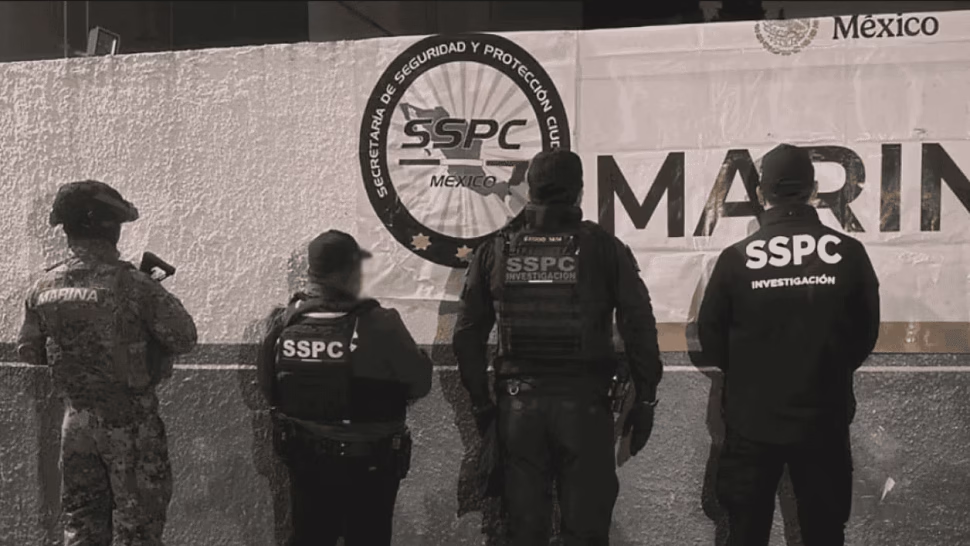
Personal de la Secretaría de Seguridad y Protección Ciudadana, la Marina Armada y la Fiscalía General de la República aseguraron 150 kilogramos de metanfetamina en Baja California. El operativo formó parte de acciones para debilitar estructuras del crimen organizado en la entidad.

Detenciones clave para el operativo

El Gabinete de Seguridad informó que el aseguramiento se derivó de la detención de dos personas, a quienes se les incautaron 68 kilos de cristal. Con esa información, los agentes federales realizaron investigaciones que llevaron al decomiso de los 150 kilos adicionales.

RelatedAuthorities seize 203 kilos of methamphetamine in a highway operation

Impacto económico y social

La droga asegurada equivale a 3 millones 750 mil dosis que no llegarán a las calles. Además, representa una afectación económica de cerca de 38 millones de pesos para las organizaciones delictivas. La sustancia fue puesta a disposición del Ministerio Público para integrar la carpeta de investigación del caso.

Continue reading