Global companies demand flexibility in the new Mexican tariff policy

The international private sector warns of the risks of rigid application and calls for adjustment mechanisms to protect production and exports.

A Call for Sanity in the Middle of the Trade Storm

In a turn of events that could define the economic destiny of the nation, Global Companies have raised their voices with a clamor that echoes in the corridors of power. This is not a simple disagreement, but a warning full of urgency: so that the recently approved tariff policy does not become a devastating boomerang, it requires an intelligent implementation, flexible and subject to constant review. The Congress of the Union has rolled the dice, but now, the business world watches with its heart in its mouth, imploring wisdom in its application.

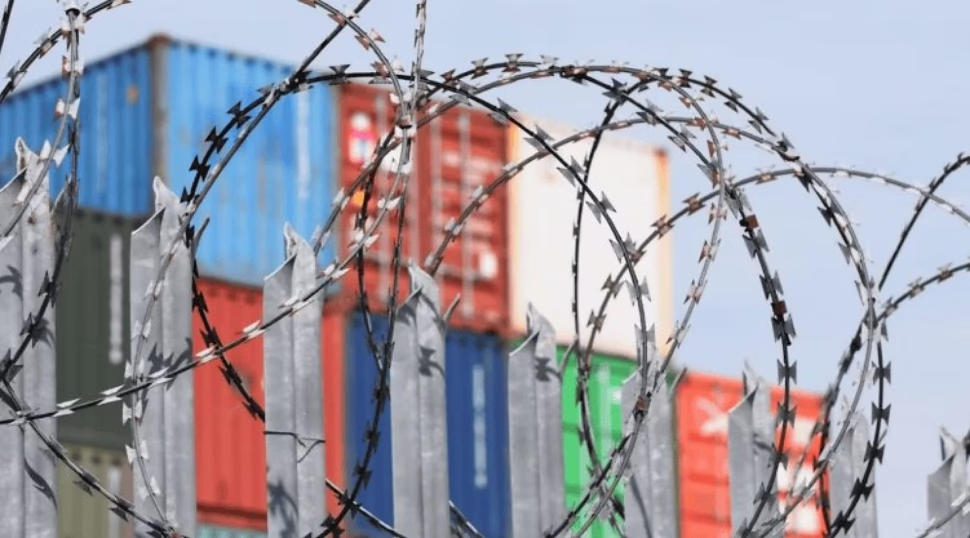
The scenario they paint is one of palpable tension. How to navigate this new sea of ​​tariffs, where waves of up to 50% threaten to sink 1,463 product fractions? The key, they passionately argue, lies in recognizing the fragile and complex diversity of national productive systems. It is not a zero-sum game, but a delicate balance where, in a dramatic contradiction, many companies depend on foreign inputs to survive and honor their sacred export commitments. Without exception mechanisms for these critical inputs, they warn in a tragic tone, chaos would be unleashed in the supply chains, paralyzing strategic sectors and putting the very Treaty between Mexico, the United States and Canada (T-MEC) in check.

RelatedCanada matches US tariff exemptions in the T-MEC

The Precipice of Competitiveness and the Shadow of Uncertainty

The shadow of doubt hangs over every decision. International corporations, those titans that pull the strings of the economy, raise their concerns with the solemnity of an omen. The implementation of these taxes must be scrutinized under the magnifying glass of three crucial factors: the real availability of local production, the impact on the final costs for the consumer – who could suffer the blow – and the operational capacity of the authorities for efficient execution. One miscalculation, one slow bureaucratic process, and national competitiveness could plummet off a cliff of inefficiency.

In the midst of this drama, there is a recognition, a flash of light in the darkness. Global Companies admit, with grave conviction, that the objective of combating unfair trade practices and global undervaluation is legitimate. It is a necessary battle to protect employment and formal production. However, his plea is clear and charged with emotion: this noble goal cannot be achieved with blunt tools. What is needed is strengthened institutional coordination, a reduction in the suffocating administrative complexity and, above all, clear rules that provide the certainty that long-term investors crave.

The private sector body extends a hand, not in defiance, but in desperate collaboration. They offer their technical expertise to the Secretary of Economy, promising information and dialogue in an epic effort to extract the benefits of tariffs while minimizing apocalyptic risks. The final message is a sentence that hangs over the future: the effectiveness of this policy will not be measured on paper, but in its herculean capacity to promote industrial development without betraying global integration or breaking the fragile trust of those who generate value and employment in the national territory. The final act of this economic drama has yet to be written.

Do you think this call for flexibility will be heard? Share this crucial story on your social networks and help us amplify the debate. Explore more analysis on the future of the USMCA and the Mexican economy in our special section.


Esteban Moctezuma, new ambassador of Mexico to Belgium and the EU

The former Secretary of Education will seek to ratify the Modernized Global Agreement with the EU.

Diplomatic appointment

The Ministry of Foreign Affairs sent to the Senate the proposal of Esteban Moctezuma Barragán as ambassador of Mexico to the Kingdom of Belgium and the European Union, with concurrence in Luxembourg.

“Your first task will be to coordinate the ratification of the Modernized Global Agreement (AGM) with all representations of Mexico in the member countries of the European Union,” the agency indicated in a statement.

President Claudia Sheinbaum tasked him with designing a strategy with European countries to increase trade and attract new investments.

Official career

Moctezuma is an economist from UNAM and a master’s degree in Development from the University of Cambridge. He has held senior positions: Secretary of the Interior (1994-1995), Secretary of Social Development (1998-1999), Senator (1997-2000), Secretary of Public Education (2018-2021) and Ambassador to the United States (2021-2026).

Now, with this new assignment, he will have to manage the approval of the AGM in a context of renegotiation of trade agreements. His experience in public service and diplomatic representation will be key to advancing the bilateral relationship with Europe.

Continue reading

Infonavit and OXXO enable credit payments without commission

New option to pay Infonavit credit in OXXO, without commission and available all day.

Infonavit announced an alliance with OXXO so that its beneficiaries can pay their credit in the chain’s stores. The service is available 24 hours a day, 365 days a year, without charging a commission.

How does it work?

Payments can be up to 10 thousand pesos per transaction, in cash or with a credit or debit card. This benefit applies to both mortgage loans and home improvement loans (Mejoravit only for you).

Only the 10-digit credit number is required, which will serve as a reference for payment. It is no longer necessary to go to bank branches during limited hours.

The measure seeks to expand payment options for those who cannot attend banks or other points during service hours. The Institute noted that with this action it reinforces its commitment to keeping housing financing up to date.

For more information on payment methods and points, beneficiaries can enter the Infonavit portal: www.infonavit.org.mx, in the Rightholders / I have a credit / Payments section.

Continue reading

Mexican banks train 100,000 employees against human trafficking

Banks train 100,000 employees in the face of a 47% increase in trafficking victims in 2025.

Months before the 2026 Soccer World Cup, the Mexican banking system activated a national strategy to detect possible cases of human trafficking and financial operations linked to this crime. The objective is to respond to the risks that tend to increase in large-scale international events.

Massive training in branches

The Association of Banks of Mexico (ABM), the Citizen Council for Security and Justice of Mexico City and the United Nations Office on Drugs and Crime (UNODC) reported that nearly 100,000 employees of financial institutions are being trained to identify warning signs and channel reports on possible cases of exploitation.

The initiative covers more than 11 thousand bank branches of the 54 institutions affiliated with the ABM. These participate in awareness and prevention actions at the national level.

The purpose is to strengthen the capacities of the financial system to detect operations that could be linked to trafficking networks and contribute to the protection of people in vulnerable situations.

According to data from the Executive Secretariat of the National Public Security System, during 2025 the number of trafficking victims in Mexico grew 47%.

Faced with this panorama, the organizations pointed out the importance of strengthening coordination between authorities, international organizations and the private sector to prevent crime and care for affected people.

The strategy coincides with alerts issued by the National Banking and Securities Commission (CNBV), the Financial Intelligence Unit (UIF) and the United States Financial Crimes Enforcement Network (FinCEN) about the risks associated with trafficking and money laundering.

As part of the program, UNODC and the Citizen Council developed training materials focused on identifying unusual financial movements, atypical transaction patterns and other risk indicators related to possible cases of sexual and labor exploitation.

Branches will also disseminate informational materials to help recognize early signs of trafficking and promote the Citizen Council’s National Anti-Human Trafficking Hotline and Chat. This service provides legal and psychological guidance, emotional support and accompaniment to victims 24 hours a day, free of charge, anonymous and confidential.

The initiative seeks to close spaces for resources from this crime to enter or circulate within the formal banking system.

Continue reading