The Vatican creates a study group on artificial intelligence

Pope Leo XIV creates an internal group and prepares an encyclical on the ethical challenges of AI.

The Vatican and artificial intelligence

The Vatican announced the creation of an internal study group on artificial intelligence (AI) by order of Pope Leo XIV. The decision responds to the acceleration in the use of this technology and its possible effects on humanity, the Holy See reported. The group will seek to integrate human dignity and peace into the global debate.

The announcement occurred one day after the pontiff signed his first encyclical, exactly 135 years after the publication of Rerum Novarum by Pope Leo XIII. That document addressed labor rights during the Industrial Revolution. The current pope believes that AI raises similar existential questions.

“I think the Catholic Church is going to be the adult in the room in some of these debates,” said Meghan Sullivan, a philosophy professor at the University of Notre Dame.

An encyclical in historical context

The encyclical, scheduled for the coming weeks, will place AI within the framework of Catholic social teaching, which encompasses work, justice and peace. This could raise tensions with Donald Trump’s government, which prioritizes the development of AI without strict regulations. Trump concluded a visit to China with businessmen such as Elon Musk and Jensen Huang.

RelatedCelebrities say goodbye to Pope Francis with emotional messages

The Vatican seeks to influence international regulation. The United Nations adopted a governance architecture for AI, while the European Union approved its AI Law in 2024. The Holy See has promoted ethical guidelines since 2020 with the Rome Call, signed by Microsoft, IBM and Cisco.

“There are almost 1.5 billion Catholics in the world, so that fact is reason to pay attention,” said Thomas Harmon, professor of theology at the University of St. Thomas.

Pope Francis, Leo’s predecessor, called for an international treaty to regulate AI and ban lethal autonomous weapons. León, who studied mathematics, has warned priests against using AI to write homilies and expressed concern about deepfakes and the impact on the truth.

“What is happening in Ukraine, Gaza and the Palestinian territories illustrates the inhuman evolution of the relationship between war and new technologies,” declared León this week at La Sapienza University.

The Church also warns about the energy consumption of data centers. Their position is clear: technology should complement, not replace, human intelligence.

Trump criticizes journalists and opponents at correspondents’ dinner

Trump attacked 'fake news' and opposition politicians before 700 attendees.

The president of the United States, Donald Trump, took advantage of the correspondents’ dinner in New York to launch criticism against the press and his political adversaries. The event was held at the Waldorf Astoria hotel, three months after an alleged attempted attack on Trump forced its suspension.

Criticism of the press and the opposition

Before about 700 people, Trump adopted a lighter tone than expected, although he did not stop referring to “fake news.” Between jokes, he claimed to have won the elections three times, repeating the theory of fraud in 2020 that he has never been able to prove.

“They have no idea how lucky they are. When I’m gone, they’re going to go bankrupt. Their business model will end. There won’t be anyone to report on. Nobody gives a damn about anyone else,” the president said.

The statements come in a context of tension between the White House and the media, which Trump has repeatedly described as “enemies of the people.” During his speech, he also criticized Democratic politicians and described some Republican opponents as “disloyal.”

The speech, although with a less confrontational tone than on previous occasions, made it clear that Trump maintains his strategy of discrediting the independent press and those who oppose his political agenda.

Continue reading

Charges against 11 for migrant smuggling with 7 dead in Texas

Eleven people face charges in the US for migrant smuggling. Seven died in a container in Texas.

The United States Federal Prosecutor’s Office filed charges against 11 people for their alleged participation in a migrant smuggling network. The case is linked to the death of seven people who were traveling hidden in a railway container in Texas.

The victims, originally from Honduras and Mexico, died in May due to high temperatures while being transported to the interior of the country.

Details of the tragedy

According to authorities, the group boarded a train in the border city of Del Río bound for San Antonio. The smugglers abandoned the container after one of the migrants fell while opening the door.

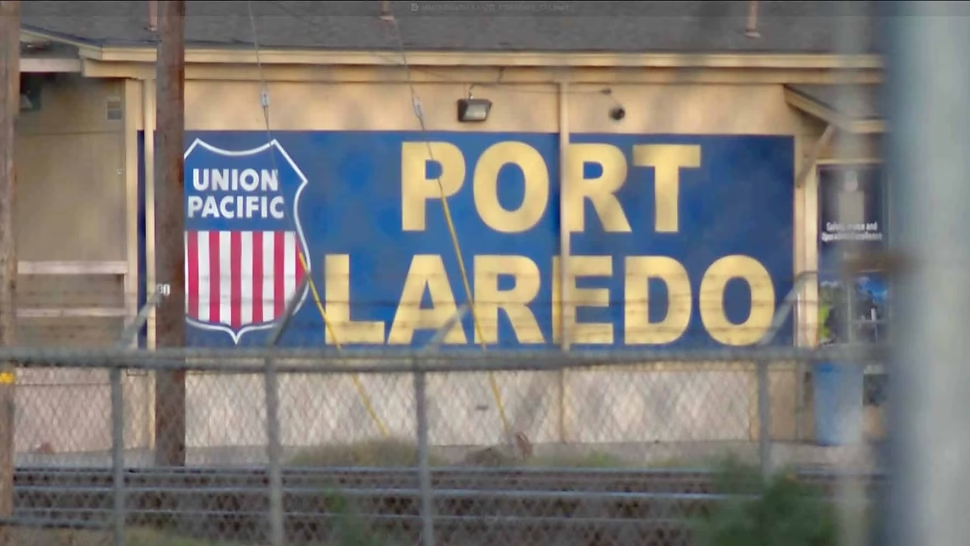
The next day, a Union Pacific employee discovered the bodies of six people inside the container at a Laredo rail yard. A seventh victim had been left next to the tracks.

The investigation determined that the container remained completely sealed, with no ventilation or cooling system. This caused the migrants to suffer heat stroke. Among the deceased was a 14-year-old teenager.

The prosecution detailed that one of the victims managed to communicate with his relatives while he was dying inside the container.

Actions of the authority

The 11 defendants face charges of conspiracy to transport foreigners and facilitating their transfer resulting in death. Crimes that could lead to life in prison.

Nine of the alleged perpetrators have already been arrested in different operations carried out in Texas. Two remain at large. Authorities reported that those involved include US citizens and permanent residents.

Continue reading

Spain declares national emergency due to forest fires

Spain declares national emergency due to fires. 20 thousand evacuated in the country and 60 thousand in France.

National emergency in Spain due to forest fires

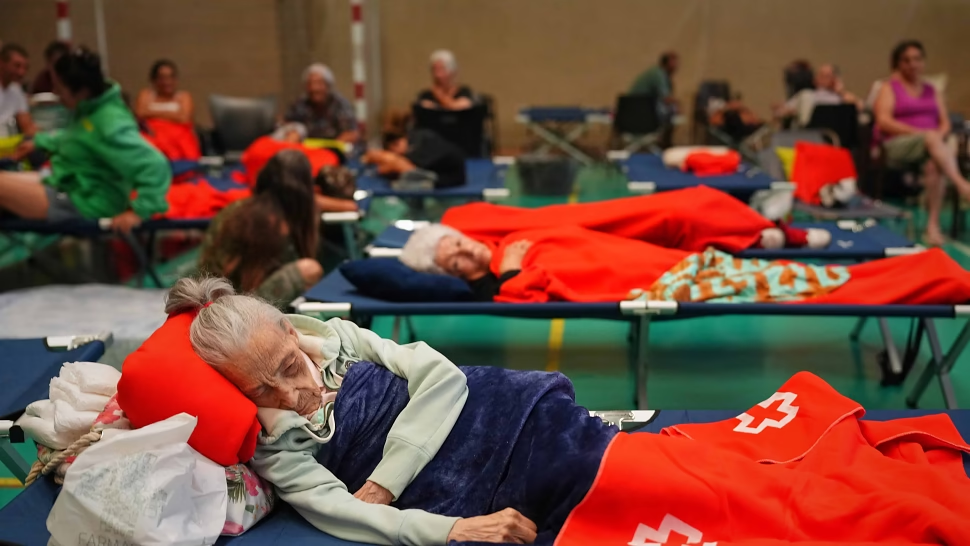
This Friday, the government of Spain activated the declaration of national emergency due to the magnitude of the forest fires. The flames have forced the evacuation of approximately 20 thousand people, mainly in towns near Madrid.

The crisis also reaches the south of France. More than 60 thousand inhabitants have had to leave their homes due to the advance of the fire.

Pedro Sánchez, president of the Spanish government, described the situation as “dramatic” and expressed his solidarity with the affected families.

The declaration of emergency allows the Ministry of the Interior to coordinate response efforts in different autonomous communities. It is expected that in the next few hours air and ground resources will be reinforced to contain the fires.

The authorities recommend that the population stay informed and follow evacuation instructions. So far no deaths have been reported, although the material damage is significant.

Continue reading