


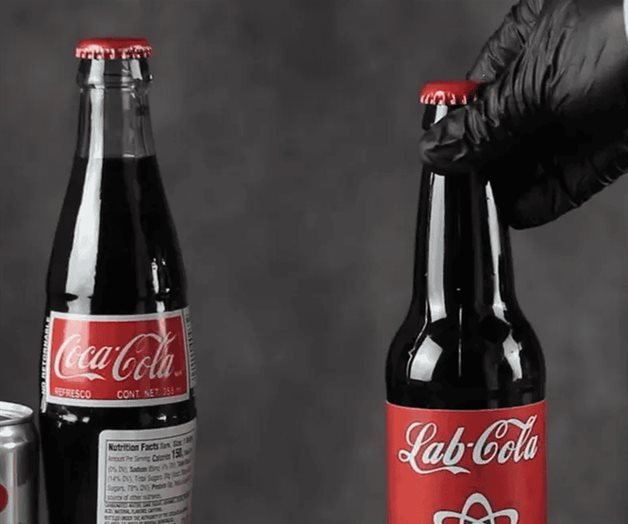
The end of a centuries-old myth? A YouTuber claims to have the formula for Coca-Cola
For more than a hundred years, the Coca-Cola recipe has been the Holy Grail of soft drinks, kept under more layers of secrecy than a double agent in the Cold War. Officially, it rests in a safe in Atlanta, protected as if it were the Ark of the Covenant. But of course, in the age of the Internet, no mystery is safe from a guy in a lab coat and too much time on his hands.
On January 8, content creator LabCoatz dropped the bombshell: a 25-minute video titled, modestly, “Replicating Coca-Cola Perfectly (It Took Me a Year).” In it, he not only documents twelve obsessive months of his life, but claims to have created Lab-Cola, a chemically and sensorially identical replica of the original. The proof? Blind tests and scientific analysis. Because nothing says “trustworthy” like a YouTuber naming complex techniques.
“It is possible to reproduce a drink protected by trade secret using accessible science,” says LabCoatz.
Of course. As accessible as gas chromatography and mass spectrometry, those appliances that we all have at home next to the toaster.
The holy grail was a mixture of spices (and maybe something else)
The great challenge, according to our scientific hero, was to decipher the legendary 7X Merchandise, that aromatic mixture that has fueled conspiracy theories for decades. After analyzing store-bought samples (a gloriously mundane detail), he concluded that the core of the flavor is a complex combination. We’re talking about citrus oils (lemon, lime, orange), spices like cassia cinnamon, nutmeg and coriander… and then come the less obvious notes: tea tree oil and wine tannins.
Added to this are ingredients that sound more like a Victorian medicine cabinet than a soft drink: vanilla, glycerin, vinegar and small amounts of phenol. Phenol? Yes, that compound that also has uses… antiseptics. How refreshing. Literally.
But the YouTuber is clear: the ingredients are nothing without the method. Its procedure is so specific that it seems like a recipe for making an artifact in Breaking Bad: dissolving sugar in syrup, integrating oils diluted in alcohol (because everything tastes better with alcohol), controlled heating so as not to ruin the volatile compounds and, finally, carbonation with extremely cold water followed by resting in the refrigerator. Basically, the process of raising a very delicate child.
The law enters the bar (but does not order a Coke)
This is where it gets juicy. Coca-Cola never patented its formula. He opted for the commercial secret. Because? Because a patent expires; A well-kept secret can last forever… or until a certain YouTuber comes along. Intellectual property experts point out that this type of reverse engineering is legal as long as information is not obtained through illicit practices. In other words, it’s okay to analyze what you buy at the store; It’s wrong to hack Atlanta’s servers while eating Cheetos.
What would not be legal is to use the trademarks or try to sell this Lab-Cola as if it were the original. For now, it appears to be just a viral experiment. Coca-Cola itself maintains a stony silence. Are you worried? Indifferent? Preparing a legal army? Who knows.The truth is that the video accumulates millions of views and revives a historical question with a flavor of irony: how secret can something remain when anyone with scientific equipment and infinite patience can try to decipher it? In the era of open knowledge and tutorials for everything—from repairing your washing machine to cloning your pet—perhaps the greatest achievement is no longer keeping a secret, but creating something so iconic that even knowing its ingredients it remains irreplicable in its cultural aura.
In the meantime, let’s toast our favorite soda—whether original or replica—to this reminder: sometimes the most fascinating thing is not the secret itself but our collective obsession with unraveling it.
—
Did this experiment surprise you? Share this story full of irony and scientific intrigue with your friends and explore more content about the modern myths that the Internet is responsible for debunking.


