The mystery of oil in the Gulf remains unanswered

A month later, the cause of the spill remains unclear while cleanup efforts continue along more than 165 km of coastline.

A month later, the origin of the spill remains an enigma

One month. Thirty full days since that dark spot appeared in the waters of the Gulf. And the question we all ask ourselves continues to float, like the hydrocarbon itself: where did it come from?

The interdisciplinary government group confirms it: they continue investigating. They use satellites, drones, flyovers. They analyze currents, review port infrastructure. But the specific origin remains a blind spot.

“A technical and scientific investigation is ongoing to determine the origin of the hydrocarbon detected,” says the official statement.

The curious thing is what the document does not say. It does not mention at all the comments of President Claudia Sheinbaum, who in her morning suggested that it was a ship from a private company. Nor does it clarify that public contradiction.

RelatedPemex reactivates oil pipeline after spill in Veracruz river

The battle against the stain and for the truth

While the investigation progresses at a slow pace, containment is racing against the clock. They have collected 128 tons of waste impregnated with crude oil along more than 165 kilometers of the Veracruz and Tabasco coastline.

The priority has been to prevent the contaminant from reaching mangroves and sensitive ecosystems. Barriers, special cordons and brigades that work manually are used.

But there is another battle, less visible: misinformation. Authorities categorically deny a “clearly false” image that circulated widely on social media, noting that it was a superimposed graphic representation, not an actual satellite photo.

The government promises that, once the origin has been identified, it will act with all the legal weight: administrative, criminal, environmental sanctions and financial fines. But first we have to find the person responsible.

The silent victims: the sea and its guardians

Beyond the numbers and tons, there are the people. Fishing communities have been stuck with uncertainty like fat for a month.

Pemex has allocated more than 35 million pesos in support to mitigate the economic damage. They have temporarily hired affected residents for sanitation work—a palliative measure while the substance of the matter is resolved.

Meanwhile, the supervisory bodies do not rest. The ASEA has carried out 11 supervision tours and has requested information from 5 extraction companies. Profepa has visited more than 32 affected sites.

The question remains suspended in the saline air: Accident? Negligence? Operational failure? The political theater has this act pending to resolve. And meanwhile, the Gulf awaits answers.

Sheinbaum recognizes Katia Itzel García, the first Mexican to referee in a World Cup

The president recognized the referee and defended the singer against criticism.

A milestone for women’s refereeing

President Claudia Sheinbaum congratulated Katia Itzel García Mendoza for becoming the first Mexican to whistle a World Cup match. García refereed the match between Tunisia and the Netherlands from the Kansas City stadium.

“Imagine what it cost Katia, in and of herself, a referee, a good referee. Well, to get to a World Cup match requires many exams, having to pass different filters. Now imagine for a woman, being the referee of a men’s match,” Sheinbaum expressed in the morning conference.

García is a student at the Faculty of Law and a graduate of the Bachelor’s Degree in Political Science and Public Administration from the Faculty of Political and Social Sciences (FCPyS) of UNAM. This Friday she led the fifth World Cup match directed by a central referee.

The president also highlighted the efforts of the auxiliary Sandra—without giving a last name—and linked the achievement to the demands of women: “An extraordinary effort by Katia and the auxiliary… speaks of personal effort, but also of the demands of women, that we can be whatever we want to be.”

Sheinbaum took the opportunity to defend the singer Julieta Venegas, who was criticized for the cover “La Niña Futbolista.” He did not give more details, but reiterated his support for the artist.

García’s case opens the conversation about female inclusion in professional arbitration, a field historically dominated by men.

Continue reading

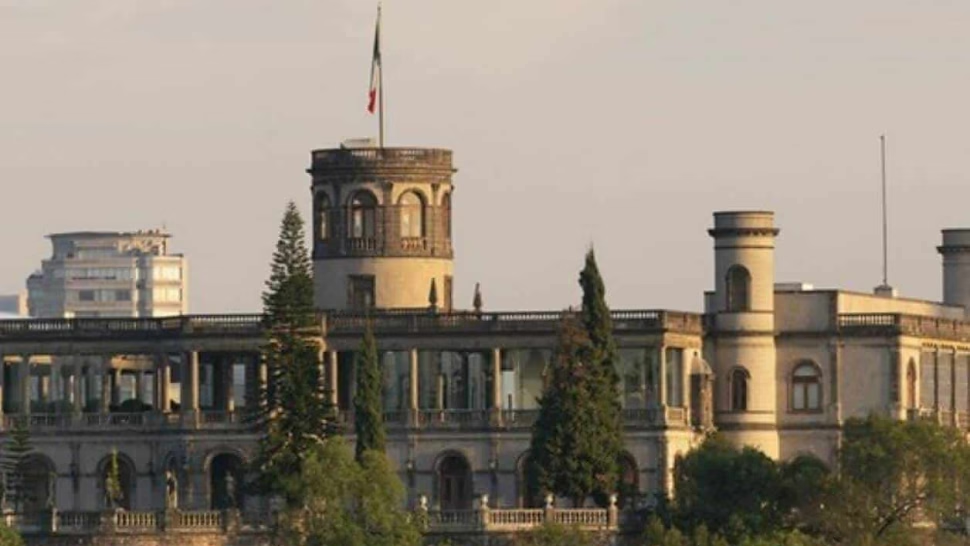
Renting Chapultepec Castle to FIFA does not violate the law: Culture

The official defends the rent of the historic site under the figure of payment of rights for use.

The Secretary of Culture, Claudia Curiel de Icaza, stated that the rental of Chapultepec Castle for a private FIFA event does not violate any regulations. The payment was 1 million 300 thousand pesos, under the concept of “Payment of rights for use.”

“It was an event of cultural diplomacy for us because it gave visibility to our country as a cultural host,” he declared during the morning conference on June 26.

The gala dinner, held on June 10 towards the 2026 World Cup, generated criticism on networks and led INAH investigators to prepare a formal complaint against those who authorized the use of the property.

The official version

Curiel indicated that the act complied with the law and that the director of the INAH already spoke with the protesters. “It does not proceed because there is no violation of any law, it is payment of rights for use of the space within the framework of a cultural event of cultural diplomacy,” he said.

President Claudia Sheinbaum pointed out that the complaint is of an administrative nature, not criminal. “It was not a complaint to the Prosecutor’s Office, it was administrative,” he clarified. Sheinbaum added that his participation was limited to welcoming and that he did not attend the exclusive dinner. He also recalled that FIFA paid one million pesos and that the Castle has been available for rent for a long time.

Reaction from academics

Historian Felipe Echenique and anthropologist Juan Manuel Sandoval asked the FGR to investigate those responsible for the event, considering that it transgressed national laws such as the General Law of National Assets and the Federal Law on Monuments. In the letter of complaint, cited by EL UNIVERSAL, it is argued that the violation of the rule of law was “promoted and sponsored.”

Curiel assured that they will review the complaints and that the venue’s legal department follows an internal procedure. The debate on the use of heritage spaces for private purposes remains open.

Continue reading

Network of museums and archaeological zones registers an increase of 18%

Investment of 400 million pesos and improvements in security increase visits to museums and archaeological sites.

Record attendance

The Secretary of Culture, Claudia Curiel de Icaza, reported that the country’s Network of Museums and Archaeological Zones increased its visitors by 18%. In the last two years, 57 million visits were registered, driven by an investment of 400 million pesos in infrastructure.

“It is relevant because we have strengthened the infrastructure with an investment of 400 million pesos, and many of us were accompanied to Teotihuacán with all the new signage, the new Museum of Mayan Grandeur,” he declared during the morning conference.

Security measures in Teotihuacán

The official highlighted the actions implemented in the Teotihuacán Archaeological Zone, where on April 20, a violent event occurred in the Pyramid of the Moon. Although he did not give details, he stressed that security operations have been reinforced to guarantee the visit.

The increase in visitors is also linked to the upcoming 2026 Soccer World Cup. Museums of the INAH, INBAL and the Ministry of Culture have mounted temporary exhibitions on the Mesoamerican ball game, an ancestral tradition of more than a thousand years.

“You know that the ball game is one of the most important ancestral ceremonies where the ball has been played in Mexico, in our country since Mesoamerican times for more than a thousand years,” said Curiel.

Featured exhibitions

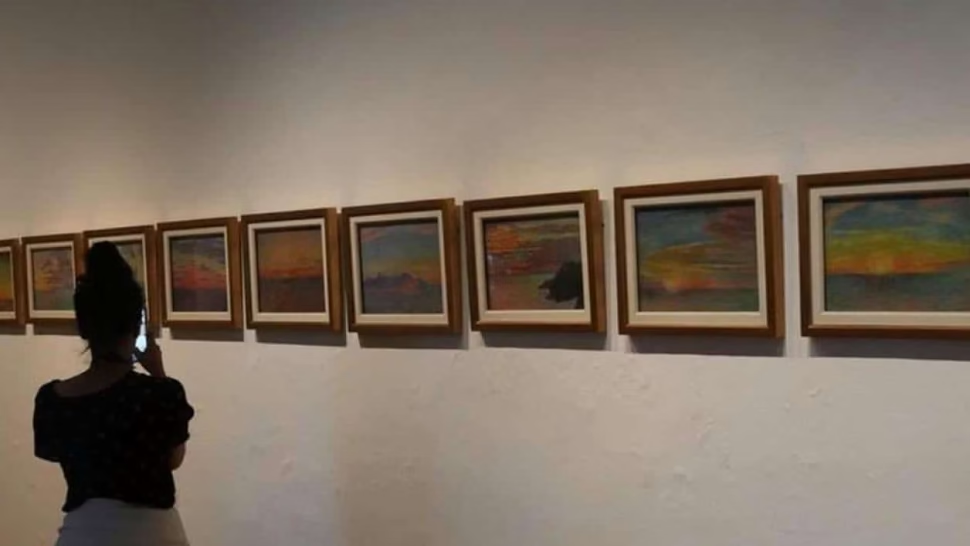
Among the exhibits he mentioned the Museo Templo Mayor about the Ball Game in Tenochtitlan, and the National Museum of Anthropology exhibits photographs by Annie Leibovitz about the 1986 World Cup. In Fine Arts, “Aztlán” is presented, Chicano art and muralism by Roberto Montenegro. In the Museum of Modern Art there are permanent collections and experiences such as Sunrises and Sunsets in archaeological zones of Tula, Xochicalco and Boca de Potrerillos.

Continue reading