Analysis of a Change in the American Political Climate
A meticulous investigation of the election results for Tuesday, November 5, 2025 reveals a profound political phenomenon: President Donald Trump has received a forceful warning from an electorate that perceives a palpable disconnection between official rhetoric and their collective fears about the national economic situation. This analysis is based on polling data in key races, which show a consistent pattern of rejection of Republican candidates and significant support for Democratic proposals, focused on immediate domestic issues.
The gubernatorial elections in Virginia and New Jersey, the New York City mayoral election and a referendum in California served as an accurate barometer of the national mood. In a notable turnaround from Trump’s re-election a year ago, the Democrats managed to expand their advantages and swept these contests, without a key Republican victory being able to be identified in any major race. This change of fortune indicates an evolution in the priorities of the voter, who initially supported the president with the promise of reducing inflation, reactivating manufacturing and generating wealth through tariffs.
The Economy as a Determinant Factor in the Vote
The evidence gathered from exit polls leaves little room for doubt. Economic anxiety emerged as the main driver of electoral behavior. In Virginia, about half of voters identified “the economy” as the top issue, and about 60% of this group supported Democratic candidate Abigail Spanberger, leading to her decisive victory. A similar pattern was seen in New Jersey, where Democrat Mikie Sherrill won about two-thirds of voters for whom the economy was the state’s top concern.
At the urban level, more than half of New York City voters considered the cost of living to be their priority issue, with Democrat Zohran Mamdani winning approximately two-thirds of this segment. In the state of California, nearly half of voters also placed the economy at the center of the debate, with two-thirds of them supporting Proposition 50. These data demonstrate widespread frustration with high grocery, utility and housing prices, factors that are eroding families’ purchasing power.
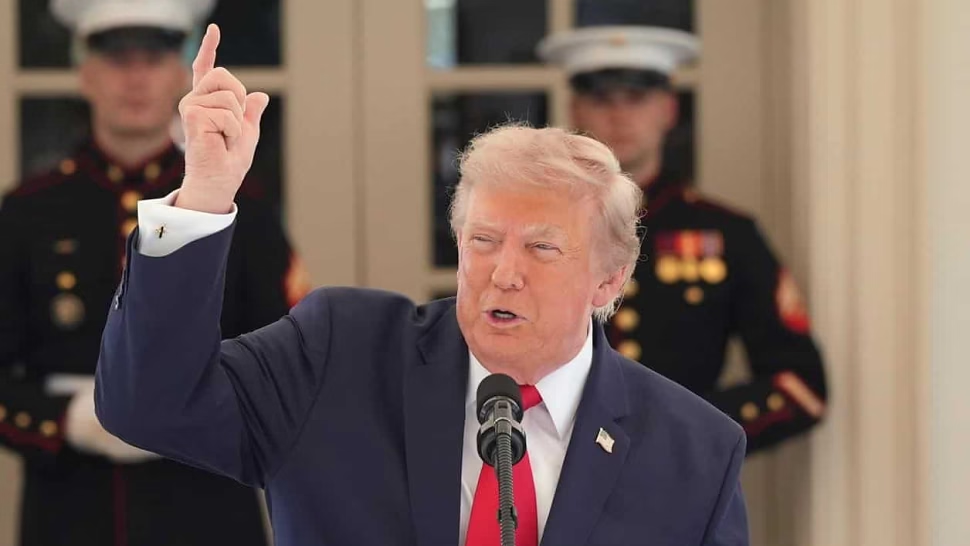
This reality contrasts markedly with the presidential speech. While Trump insists that he has strengthened the economy and proclaims the advent of a “golden age,” pointing to the stock market as an indicator of success, the public appears not to place confidence in these claims. The contradiction is exacerbated when considering that, although the stock market is booming and technology executives are making juicy profits, job hiring slowed down drastically during the summer after the implementation of Trump’s tariffs, a fact that does not go unnoticed by the common voter.
Consequences and Political Projections
The president’s reaction to these results has come under scrutiny. Initially, he chose to avoid any responsibility, highlighting on his social networks that “I WAS NOT ON THE BALLOT”. However, in a more reflective tone during a meeting with legislators of his party at the White House the next morning, he acknowledged: “Last night, it was not expected to be a victory.” This duality in the response illustrates the internal tension within the Republican party in the face of an adverse electoral scenario.
It is crucial to contextualize that these elections took place predominantly in areas that have recently favored Democrats, so a direct extrapolation to next year’s legislative elections must be made with caution. However, the magnitude of the Democratic margins of victory is a strong indicator of the degree of frustration with the economic conditions prevailing under the current administration. Trump, who once capitalized on populist discontent, has now become, as head of the executive branch, the face of that same discontent. The central question that emerges from this analysis is whether the administration will internalize the need to confront the inflationary challenges that plagued its predecessor, Joe Biden, or if it will persist in a narrative that the electorate, as evidenced, is beginning to question.
Do you agree with this analysis of the political panorama? Share this research on your social networks to encourage informed debate and explore more content related to economic trends and their impact on the public sphere.