
US tightens access to credit for undocumented immigrants

New banking guidelines tighten the financial fence on immigrants without legal status.

New banking rules against immigrants without status

Donald Trump’s government announced a new immigration tightening. Starting this Monday, banking regulators will issue guidelines for financial institutions to better monitor loans granted to people without work permits.

The Office of the Comptroller of the Currency, the Federal Deposit Insurance Corporation and the National Credit Union Association will remind banks and credit unions of their “know your customer” obligations. They will be recommended to more rigorously evaluate the applicants’ ability to pay, considering the risk that deportation will prevent them from meeting financial obligations.

RelatedThe SAT recovers 6.8 million with invitation letters

The federal government does not explicitly order closing accounts or denying credit. But he maintains that this group represents a greater risk due to the uncertainty about their permanence in the country. There is no precise data on how many people without legal status maintain accounts or credit in the US.

Measures that are already underway

This action is part of the executive order that Trump signed in May. He instructed regulatory agencies to review the citizenship and immigration status of bank customers in more detail. That same month, the Financial Crimes Enforcement Network (FinCEN) issued an advisory to detect possible identity theft, tax fraud and money laundering related to hiring people without work authorization.

Additionally, in November the Treasury Department announced that certain refundable tax credits will be considered federal public benefits. That would prevent some immigrant taxpayers from receiving them. Specialists warn that the measure could also affect beneficiaries of the DACA program and people with Temporary Protected Status (TPS).
Trump announces blockade and toll in the Strait of Hormuz

Trump reestablishes blockade in Hormuz and proposes charging ships for safe passage. Iran rejects and warns of retaliation.

Trump announces blockade and toll in the Strait of Hormuz

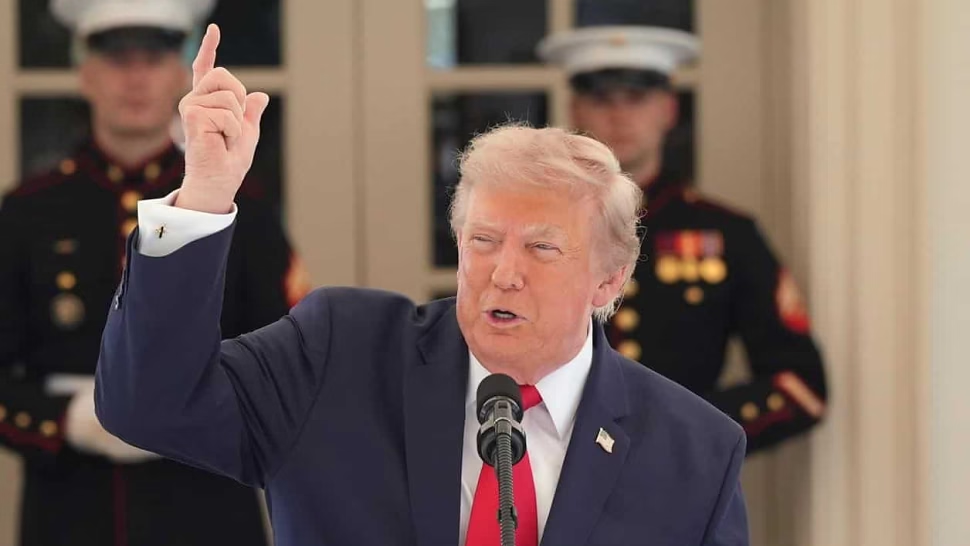
US President Donald Trump announced that his government will reestablish a blockade on Iran in the Strait of Hormuz. It also plans to charge foreign ships 20% of the value of the cargo for safe passage. This is a change in the position of Washington, which previously defended free navigation without tolls on this key route for the global hydrocarbon trade.

Trump assured on social networks that the United States will guarantee security in the strait and will recover the costs through this charge. Iran rejected the proposal. It maintains that it has the right to manage traffic under the interim peace agreement signed last month. He warned that he will respond to any US interference.

The announcement occurs amid a military escalation. The US military bombed dozens of Iranian targets – air defense systems, radars, missiles, drones and naval facilities – in response to an Iranian attack on a container ship. Tehran reported bombings in several provinces and confirmed at least two people dead.

The tension spread to neighboring countries. Bahrain activated missile alerts. Kuwait reported attacks on border facilities and an oil platform. Jordan reported that it intercepted four Iranian missiles. There were also actions with drones in Iraqi Kurdistan, without a group claiming responsibility so far.

The International Maritime Organization reiterated that there is no legal basis for imposing mandatory tolls in an international strait. Meanwhile, diplomatic efforts led by Qatar, Egypt and Pakistan continue to avoid a full-scale war.

Iran blamed the United States for the deterioration of regional security. He announced that he will not allow inspections by the International Atomic Energy Agency at previously bombed nuclear facilities.

Continue reading

Ukraine loses its main ally in the US Senate

The death of Senator Graham weakens the main bridge between kyiv and Washington.

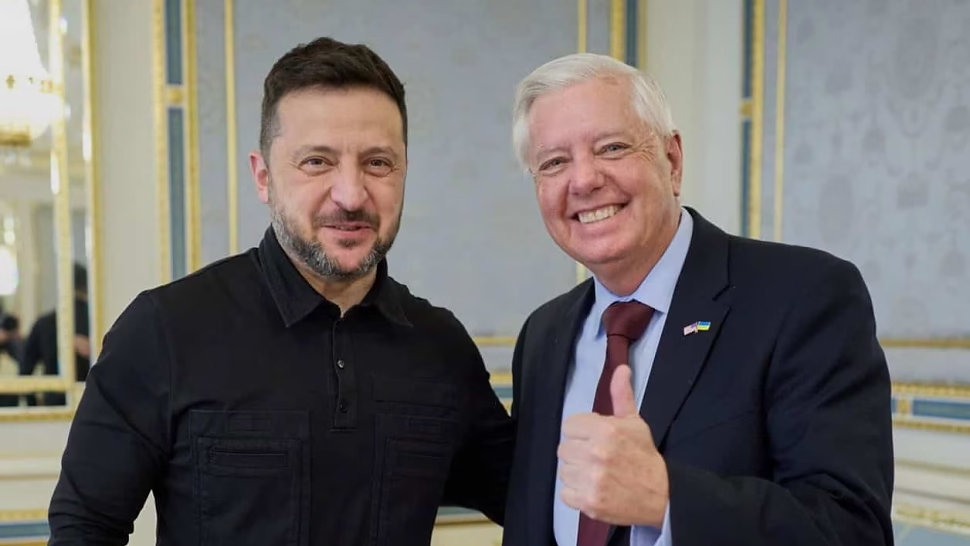
The death of Republican Senator Lindsey Graham represents a severe setback for Ukraine. kyiv loses one of its biggest defenders in Washington, a figure with direct access to President Donald Trump. Ukrainian lawmakers and officials expressed concern about the impact his absence will have on the bilateral relationship, at a critical time in the war with Russia.

Graham visited kyiv just two days before his death. There he assured that a new package of economic sanctions against Russia was close to being finalized. The initiative, promoted together with Democratic Senator Richard Blumenthal, sought to increase pressure on Moscow. Graham hoped to gain congressional support upon his return.

Reactions and legacy

President Volodymyr Zelenskyy deeply mourned the loss. He recalled that they maintained a constant dialogue and that Graham visited Ukraine ten times since the beginning of the Russian invasion. Other officials called him an unwavering friend and a staunch defender of the Ukrainian cause.

Analysts believe that its disappearance could weaken Ukraine’s ability to influence the Trump administration. Graham was seen as the main bridge between Zelenskyy and the US president, especially given the uncertainty about the future of US military and economic support.

Despite his closeness to Trump, Graham maintained firm positions in favor of Ukraine, NATO and a policy of greater pressure against Russia. His allies in the Senate, including Blumenthal, indicated that they will seek to move forward with the sanctions package as a tribute to his legacy. Graham’s death is not only a personal loss for many in Ukraine, but it raises questions about American support at a decisive moment in the conflict.

Continue reading

Shooting by ICE agent in Maine leaves one dead

Young Colombian with a work permit dies in an ICE operation in Maine.

The incident in Biddeford

An immigration operation in Biddeford, Maine, ended in tragedy this Monday. An ICE agent shot a driver who, according to authorities, tried to run over the officers during an attempted deportation arrest.

The man was identified by civil organizations as a 26-year-old Colombian citizen. He had a work permit and Social Security number. His family claims that he was on his way to work when the incident occurred and demands a transparent investigation.

Senator Angus King reported that the Secretary of Homeland Security explained that the driver used his vehicle as a weapon when trying to escape. The officers were not wearing body cameras, which will make it difficult to clarify whether the action was justified. The FBI is already investigating the facts.

Hours later, dozens of demonstrators gathered near the site to protest against the Trump administration’s immigration policies. With banners, they condemned the use of force in operations and called for a stop to mass deportations.

This is the second case in a week in which an ICE agent used deadly force. The fact revives the debate about transparency and accountability in this type of operations.

Continue reading