The AICM launches security and speed for May

Semar announces that the renovation of the AICM will conclude in May, with cutting-edge technology to speed up the flow of passengers.

The big change for AICM comes in May

The Secretary of the Navy has just set a date. The remodeling of the Mexico City International Airport will be ready in mid-May. It’s not just graffiti. We are talking about a profound change in safety and efficiency.

Admiral Ramón Lara, head of the Task Force for the 2026 World Cup, was clear. new security filters and 40 autonomous immigration filters will be installed. This, they promise, will speed up passenger movement by 50%.

RelatedThe AICM registers a contraction of passengers for the second consecutive year

But there is more. Inspection with x-ray vision will be key. It will allow scanning 100% of cargo and logistics access. The objective is clear: to protect the airport against prohibited substances and dangerous devices.

“With the support of artificial intelligence, to the extent that all these technological implementations take place in the coming months, the dynamics and mobility of passengers will be favored with efficiency and modernity,” said Admiral Lara.

Technology that changes the experience

Modernization is a strong commitment to digital. 3,240 cameras will be installed with advanced systems:

  • Analytics and algorithms
  • Facial recognition
  • Behavioral patterns

In terminals 1 and 2, lounges, hallways and key areas such as immigration and baggage claim have already been remodeled. Work is also being done in the parking lots to avoid the dreaded bottlenecks.

Even the fast food area is undergoing transformation. They improve the architectural image and redistribute spaces for greater comfort.

Road reorganization is also advancing. They are building a new parking lot near Fuerza Aérea Avenue and three taxiways to speed up operations on the runway.

The admiral’s final message was forceful: the AICM will be ready from mid-May. The countdown to a faster, safer and more modern airport has already begun.

Sheinbaum announces 42 CT scanners and telemedicine to strengthen health

The president detailed investments in medical equipment, telemedicine and improvement of clinics.

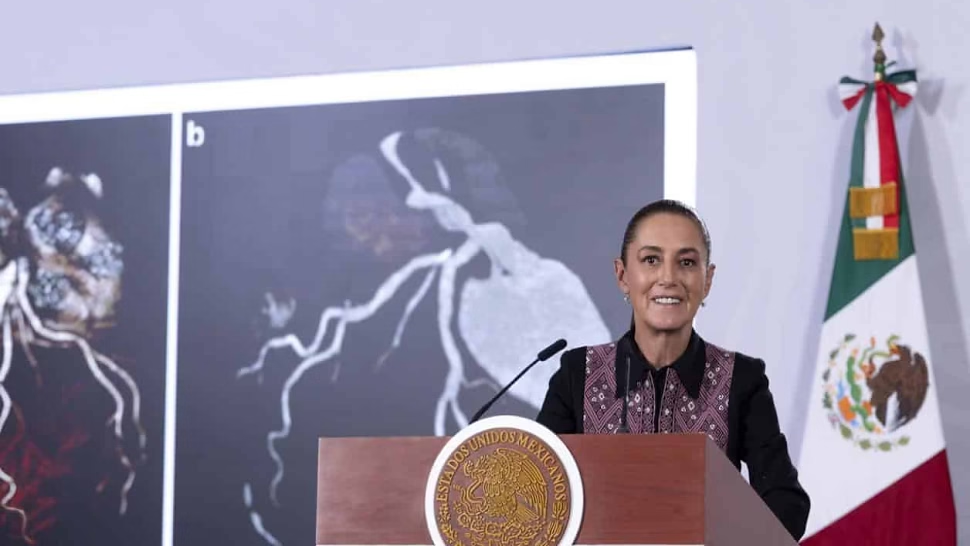
President Claudia Sheinbaum reported on advances in the public health system, with investments in equipment, telemedicine and improvement of clinics. He affirmed that the State must guarantee access to health from prevention to care for complex diseases.

“We are compensating for the profound damage that neoliberalism caused in the health system,” he said at the morning conference.

Equipment and telemedicine

The IMSS installed 42 state-of-the-art CT scanners in 40 hospitals in 19 states. Of these, 41 are from 256 cuts. They allow early detection of tumors and bleeding, perform up to 50 studies per day and reduce waiting times. They were acquired for 29 million pesos each, below the 40 million in the past.

The ISSSTE expanded telemedicine from 239 to 859 units. It offers consultations in 15 specialties, such as cardiology and dermatology, from 118 second and third level units to 741 first level.

The Clinic is Ours

The La Clínica es Nuestra program delivered 4,608 million pesos in 2025 to 8,483 medical units, with the participation of 67,864 people. 42 thousand improvement actions were carried out in infrastructure and equipment. The 2026 call will begin in July, including for the first time 153 units from Yucatán with 80 million pesos.

Sheinbaum added that progress is being made in the House to House Health program, with more than 20 million consultations with older adults and people with disabilities. Starting in August-September, you will be able to collect medications at Farmacias del Bienestar, health centers and a network of pharmacies. Next year the Universal Health Service will begin with a single credential.

Continue reading

Massive security reinforcement and alcohol ban at the Azteca

56,000 police officers and alcohol restriction for the game at the Azteca.

Measures for the Mexico-Czech Republic match

The government of Mexico City announced an unprecedented security operation for this Wednesday’s game at the Azteca stadium. 56,000 personnel will be deployed, five times more than the 11,219 employed last week.

The decision responds to the celebrations of the previous Thursday, when some 700,000 people gathered in the capital after Mexico’s victory over South Korea. Although there were no injuries, nearly 40 tons of garbage were collected in the Ángel de la Independencia and the Zócalo.

The Secretary of Security, Pablo Vázquez, detailed that 7,500 police officers will guard the Azteca stadium. Another 3,275 will be in the Zócalo and 4,200 on Reforma Avenue. The objective is to protect players, referees, authorities and fans.

In addition, the Secretary of Government, César Cravioto, reported that starting at 3 p.m. on June 24, a ban on the sale of alcohol will take effect for sixteen hours. Applies to the Historic Center and five neighborhoods of Cuauhtémoc.

Sales will only be allowed in restaurants, hotels and private clubs, accompanied by food. Convenience stores and supermarkets are excluded. The fines for non-compliance amount to up to 293,275 pesos (about $17,251).

The Mexican Alliance of Transporters Organization (AMOTAC) called for mobilizations on highways in the 32 states and blockades in the capital to protest against the violence. The operation also considers these protests.

Continue reading

UNAM, new WHO collaborating center in oral health

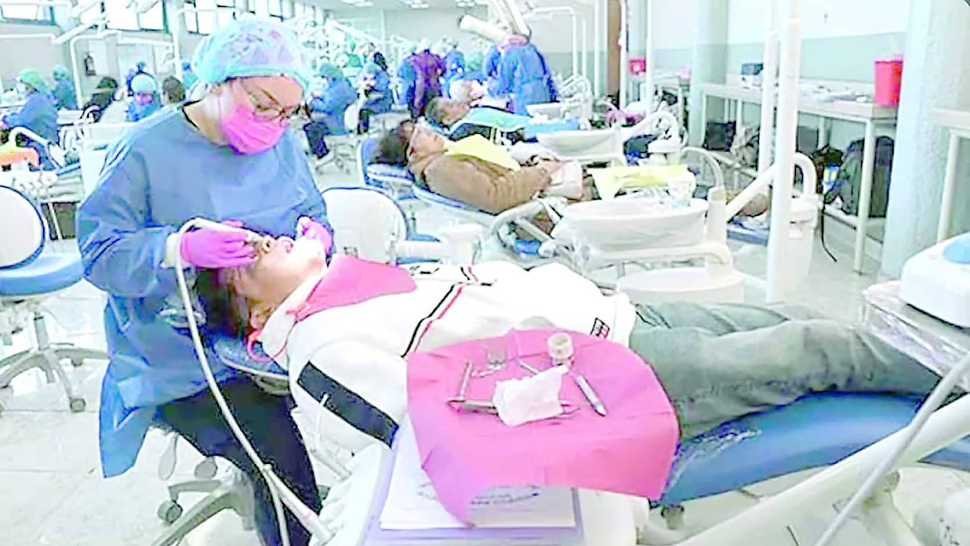
The WHO recognizes UNAM as a reference in oral health and aging.

International recognition for UNAM

The World Health Organization (WHO) designated the Department of Oral Public Health of the UNAM Faculty of Dentistry as a Collaborating Center in Oral Health and Aging. The distinction is valid for four years.

With this appointment, the highest educational institution consolidates itself as a regional reference in the comprehensive care of older adults.

Implications of the appointment

The recognition will allow university specialists to participate in the development of public policies focused on improving the quality of life of the elderly.

In addition, they will promote strategies to promote among older adults and caregivers the importance of maintaining adequate oral health as an essential part of general well-being.

The designation places UNAM on a level of technical cooperation with the WHO, which opens opportunities to influence global guidelines on aging and oral health.

Continue reading