Congress decides that minors should be sleepy and bored, as God intended
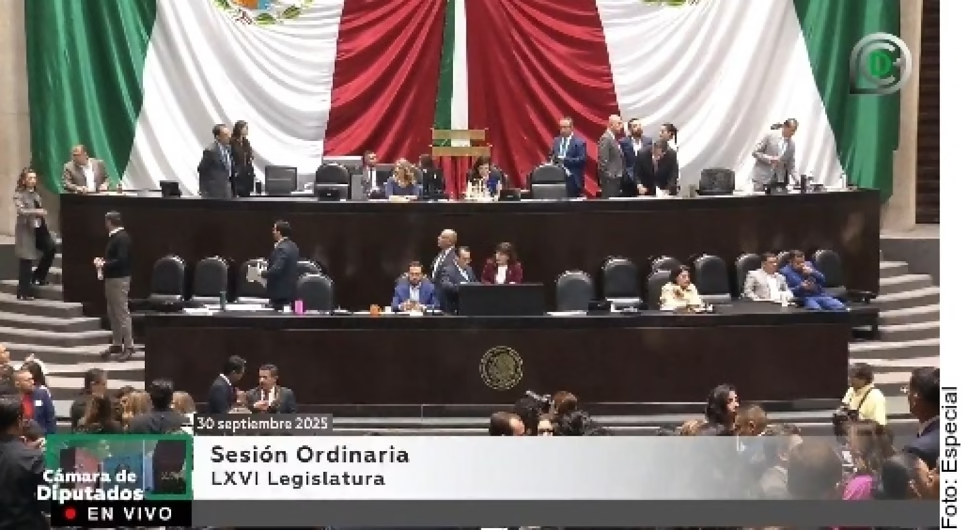
In an act of legislative paternalism that would make any sleepy teenager blush, the plenary session of the Chamber of Deputies has decided that minors can no longer intoxicate their fragile organisms with those modern elixirs known as energy drinks. With a suspicious unanimity of 401 votes—did they all drink coffee from the same coffee shop?—our representatives approved a reform to the General Health Law that, basically, tells businesses: “If you sell a Red Bull to a kid, we will fill your wallet with more than 226 thousand pesos.” A figure painful enough to keep anyone awake at night, with or without caffeine.
The jewel in the crown, proposed by the dynamic duo of Ricardo Monreal (Morena) and José Luis Fernández (PVEM), included a strategic reserve worthy of a war treaty. It turns out that the ban will not be for any liquid with bubbles and an aggressive logo, but only for those drinks that the Secretary of Health determines, in its infinite wisdom, as “high risk” for minors. In other words, the government reserves the right of admission on how fast-paced young people can get. They have 180 days to decide which ingredients turn a drink into a passport to tachycardia, a period that, ironically, is more than enough for a college student to graduate drinking the drink that they will soon no longer be able to legally purchase.
The art of selling illusions (and very expensive fines)
The reform, which is now sleeping the sleep of the righteous in the Senate, is not only dedicated to prohibiting, but also empowers the health bureaucracy to classify substances that produce stimulant effects. We’re talking about the usual suspects: caffeine, taurine, glucuronolactone and other compounds with names that seem straight out of a witchcraft manual. The establishments, for their part, will have the noble task of becoming age detectives, verifying official identification with the same meticulousness with which a voting card is requested in a canteen. Because, clearly, the greatest danger for a teenager is not alcohol alone, but the explosive mixture with an energizer, a cocktail that, according to experts, generates a “shock to the nervous system.” It sounds like a sci-fi movie, but apparently it happens at parties every weekend.
But what would a good law be without exemplary sanctions? Failure to comply will be punished with fines of up to two thousand UMA, which translate into the handsome sum of 226,280 pesos. A figure that, thinking about it, could buy so many cans of energy that would probably be enough to keep the entire Chamber of Deputies awake during a marathon session. Deputy Monreal, in a burst of clarity, declared that this measure responds to one of the “most worrying demands of parents.” Because, of course, between the climate crisis, insecurity and the economy, what really keeps parents awake at night is when their 17-year-old son drinks a Monster before playing video games.
Deputy Amancay González Franco, for her part, enlightened us with a list of the havoc caused by these drinks: from the classic tachycardia and insomnia to heart attacks and strokes. Come on, they sound almost as dangerous as listening to a political speech at 3 in the morning. And in case anyone doubted it, he dropped the bomb: 300 thousand young people consume one of these drinks a day. A terrifying statistic, suggesting that there is an epidemic of youth drowsiness that can only be cured with stimulant chemicals. He acknowledged, however, that they are popular among exploited students and workers with long hours. Could it be that the solution is not to prohibit drinking, but to regulate the work hours that force people to need them? Nah, let’s make a law instead.
And the conspiratorial touch could not be missed: he denounced that the production companies tried to stop the reform. What a surprise! Companies that sell expensive caffeinated liquid don’t want their market restricted. It’s almost as if they like to make money. But the juiciest fact is that 43% of consumers mix them with alcohol, a practice so Russian that, indeed, it is already prohibited in Russia. The deputy is already envisioning the next step: prohibiting that mixture here as well. Because, apparently, the Mexican citizen cannot be trusted with a vodka-Red Bull, but they can be trusted with electing their rulers. The irony is delicious.
To finish off the show, PAN member José Mario Iñiguez came out to say that legislating on this matter is an “act of social responsibility and justice.” Of course, because putting the well-being of children before commercial interests sounds very laudable, especially when it is done with the same fanfare with which a new department store is announced. He agreed that there is aggressive propaganda aimed at minors that links these products with high-performance sports and healthy fun. It’s true, it is advertising that is as misleading as the one that promises that a politician will solve all your problems. And, of course, he called for awareness campaigns. Because nothing says “protect the children” like a government brochure competing against a TV ad featuring a famous athlete.
In short, our representatives have decided that it is easier to ban energy drinks than to deal with the structural causes that lead people to consume them. A quick, media-friendly solution that allows them to appear as the heroes who protect innocent youth from the evil elixirs of modernity. Of course, with fines that ensure that businesses take it seriously. Because, at the end of the day, nothing motivates compliance with the law more than the fear of a financial penalty that hurts more than a Friday night hangover.
Were you amused by this wry look at the new legislation?Share this scathing analysis on your social networks and help more people laugh while they’re informed.Explore more content about the absurd and fascinating decisions of our legislators on our site.