Deputy denounces Cuauhtémoc Blanco for harassment in session

A complaint for an inappropriate gesture in the legislative chamber unleashes an ethical conflict and exposes the institutional culture.

The day politics became more intense than an episode of ‘House of Cards’ neighborhood version

It seems that Congress decided to change the script of the ordinary session for one with a little more drama. In what could be described as a crossover between a legislative debate and an awkward moment at a family gathering, PT MP Martha Aracely Cruz Jiménez took the microphone and dropped the bomb: she accused none other than Cuauhtémoc Blanco of being misogynist. Yes, the same one who previously made us scream with excitement with his goals and now makes us scream with… well, dismay. The matter was so serious that the complaint ended up at the table of the Ethics Commission, because apparently, attitudes are creeping into the premises that have no place even in a family WhatsApp group.

The congresswoman, with a seriousness that any of the protagonists of ‘The Crown’ would have loved, asked to speak from her seat to make a public complaint that left more than one person not knowing whether to take notes or look for a place to hide. “To report an act of harassment in this facility,” he began, with the calm of someone who is about to reveal a fact that could literally change the work environment of the place. “Today I am forced to raise my voice to denounce an event that not only affected me, but also reflects a much deeper problem in our institutional culture.” Come on, this was not a simple out-of-place comment, but rather what seems to be the tip of the iceberg of an environment that needs urgent renewal, something like moving from the era of faxes to the digital cloud.

RelatedCuauhtémoc Blanco misses legislative session for playing paddle tennis

When a gesture becomes the protagonist of a national debate

But what exactly happened? According to the deputy, in the full exercise of her duties – that is, while she was trying to work like any other mortal – she was subjected to what experts call symbolic and sexual violence. The action in question? The simulation of a kiss. A gesture that, in other contexts, could seem harmless, but that in a space of power like the legislature becomes a clear form of sexual harassment. Because, let’s be honest, in 2025 we should already be clear that a simulated kiss at work is not comparable to a funny meme; It’s an invasion of personal space that many try to minimize with “it was just a joke.” Spoiler alert: no, it wasn’t.

This incident not only highlights the fragility of anti-harassment protocols in political circles, but also opens a necessary debate about how certain behaviors are normalized in environments traditionally dominated by sexist dynamics. Martha Cruz’s complaint is not a simple personal claim; It is a call to attention about an institutional culture that allows these types of actions to be repeated without consequences. And while the Ethics Commission analyzes the case, society observes whether institutions are really prepared to face these challenges or whether they will continue to act as if we lived in a time where these attitudes were “acceptable.”

The situation with Cuauhtémoc Blanco, who has gone from being a sports idol to a controversial political figure, exemplifies how power and fame sometimes cloud the limits of basic respect. This event, far from being an isolated event, is part of a series of global discussions about gender equality and respect in public spaces. The authorities’ response will not only define the future of this specific case, but will send a clear message about whether Mexican policy is evolving or remains anchored in obsolete practices. For now, everything remains in the hands of the commission, while we, as viewers, wonder: will the day come when this news is a thing of the past?

Are you surprised by these types of situations in politics? Share this note on your social networks to raise awareness and continue exploring our content to stay informed on the topics that really matter.
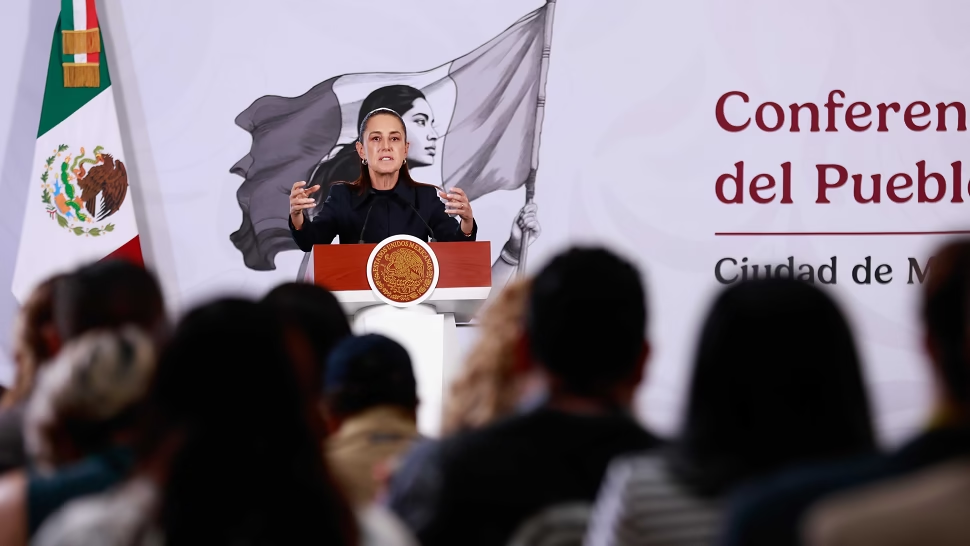
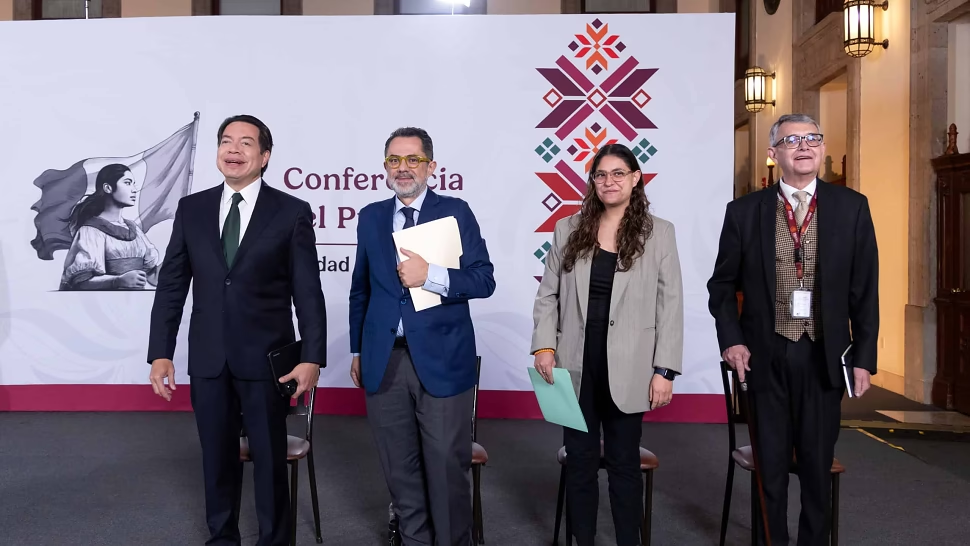
Sheinbaum calls for unity in the face of violations of the rights of Mexicans in the US.

President calls on parties and society to reject violations of the rights of fellow citizens.

Sheinbaum calls for national unity

President Claudia Sheinbaum asked all political parties, Congress and Mexican society to join in rejecting the violations of the human rights of fellow citizens in the United States. He reported that this Monday the Ministry of Foreign Affairs (SRE) will present formal complaints for the death of 17 Mexicans linked to actions of the Immigration and Customs Enforcement Service (ICE).

“This is an issue not only for the Government of Mexico… I call on all political parties, everyone, the entire society… to be in solidarity with our fellow citizens in the United States. I don’t think anyone would like this situation,” he declared at the morning conference.

The president also reported contact with the US ambassador Ronald D. Johnson, who was receptive to the Mexican position. Foreign Minister Roberto Velasco Álvarez communicated the legal actions to be taken and Johnson perceived the concern of the Government of Mexico.

Sheinbaum clarified that a bilateral conflict is not sought, but maintained that it is necessary to raise our voice in the face of human rights violations. He called on the Permanent Commission of the Congress of the Union so that all parties, without exception, present requests for information and show their rejection.

Continue reading

Historic investment of 59 thousand million pesos in schools by 2026

The federal government will invest 59 thousand million pesos in schools, benefiting 71 thousand schools.

President Claudia Sheinbaum announced a historic investment of nearly 59 billion pesos for educational infrastructure in 2026. The resources will be channeled through the School is Ours (LEEN) program and the Multiple Contributions Fund (FAM).

“Historical investment of 59 billion pesos for schools in the country, without considering what the federal entities invest directly,” he pointed out in the morning conference.

The Secretary of Education, Mario Delgado, detailed the distribution: 37,715 million pesos for basic education (15,021 million pesos direct and 22,694 million pesos from LEEN); 10,916.4 million pesos for upper secondary education, which includes the creation of 156,240 new places through new National Baccalaureates; and 9,783.9 million pesos for higher education in schools such as the Rosario Castellanos University and TecNM.

In addition, the year closes with 22 million scholarship recipients at all educational levels, according to the official.

The School is Ours reaches more than 71 thousand schools

The general director of LEEN, Pamela López, reported that this year 71,482 schools were served with a social investment of 22,694 million pesos. Resources are allocated according to vulnerability, marginalization and social backwardness. The program covers from Multiple Care Centers to high schools, with full coverage in middle and high schools.

“All these achievements have been possible thanks to the participation of mothers, fathers, teachers, who make up the school communities,” said López.

Continue reading

Mexico sends 388 tons of aid to Venezuela after earthquakes

Semar vessels complete eight-day journey with supplies and water treatment plants.

Humanitarian aid from Mexico to Venezuela

The logistical support vessels ARM Isla Holbox and ARM Huasteco docked at the port of La Guaira, Venezuela. They carry assistance sent by the Mexican government for the victims of the June 24 earthquakes. The phenomenon left thousands of people dead and injured.

The Secretary of the Navy (Semar) reported that the mission was ordered by President Claudia Sheinbaum. It is part of Mexico’s commitment to international cooperation in the face of natural disasters.

What does the cargo include?

The boats sailed eight days through the Caribbean. They transported 388.4 tons of aid: food, bottled water, medicines, personal hygiene items and medical supplies. They also have four water treatment plants, each capable of generating a thousand liters of purified water per hour. The journey covered 1,969 nautical miles, equivalent to more than 3,600 kilometers.

Naval participation

One hundred elements of the Navy Emergency Response Brigades will participate in the disembarkation, installation and operation of the water treatment plants. They will also collaborate in the distribution of support together with local authorities.

Semar highlighted that the immediate emergency has already been overcome, but recovery actions continue to restore essential services in the affected communities. The operation was possible thanks to the coordination between the government, companies, foundations and civil organizations. Mexico thus reaffirms its policy of international solidarity in the face of disasters.

Continue reading