Deadly rains leave 47 dead in five Mexican states

The tragedy strikes five states while the government mobilizes a massive operation to address the emergency and search for missing persons.

Nature Bowls with Five States and the Score is Desolate

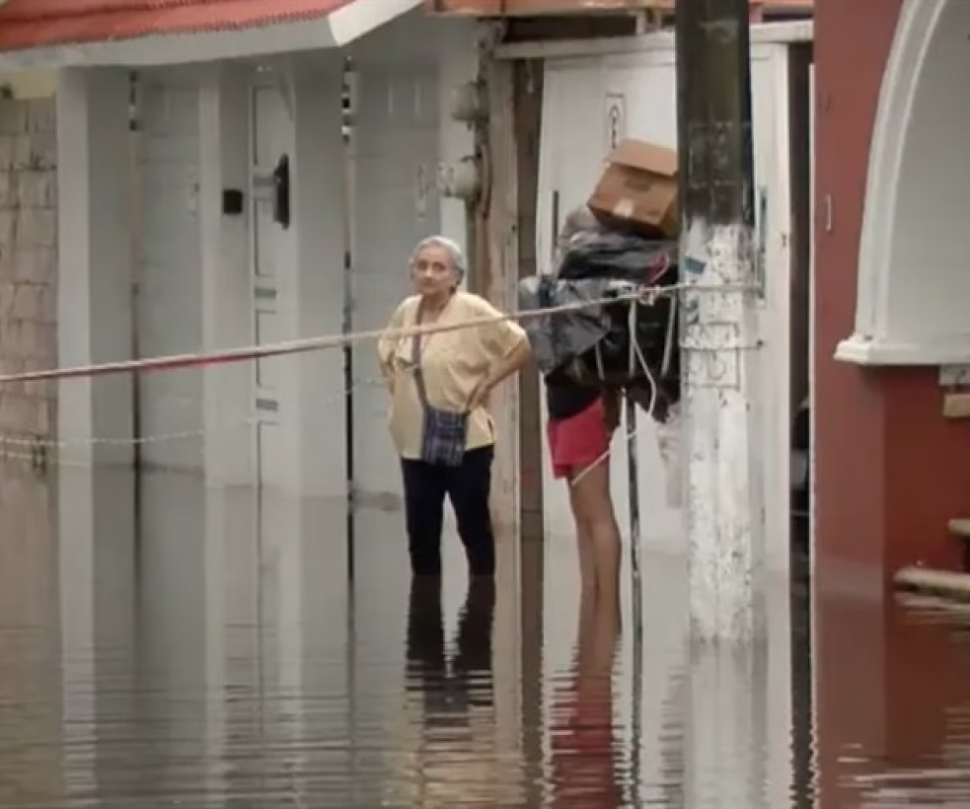
It seems that Tropical Disturbance 90-E, such a technical and cold name for such a visceral phenomenon, decided that October 6-9 was the perfect time to unleash its wrath on eastern Mexico. The result, as if it were a macabre game, is a toll of 47 people dead. Because nothing unites a country more than a natural tragedy that shows, with cruel irony, how unprepared we are always for the predictably unpredictable.

And on this gloomy podium of misfortune, the prizes are distributed with a logic that only chaos understands: Veracruz takes the gold medal with 18 deaths, Hidalgo the silver medal with 16, and Puebla completes the trio with 12. Querétaro and San Luis Potosí, for their part, contribute their own doses of pain to round this figure that will surely remain a “preliminary number” until it stops being news. Does anyone bet on when it will stop being so?

RelatedTorrential rains in Mexico leave 47 dead

The Great Theater of Aid: Statistics to the Rescue

Faced with this bleak panorama, the Federal Government has come to the fore with the speed of a bureaucrat in a marathon. They inform us, with the solemnity of a war report, that at the instruction of President Claudia Sheinbaum, an operation has been deployed that looks like the cast of an action blockbuster, but instead of explosions, there is mud. A lot of mud.

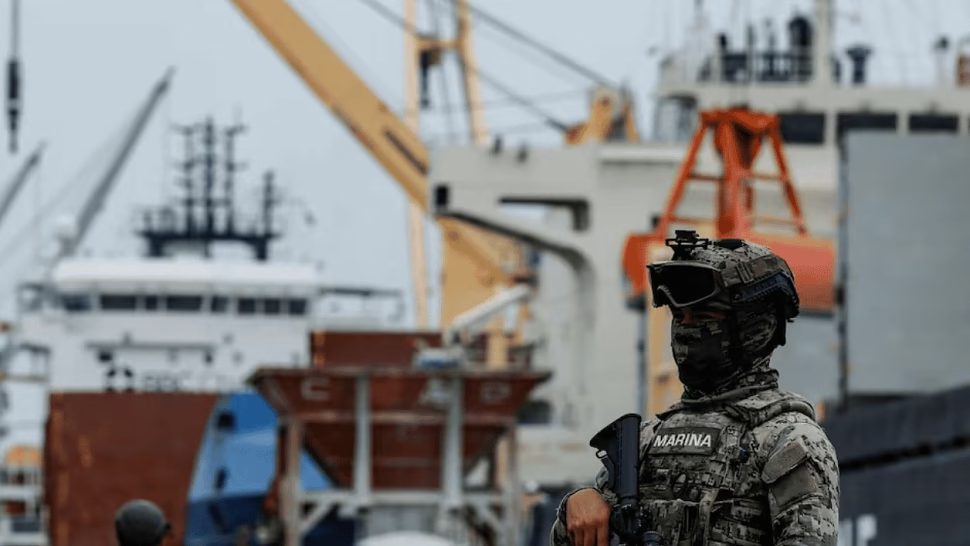
In Veracruz, the hardest hit state where there are not only deaths but also six people who, with a euphemism worthy of a thriller, are called “not located”, the spectacle of aid unfolds. The National Defense and the National Guard add up to an impressive battalion of 1,810 uniformed personnel. Their mission: clean homes, remove debris and, supposedly, provide security. One wonders if such force would not be more useful *before* the catastrophe, but that is perhaps too cynical a reflection even for this narrator.

Meanwhile, Semar is not far behind in this military popularity contest. It deploys 1,686 elements in Poza Rica and Álamo, boasts of having helped 3,405 people, and has distributed water and food supplies as if they were candy in a parade. They have freed roads, collected garbage and have even removed billboards that, apparently, had a strange attraction for obstructing roads. All this seasoned with the surreal detail of having “mobile kitchenettes” – because nothing says “we are in an emergency” like a government food truck – and a motorized bilge pump whose name suggests that they faced a particularly stubborn puddle.

The Map of Pain Spreads: Everyone Plays, Everyone Loses

The function does not end in Veracruz. In Puebla, with its 12 deceased and 15 people in the disturbing category of “not located”, they have joined the choreography of the troops. The Defense and the National Guard present a combo of 2,140 souls dedicated to cleaning, removing debris and moving people. It’s comforting to know that, in the midst of the chaos, someone is counting the numbers so accurately.

Hidalgo, with 16 dead, receives the promise of 200 Semar elements “on arrival.” A phrase that evokes the image of a ship sailing calmly towards disaster, slowly but surely. Meanwhile, San Luis Potosí boasts its “white balance“, a term that sounds like a pyrrhic victory when talking about natural disasters, as if nature had done them the favor of being less lethal there. For its part, Querétaro reports one death and some 150 homes affected, reminding us that in the lottery of tragedy, there is no completely white ticket.

And so that no one is left with any doubt about the state’s logistical power, the arsenal deployed is detailed: seven aircraft, 31 heavy machinery, 21 dump trucks, 6 tractor-trailers and 11 boats. It sounds like the fleet with which you could invade a small island, but in this case, its heroic mission is cleaning, clearing and sanitizing. Because if a family that has lost everything needs something, it is to have a damp cloth wiped over what was their house.

This Sunday, they tell us, these tasks were “intensified.” What a relief, we thought they were going to wait for it to magically dry. The final objective, they say, is to “channel support in a timely manner.” A phrase as full of good intentions as it is administrative vagueness, leaving us all hoping that “timely” means something more than a well-written press release.

The federal, state and municipal forces continue to be deployed, they assure us. News that, without a doubt, is a balm for those affected, who surely appreciate the company of so many troops while they contemplate what the water took away. In this great theater of absurdity that is sometimes confronting a natural force with pure bureaucracy and numerical reports, the only thing left to do is hope that the help is as efficient as the accounting of the victims is.

Are you moved by this example of how institutional brute force confronts the brute force of nature? Don’t stay with the drama. Share this chronicle of the surreal on your social networks and help us get more eyes to see the sometimes hilarious and sad spectacle of disaster management. And of course, explore more related content to continue fueling your informed skepticism.

12 locomotives arrive at the Mayan Train for cargo service

Twelve locomotives begin loading operations on the Mayan Train starting in January 2027.

12 locomotives arrive at the Mayan Train

President Claudia Sheinbaum announced in Puerto Morelos, Quintana Roo, the arrival of the first 12 locomotives for the Mayan Train cargo service. These units are currently used to transport materials for the consolidation of the project’s infrastructure.

The train will strategically connect five entities in the southeast: Campeche, Chiapas, Tabasco, Quintana Roo and Yucatán. Sheinbaum announced that commercial cargo operations will formally begin in January 2027, which he described as an economic trigger for the region.

The Secretary of National Defense, Ricardo Trevilla Trejo, participated in the event; the secretaries of Tourism, Josefina Rodríguez Zamora, and of Culture, Claudia Curiel de Icaza; as well as the governors of the five entities. Also attending were the directors of the Trains and Integrated Public Transport Agency, Andrés Lajous Loaeza; from the National Tourism Promotion Fund, Sebastián Ramírez Mendoza; and from INAH, Joel Omar Vázquez Herrera, along with representatives of Grupo ICA and Grupo INDI.

The president highlighted that Sedena contributes to logistical development through the engineering and operation of projects of this scale. The arrival of these locomotives represents a significant step to improve connectivity and boost economic and tourism development in the southeast.

Continue reading

Sheinbaum flight to New York canceled due to adverse weather

Sheinbaum's flight to New York is canceled due to weather and fire smoke.

Cancellation due to weather conditions

Delta commercial flight 2973, where President Claudia Sheinbaum would travel to New York, was canceled Saturday afternoon at the Cancun Airport. Originally scheduled at 3:40 p.m., it had a first delay until 5:25 p.m. before the final suspension.

According to airport authorities, the cancellation responds to adverse weather conditions and poor air quality in New York, derived from recent forest fires.

Sheinbaum confirms attendance

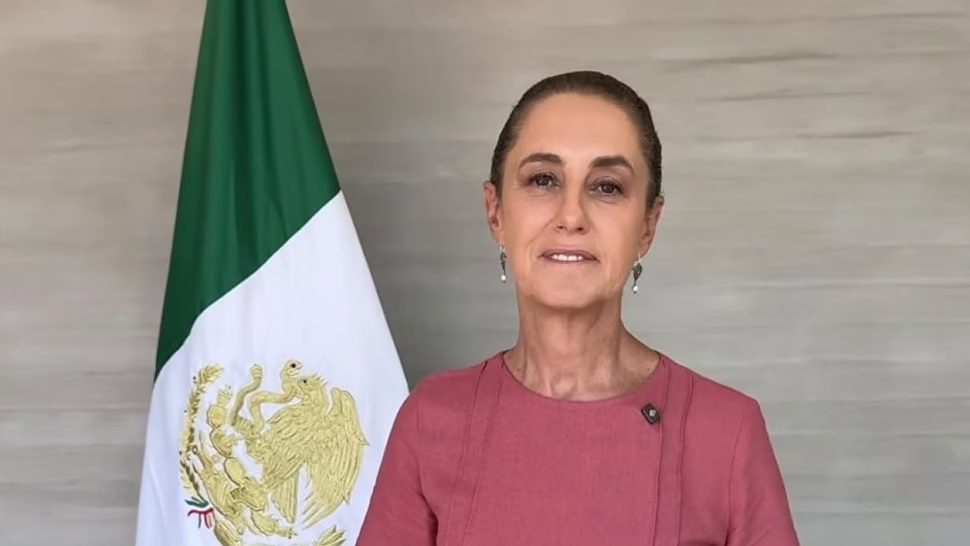
Despite the setback, Sheinbaum published a video on his social networks confirming his presence in the World Cup final this Sunday at the New York-New Jersey Stadium. In the message, he highlighted the diplomatic nature of his trip: he will attend at the invitation of President Donald Trump and will coincide with Canadian Prime Minister Mark Carney.

The president reiterated that the meeting of the three heads of state reflects the coordination between the co-organizing nations of the tournament, where Spain and Argentina will compete in the championship.

So far, the Presidency has not reported whether Sheinbaum will use an alternative commercial route or an armed forces aircraft. The official delegation maintains the return to Mexico City for Monday.

Continue reading

Tamaulipas: the center of the fiscal huachicol that drained the treasury

Tamaulipas is the epicenter of fuel smuggling from the US to Mexico, with corruption in customs and links to organized crime.

Fuel smuggling from the United States to Mexico, which grew during the six-year term of Andrés Manuel López Obrador, has a clear epicenter: Tamaulipas. At its customs, sailors and soldiers were corrupted, charging millions for allowing millions of liters to pass through. Sergio Carmona, The king of huachicol, and also Roberto Blanco Cantú, The lord of the ships, a fugitive from justice, were originally from Tamaulipas. The Metros, a faction of the Gulf Cartel now linked to the CJNG, operate from there. In that entity, prosecutor Ernesto Vásquez Reyna was killed after a fuel seizure. The Financial Crimes Enforcement Network reported $7 billion in suspicious activity in the last year.

The criminal network at customs

A EL PAÍS database, combining confidential reports and foreign trade statistics, reveals that of the 2.8 billion liters of lubricants imported since 2019, almost 2,700 entered through the customs of Tampico, Matamoros, Altamira, Nuevo Laredo and Ciudad Reynosa. In March 2025, the oil tanker Challenge Procyon arrived in Tampico with alleged additives; It was actually transporting fuel. The search led to the seizure of 10 million liters of diesel, 192 containers and 32 vehicles. This case uncovered a conspiracy that united high-ranking sailors, customs officials and businessmen, managing to smuggle at least 564 million liters in 69 ships since 2023. The Prosecutor’s Office points to Fernando and Manuel Roberto Farías Laguna, political nephews of former Secretary of the Navy José Rafael Ojeda Durán, as ringleaders.

Collaborators and leaks

Mefra Fletes, a company that distributes trafficked fuel, had Roberto Blanco Cantú as a partner since 2019. One of his pipes took the police from the Challenge Procyon to a property in Altamira where they found the millions of liters. Blanco Cantú has been a fugitive since September 2025, when another arrest warrant was issued against eight people linked to that firm. In addition, three high-ranking soldiers are fugitives accused of allowing, from Matamoros customs, the smuggling of 144 million liters between June 2024 and July 2025. Internal documents from Sedena, leaked in the Guacamaya Leaks, indicate that the Government had information about these operations for more than five years.

US sanctions and huachicol in reverse

In August 2025, the US Office of Foreign Assets Control sanctioned two Mexicans and nine companies for fuel smuggling. He pointed to Tamaulipas, along with Nuevo León and Coahuila, as entry points. At the same time, in a trial in the US, tycoon James Jensen is accused of a huachicol in reverse: introducing crude oil stolen from Pemex from Mexico. The star witness, Luis Ariel Rivera, revealed links to the CJNG and bribery at customs. The case shows that huachicol is a shared crisis between Mexico and the United States, with multimillion-dollar losses for both countries.

Continue reading