Court admits complaint against judge dismissed for rulings on bosses

A judge faces legal consequences after controversial decisions that benefited drug traffickers.

Context of the case

A College Court gave way to the complaint filed by Gregorio Salazar Hernández, former District Judge, following the refusal of the Seventh District Court in Criminal Matters of Mexico City to suspend his temporary separation from office. The measure was ordered in June by the Council of the Federal Judiciary (CJF) due to its controversial resolutions in favor of leaders of the Gulf Cartel.

Details of the legal process

According to the agreement published this Tuesday, the appeal (file Q.P 145/2025) was transferred to the Ninth Collegiate Court in Criminal Matters, which will evaluate its origin. Previously, Judge Julio Veredín Sena Velázquez declared himself incompetent to resolve the suspension requested by Salazar Hernández, arguing that his dismissal was of an administrative and not a criminal nature.

RelatedCourt admits César Duarte’s complaint for denial of freedom

The temporary suspension of Salazar Hernández arose after an administrative investigation for conditionally releasing José Alberto Cárdenas Martínez, alias “El Contador”, and acquitting Gerardo Sosa Castelán, a Hidalgo politician accused of money laundering. These decisions generated criticism for their alleged favoritism towards figures linked to drug trafficking.

Legal implications

The former judge resorted to a amparo trial to challenge his dismissal, alleging violations of his rights. However, the administrative nature of the case complicates their legal strategy. The College Court will now determine if the CJF acted within its jurisdiction or if there were irregularities in the process.

In an official statement, Judge Veredín Sena Velázquez confirmed the admission of the complaint, highlighting that the Ninth Court will analyze the records sent. The ruling could set a precedent on judicial autonomy and the limits of administrative oversight in cases of alleged corruption.

Institutional repercussions

This case highlights the challenges of the Mexican judicial system in balancing the independence of judges with accountability. Civil organizations have demanded greater transparency in investigations against officials accused of collusion with organized crime.

Are you interested in the impact of this case on the fight against drug trafficking? Share this analysis on your social networks and explore more content on judicial reforms on our portal.

CTA:Share this article to keep your network informed about the challenges of the judicial system. Visit our Justice and Security section for more specialized analysis.
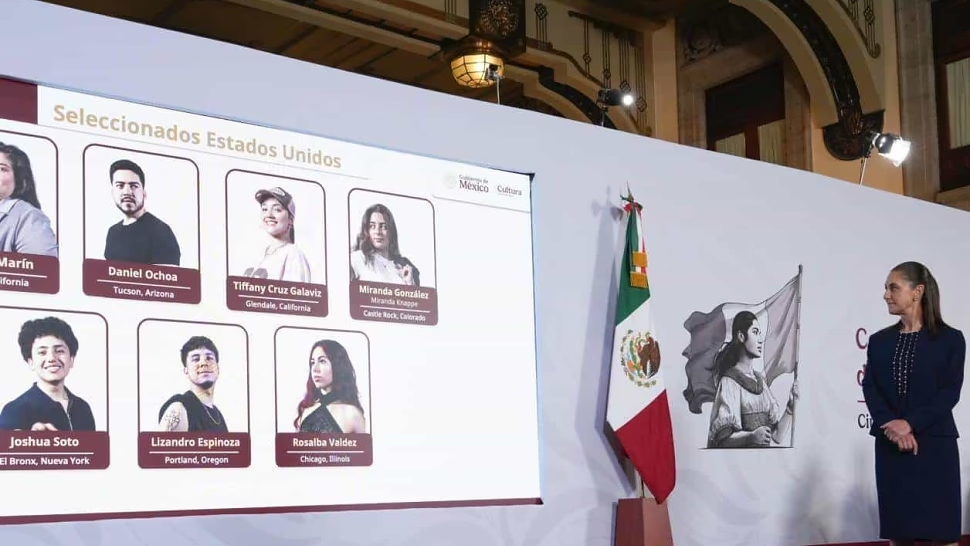

México Canta 2026: 16 thousand young people seek peace through music

16 thousand participants registered for the 2026 edition of the binational México Canta contest.

A contest that bridges borders

President Claudia Sheinbaum Pardo presented the seven Mexican-American semifinalists of México Canta 2026. She highlighted that the contest promotes values, love for Mexican music and the bond between families on both sides of the border.

“That bond is never broken, it is part of fraternity, love, solidarity,” he stated during the morning conference.

Sheinbaum stressed that the initiative transcends politics: it is a cultural defense that puts love above all.

Figures and stages

The Secretary of Culture, Claudia Curiel de Icaza, explained that in the first stage (May 11 to June 10) 16,289 participants were registered: 10,528 from Mexico and 5,761 from the United States. After in-person auditions, the Mexican Music Council selected 14 semifinalists: seven Mexicans and seven Mexican-Americans.

The seven selected from the other side of the border are:

  • Grecia Marín (Perris, California)
  • Daniel Ochoa (Tucson, Arizona)
  • Tiffany Galaviz (Glendale, California)
  • Miranda González (Castle Rock, Colorado)
  • Joshua Soto (The Bronx, New York)
  • Lizandro Espinoza (Portland, Oregon)
  • Rosalba Valdez (Chicago, Illinois)

The semifinals are broadcast on 45 public media on Sundays from 7 to 9 p.m. The live performances will be on August 23 at the Million Dollar Theater (Los Angeles) and August 30 at the Ángela Peralta Theater (Mazatlán). The public will choose six finalists in real time. The grand final will be on September 13 at the National Auditorium, and the winners will be presented on September 15 at the capital’s Zócalo.

The singer Armando Toledo Rosas “El Bogueto” celebrated the contest as a sign that young people can get ahead with talent and work. Grecia Marín, representing the semifinalists, thanked the president for opening spaces that carry messages of hope. Joshua Soto added that México Canta shows that music inspires and unites.

Continue reading

FDA recognizes false positive in Taylor Farms lettuce

Cofepris analysis rules out contamination; FDA admits error in initial sample.

Analysis results

The Ministry of Health reported that tests carried out on lettuce and water samples from the Taylor Farms Mexico plant were negative for the parasite Cyclospora cayetanensis —which causes severe diarrhea— and also for fecal coliforms. The analyses, carried out by Cofepris, confirmed that the product complies with the physicochemical parameters established in national standards.

Traceability and false positive

Taylor Farms has a traceability system that allowed United States authorities to identify the origin of the product and track a batch held at customs in Laredo, Texas. That batch never entered US territory.

The sample obtained from that batch returned a false positive, a situation that the United States Food and Drug Administration (FDA) recognized in an update published on July 19. The Ministry of Health emphasized that the product is suitable for human consumption.

Continue reading

UIF identifies 55 people in the CJNG financial network

The FIU detected 55 people linked to a CJNG financial network, including 16 front companies.

The Financial Intelligence Unit (UIF) of Mexico detected 55 people allegedly linked to a financial network of the Jalisco New Generation Cartel (CJNG). The finding was achieved through specific financial indicators, as reported by the Ministry of Finance and Public Credit (SHCP).

Release 61 details that the Office of Foreign Assets Control (OFAC) of the United States Department of the Treasury designated 55 people – 39 individuals and 16 legal entities – related to this structure. The action is part of bilateral cooperation against the finances of organized crime.

Indicators detected

The FIU identified “indicators related to possible operations with resources of illicit origin.” Among them: cash operations, acquisition of high-end vehicles, jewelry and real estate, international transfers, intensive use of credit and service cards, and inconsistencies in income reported to the SAT.

The authorities detected “possible inconsistencies between the income reported to the tax authority and the resources observed in the financial system,” which strengthened the identification of the network.

Front companies and complaints

Of the total, 16 legal entities had illegal activities. According to the FIU, some registered relevant operations, while others were front companies with “limited or no apparent economic activity.”

The UIF filed a complaint with the Attorney General’s Office (FGR) for the crime of operations with resources of illicit origin. It also included the subjects designated by OFAC on the List of Blocked Persons (LPB), and added eight additional ones—four individuals and four legal entities—linked to the same financial structure.

International coordination

The Treasury stressed that the coordinated actions with the United States seek to “prevent improper use of the financial system, combat money laundering and weaken the economic structures of organized crime.” The FIU maintains cooperation with national and international authorities, in accordance with the standards of the Financial Action Task Force (FATF).

Continue reading