Analysis of the Conflict over Musical Royalties in Mexican Commerce
A new episode of friction has emerged in the Mexican commercial landscape, led by commercial establishments and federal authorities. The core of this dispute lies in the mandatory payment of royalties for the public communication of musical works. Business organizations have expressed their discontent with the joint operation carried out by the Society of Authors and Composers of Mexico (SACM) and the Mexican Institute of Industrial Property (IMPI), whose objective is to demand compliance with this copyright from any business that uses recorded or live music as part of its atmosphere or service.
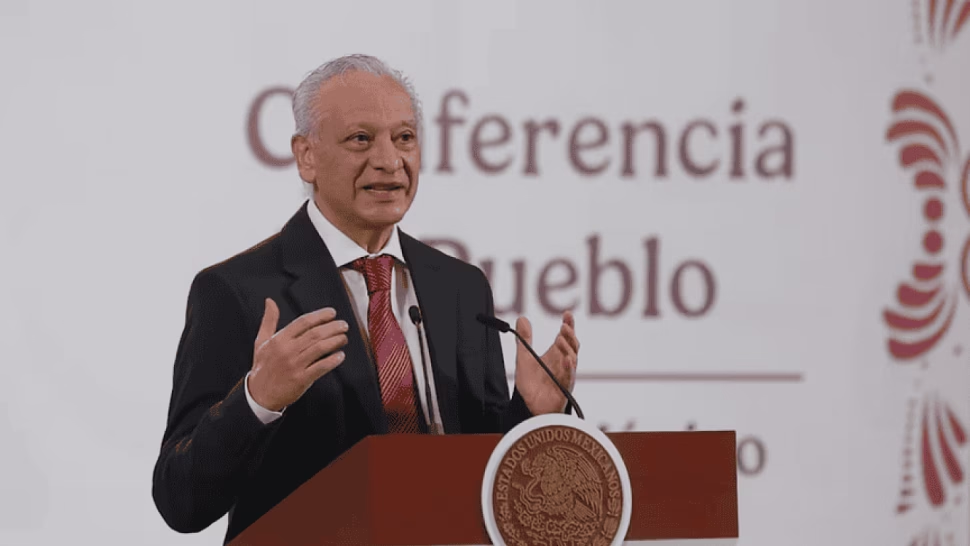
The controversy intensifies due to the disparity in perceptions regarding the execution of these actions. On the one hand, merchants allege that SACM personnel show up at their premises to demand a disbursement that can range between five thousand and one hundred twenty thousand pesos per month, a figure that they consider arbitrary and that depends on the size and line of business of the establishment. On the other hand, the IMPI maintains that this procedure is an act of strict application of the law. Santiago Nieto, head of the institute, bases the action on the legal framework that establishes that “any person who communicates or publicly transmits a work by any means has the obligation to pay royalties directly to the author or, where appropriate, to the Collective Management Company that represents them.”
Legal Framework and Coercive Measures
The legal basis for this requirement is found in the Federal Copyright Law, which protects the intellectual work of creators and composers. The figure of public communication is key here: when a business plays music for its clients, it is benefiting from a protected work, which generates the obligation to compensate its owners. The IMPI, as a regulatory body, has the power to verify compliance and, in the event of infraction, apply precautionary measures. These measures may include, forcefully, the temporary closure of establishments for a period of up to three days, a sanction that represents a significant risk to the continued operation of any company.
IMPI’s position is that this operation seeks a balance, ensuring that hotels, restaurants, bars, nightclubs and other businesses that integrate music into their business model contribute financially to authors and composers. Nieto has indicated that dialogues are being held with the Confederation of National Chambers of Commerce, Services and Tourism (Concanaco) and with the National Chamber of Commerce, Services and Tourism of Mexico City (Canaco CDMX) in order to find “a fair medium” that guarantees equitable and updated rates.
The Business Sector Perspective: Extortion Accusations
From the perspective of merchants, the situation is radically different. Iván Pérez Ruiz, president of Canaco Juárez, has used strong terms such as “extortion” and “harassment” to describe the tactics used. According to his testimony, the SACM, with the endorsement of the IMPI, appears in businesses with a document that, although called an “invitation” to process a license, is perceived as a demand under the threat of legal, administrative, civil or criminal actions. The lack of a clear and public tabulator is one of the critical points of complaint; The amounts appear to be discretionary, varying enormously without transparent support.
This perception of arbitrariness has led to an organized reaction. Pérez Ruiz began a campaign urging various establishments to refrain from playing music by composers associated with the SACM, such as Martín Urieta Solano. In addition, presidents of various chambers of commerce in the state of Chihuahua have formed a common front to stop what they consider harmful actions for the sector. They argue that the SACM catalog does not exhaustively detail all the authors it represents, raising doubts about the legitimacy of the total fee.
The tension underlies the documentation presented. The “invitation” document does not include a specific fee, which creates an information gap for the entrepreneur. This opacity contrasts with the statements of the IMPI, which ensures that the amounts have been previously agreed upon with representative organizations and are duly registered. Until the end of August, the IMPI reported 2,084 inspection visits, of which 1,200 were ex officio and 884 at the request of a party, which indicates a significant level of inspection activity.
Search for a Solution and Conclusion
Recently, a joint statement from the Ministry of Economy, IMPI, SACM and Concanaco announced the coordination to prepare a proposal that will culminate in a national agreement. The objective of this pact would be to establish clear and beneficial rules for all parties, including special consideration for micro and small businesses. This is, without a doubt, a crucial step towards de-escalation of the conflict.
In conclusion, this confrontation transcends a simple commercial disagreement. It exposes the complexity of applying intellectual property rights in the modern economy and the need for a regulatory framework that is both fair to creators and understandable to users. The resolution of this conflict will set a vital precedent for the balance between the protection of creativity and the viability of business in Mexico. Rigor in the application of the law must go hand in hand with transparency and equity to prevent a measure intended to protect artists from being perceived as an abusive practice against business.
Did you find this analysis interesting? Share this article on your social networks to expand the conversation about copyright and the national economy. Explore more content related to law and business on our site.