Compras MX replaces Compranet with technology and transparency

A historic turn in State purchases: the Compranet era comes to an end.

The twilight of an era and the dawn of a digital revolution

The destiny of public procurement in Mexico has changed forever! With a decree from the Senate that resounded like thunder in the corridors of power, the legendary Compranet platform has been swept away by the winds of progress, giving way to the titan that will take its place: Compras MX. A portal reborn from its ashes, bolder, more intuitive and, above all, unbeatable in its fight against the shadows of opacity.

A new colossus at the service of the people

Under the shield of the Anti-Corruption Secretariat, this platform promises an all-out battle against inefficiency. With a crystal clear interface and tools designed to unleash lightning speed, Compras MX swears allegiance to three sacred flags: transparency, efficiency and equitable access. No supplier, no contractor, no government entity will be left out of its watchful eye!

RelatedCompras MX revolutionizes public procurement with transparency

“Welcome to the future!” cries the portal, while deploying its arsenal of innovation. It is no longer just a system; It is a living legal framework, adapted to the demands of a country that demands to know what its government buys, from whom and why. From the most powerful businessman to the most curious citizen, everyone will have a front-row seat to witness the great theater of public procurement.

The final word of the anti-corruption watchdogs

In a speech that shook the morning conference, Raquel Buenrostro, the fearsome captain of the Anti-Corruption Secretariat, cleared up doubts with the forcefulness of a sword: “It is not a disappearance, it is an evolution!” He compared the old Compranet to an obsolete telephone, while praising the new technology that, since 2023, has already woven its unstoppable network. And as if that were not enough, he announced the masterstroke: no contract can be hidden behind phantom subcontracts, and everything must be displayed in the digital showcase, under the raw light of transparency.

The message is clear: Mexico has crossed the threshold. Are you ready to witness this epic transformation? Share this news and join the public procurement revolution. Explore more about how Compras MX is rewriting the rules of the game!
Earthquake in La Guaira: 2,295 dead and thousands missing

Families seek to identify their loved ones in the rubble before mass graves.

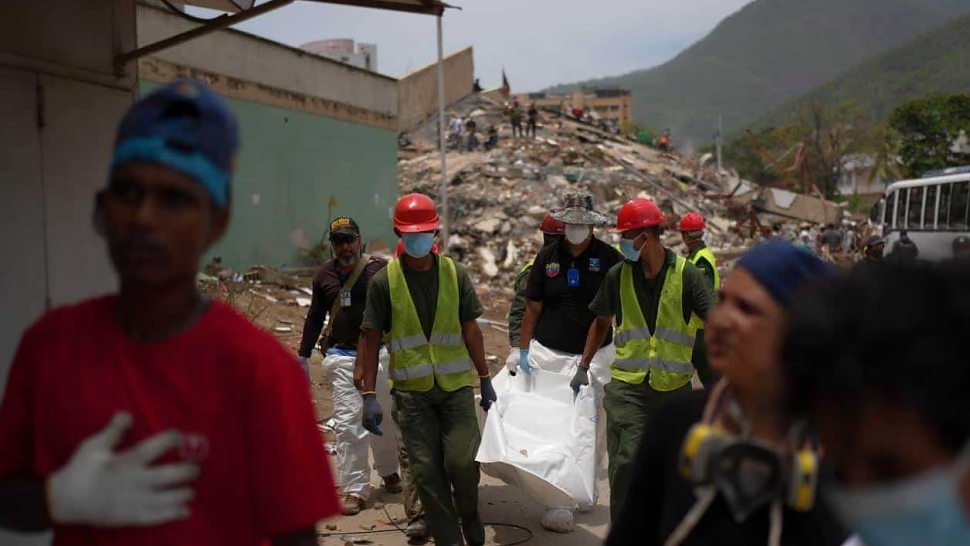
The tragedy of the June 24 earthquake in the Venezuelan state of La Guaira leaves at least 2,295 dead. Thousands of people remain missing. Hundreds of families tour hospitals and makeshift morgues to identify bodies before they are sent to mass graves.

Number of victims and rescue efforts

The forensic teams, led by technician Joel Mirabal, work tirelessly. According to specialists, between 60 and 70 percent of the victims are recognized by family or neighbors. The advanced state of decomposition complicates tasks. Refrigerated containers have been installed due to the increase in bodies. The authorities do not rule out opening mass graves.

Around the port of La Guaira and the temporary morgues, dozens of families remain formed for hours. They use tattoos, scars or clothing to confirm identities. The uncertainty about the fate of the missing aggravates the pain.

The drama of families

Rosa López recounted the difficult process of finding the body of her son-in-law, José Antonio Toledo, who died when the building where he worked as a security guard collapsed. After visiting several sites, the family managed to identify his remains. Without resources for a funeral service, the mayor’s office gave them a free space to bury him.

Rescuers estimate that recovery efforts will last at least three months due to the number of collapsed buildings. Thousands of volunteers have joined the search, hoping that families can say goodbye to their loved ones.

Continue reading

Sheinbaum announces investment of 4 billion pesos for the Purépecha people

The president detailed new commitments in health, education and security during her visit to Michoacán.

Justice Plan for the Purépecha people

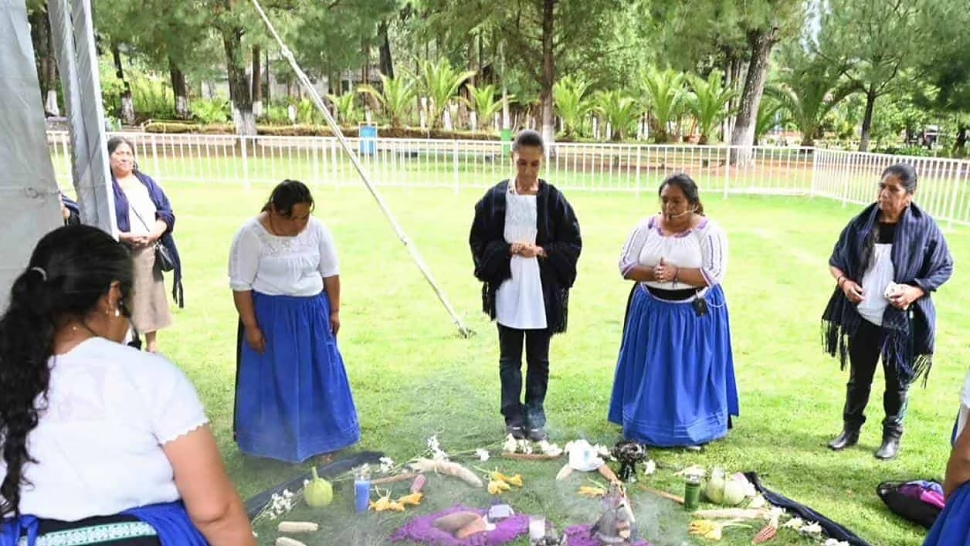
From Cherán, Michoacán, President Claudia Sheinbaum highlighted the progress of the Justice Plan for the Purépecha people. One year and two months after its implementation, more than 4 billion pesos (mp) have been allocated for health, education, roads and security.

“How are the Justice Plans made? With you. They are not made in an office of the federal government, of the State Government, they are made in assemblies,” said Sheinbaum.

The president recalled that, with the Second Floor of the Fourth Transformation, the Constitution was modified to recognize indigenous and Afro-Mexican peoples as subjects of public law. In addition, the Contribution Fund for the Social Infrastructure of Indigenous and Afro-Mexican Peoples (FAISPIAM) went from 12 thousand million pesos in 2025 to 13 thousand 500 million pesos by 2026, with the objective that this resource is established in the Constitution so that it increases each year.

The director of INPI, Adelfo Regino Montes, detailed the distribution of the investment: 27 artisanal paths (74.34 km, 485.01 million pesos), School Houses and Canteens for 527 children, 21 Community Houses of Indigenous Languages, and 161 communities benefited from FAISPIAM (212.74 million pesos in 2025 and 234.47 mdp in 2026).

Sheinbaum announced new commitments: improve the Cherán Hospital with a hemodialysis area, fix the Sports Unit, open degrees in Medicine and Nursing, strengthen community businesses, build a C2 in the community and hold a meeting on security in Mexico City.

The Undersecretary of Sciences and Humanities, Violeta Vázquez-Rojas, reported other advances: construction of an ISSSTE hospital, studies for an IMSS Bienestar hospital, hiring of 646 doctors and more than a thousand nurses, a National Guard barracks for 150 elements, remodeling of 17 highway sections, delivery of 27 thousand efficient stoves, and translation of the Women’s Booklet into Purépecha.

The governor of Michoacán, Alfredo Ramírez Bedolla, supported the initiative and highlighted the defense of the uses and customs of the native peoples.

Continue reading

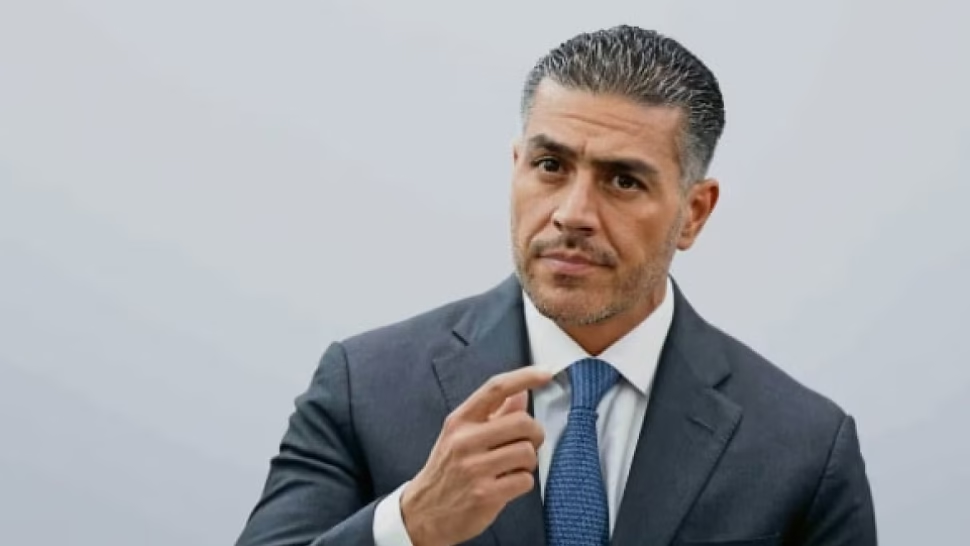
Colombians arrested for training in the manufacture of explosives in Michoacán

Colombian detainees linked to the manufacture of explosives in Michoacán.

The Security Cabinet has arrested Colombian citizens linked to the training and manufacturing of improvised explosive devices in Michoacán. This was reported by the Secretary of Security and Citizen Protection, Omar García Harfuch, during the morning conference on Friday, July 3 in Morelia.

These arrests are part of investigations that identified the entry of several people involved into the country, mainly through the Mexico City International Airport and other air entry points. The National Intelligence Center monitored these movements.

The entry of foreign people by land was also detected, who allegedly collaborate in the training of members of criminal groups to install these devices. García Harfuch pointed out that there is an ongoing investigation to locate the leaders of these networks in Michoacán, including alleged high-level members of the Jalisco Nueva Generación Cartel.

The head of the SSPC confirmed the participation of citizens from different countries, mainly from Colombia. We are working in coordination with Colombian authorities to strengthen the investigations. In the coming days, the exact number of people arrested related to the manufacture and use of these explosives will be specified.

Continue reading