Coco Gauff renews her approach to defend the French Open

Gauff changes his mentality to defend the title at Roland Garros: he no longer thinks about 'defending'.

A new approach to defending the title

Coco Gauff arrives at Roland Garros with a different strategy. The American, who beat number one Aryna Sabalenka in the final a year ago, is now seeking her second consecutive title in Paris. But his mentality changed.

“I realize that ‘defend’ doesn’t mean anything, in a way,” Gauff said. “I don’t really see it as a defense anymore.”

RelatedCoco Gauff advances at Roland Garros while an unknown makes history

Two years ago, at the US Open, Gauff lost in the fourth round after committing 19 double faults. That experience marked her. Now, in Rome, he explained: “At the US Open I was like: ‘I have to defend, defend’. When you play a tournament that you didn’t win, what is it called? That’s why now I say it’s just another tournament: ‘I won it last year. I’ll try again this year’. I’m not going to be able to defend every year. I’m not Rafa.”

Rafa, of course, is Rafael Nadal, owner of 14 titles in Paris.

Lessons from Rome

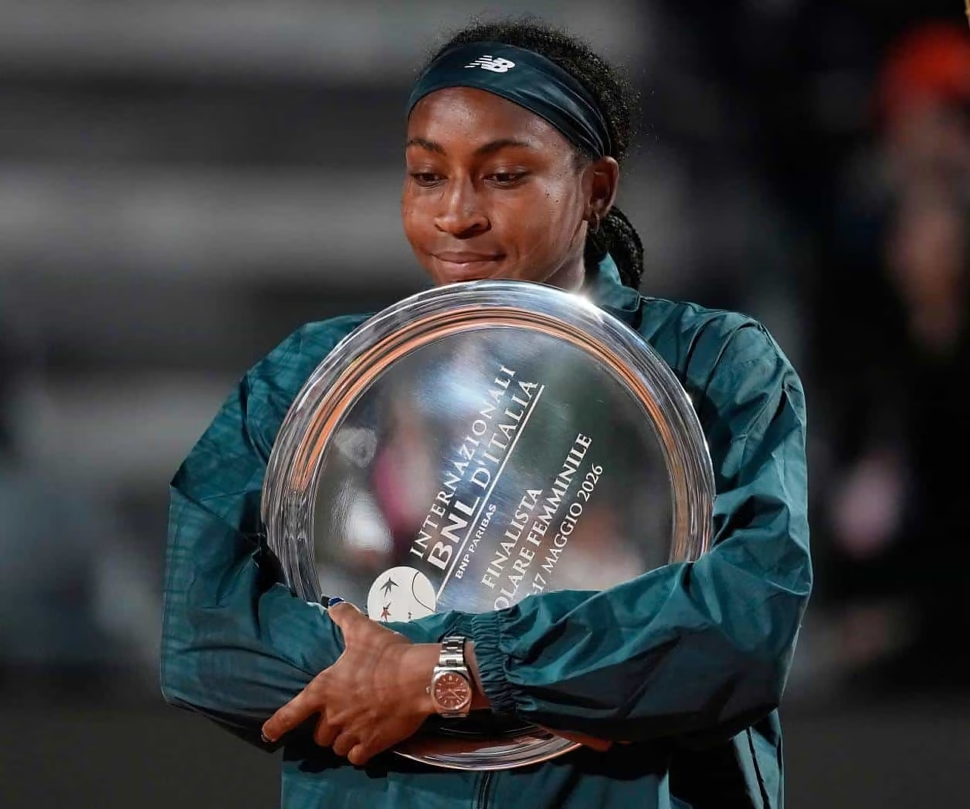
Gauff was runner-up at the Italian Open, a key clay tournament. Although she lost the final to Elina Svitolina, she brings out positive aspects.

“There are a lot of positive things I can take away from this tournament and a lot I can learn,” he said. “This week I experienced all the ups and downs of a tournament… I have been down, I have had the advantage, I have lost the advantage, I have been in a final, I have been down with match point against. I think I have experienced all the scenarios that can prepare me for Roland Garros.”

“Hopefully I can really learn from each scenario and do better,” he added.

One of the biggest improvements was his serve, which caused him problems for years. In two victories in Rome he only committed one double fault, although in the final there were seven. “I think it’s a real improvement,” he said after hitting 78% of first serves in the semifinals. “It’s the first time in my career that I feel like I’m really stable with that shot.”

“I’m throwing the ball a little more consistently. My weight is a little better. And also the confidence, the security in it is much better,” he explained. “Because my confidence is better, then I’m consistently throwing the ball in the right place, making my technique the same every serve no matter what my goal is. That’s the biggest difference.”

Gauff begins his defense at Roland Garros on Sunday, with a new mentality and a more reliable serve.

Egypt comes back and advances to the round of 16 in the 2026 World Cup

Egypt reverses the score against New Zealand and approaches the round of 16.

Egyptian comeback in Group G

Egypt achieved a key victory against New Zealand, overcoming an adverse score to become the leader of Group G and secure its place in the round of 16 of the 2026 World Cup.

The match started uphill for the Africans. In the 15th minute, Finn Surman put New Zealand ahead with a goal that put the Oceanians in front. However, Egypt remained calm and found an equalizer in the second half.

Mustafa Ziko equalized with a powerful header in the 58th, and shortly after, Mohamed Salah, with his offensive ability, put his team ahead. The Egyptian showed why he is one of the figures of the tournament.

Trézéguet sealed the victory in the 82nd minute, eliminating any possibility of a New Zealand reaction. The victory not only classifies Egypt, but also outlines it as a serious contender in the World Cup.

Continue reading

Cape Verde empathizes and dreams; Uruguay suffers from the World Cup surprise

Cape Verde achieves another historic tie; Uruguay gets complicated in Group H.

Two ties, two opposite faces

For Uruguay, two draws with the taste of defeat. For Cape Verde, two results that taste like triumph and mark a milestone in its first World Cup.

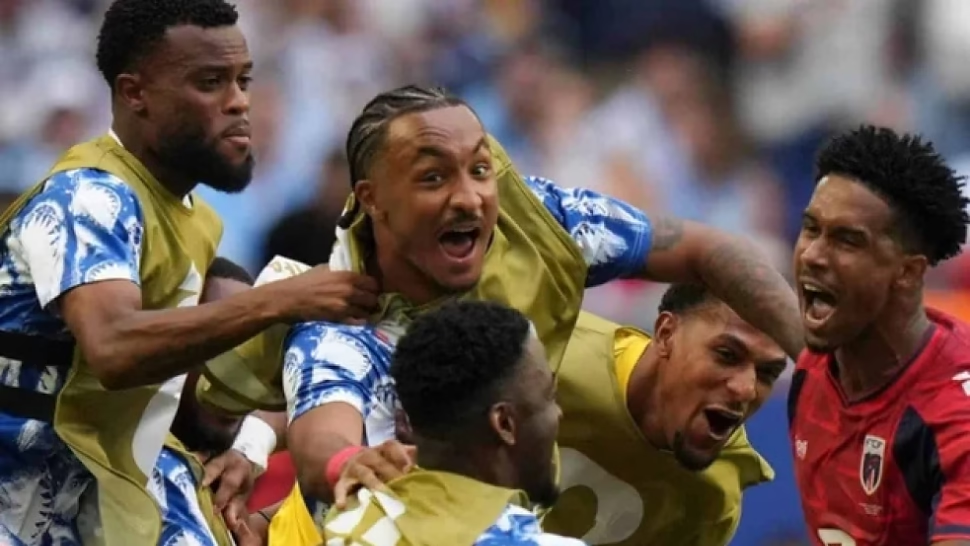
The team led by Marcelo Bielsa must now beat Spain to avoid a fiasco. Meanwhile, the African team, which had already surprised by drawing without goals against La Roja, did it again: it tied 2-2 against La Celeste in Miami.

Kevin Pina opened the scoring with a free kick that became Cape Verde’s first goal in a World Cup. Helio Varela, who came on in the second half, tied the game with a long shot that surprised goalkeeper Fernando Muslera.

The controversy and the statements

Maxi Araújo and Agustín Canobbio put Uruguay ahead with two goals in quick succession at the close of the first half. However, the advantage did not last. “The truth is that the goal is of no use… we should have taken care of the result,” said Araújo.

Bielsa took responsibility: “Organizational errors are always the coach’s responsibility. We pay a very high price for that.”

The match also had a special detail: it was the first World Cup match with two goalkeepers over 40 years old. Muslera, who turned 40 on June 16, and Vozinha, 40, faced off on the grass. Vozinha’s mother, who could not travel to the debut against Spain due to lack of visa, was in the stands this time.

Group H is reconfigured: Spain leads with 4 points, Uruguay and Cape Verde have 2, and Saudi Arabia closes with 1. Uruguay will risk their lives against Spain on Friday, while Cape Verde will face the Saudis with their hopes intact.

Continue reading

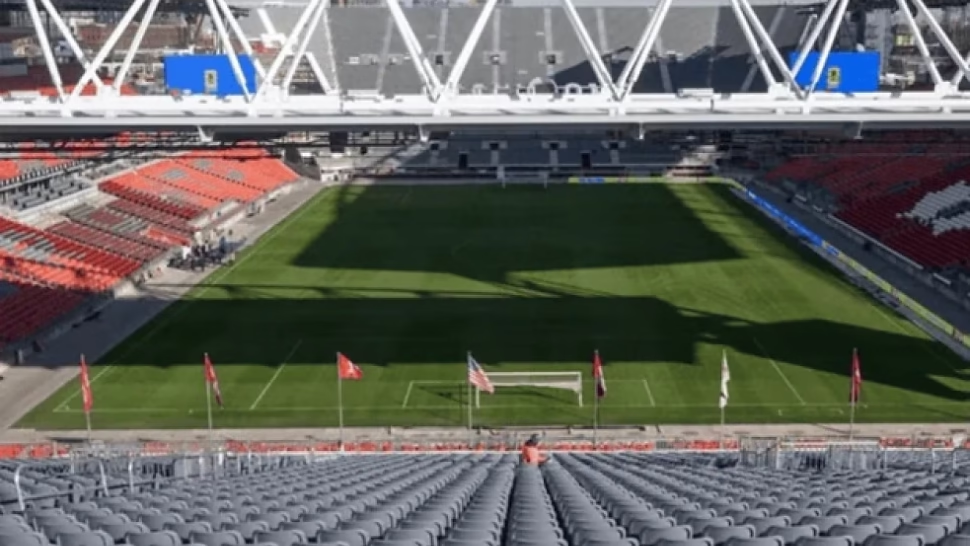
BMO Field: Toronto’s key stadium for the 2026 World Cup

BMO Field, with capacity for 30,000 attendees, will host the 2026 World Cup.

Key facts about BMO Field

BMO Field is located in Toronto, Canada, and will be one of the venues for the 2026 World Cup. Its capacity of 30,000 spectators classifies it as a medium-capacity stadium, but its natural grass surface aligns it with the traditional standards of national team soccer.

The venue is owned by the City of Toronto, a relevant fact to understand its governance and decisions on adaptations for the tournament. It was inaugurated on April 28, 2007, with a construction cost of 72 million dollars, which places it as a relatively recent infrastructure in North America.

Its exact location (43°37’58″N 79°25’07″W) is key for the logistics of travel, security and access during the event. Although operational details are not specified, these basic elements define its role in the 2026 World Cup.

Continue reading