CNTE announces 48-hour national strike in Mexico

The dissident teachers are preparing two days of blockades and sit-ins in 30 states, intensifying their fight with the federal government.

Well, road chaos is served (again)

It seems that the National Coordinator of Education Workers, or CNTE for the folks, decided that what this country needs is not peace and love, but a good 48-hour national strike. The days chosen for this display of… magisterial force? They were on November 13 and 14. Get ready, because according to the statement, this will not be a discreet event: there will be simultaneous mobilizations, street closures and the seizure of main squares in at least 30 entities. Basically, a macro-event of organized chaos that promises to turn the logistics of half of Mexico upside down. Because nothing says “we want to talk” like paralyzing the country, right?

The dissident teaching profession, which always has a list of requests longer than the queue for a Bad Bunny concert, put its main demands on the table. In the crosshairs is the repeal of the ISSSTE Law of 2017 and the total elimination of the educational reforms. And here’s the good thing: they don’t make partisan distinctions. They throw equally at those promoted by Enrique Peña Nieto and those by Andrés Manuel López Obrador. To them, bad government is bad government, regardless of the color of the logo. They are also loudly demanding (and with blockades) that the national working group with the federal government be reinstated and that the state resolution boards, which have been on pause longer than the careers of some influencers, be reactivated.

RelatedCNTE announces national strike for October 17

The chaos itinerary: your guide to avoiding unemployment

In a video broadcast on social networks—because even the protest is modernized—, the CNTE detailed the schedule. The actions will begin at 8 in the morning, because even to protest you have to get up early. Rallies will follow in the most important public squares. But the clear warning is that during these two days of active strike, they will take over avenues, streets, booths and any nerve center that could generate enough chaos for the headlines to focus on them. It’s the classic strategy of “if they don’t see me, they hear me… better, if they don’t see me, I’ll knock them down.”

In Mexico City, the epicenter of the political-social performance will be in front of the Congress of the Union and in the Zócalo, where they plan to install sit-ins and political events. And in case anyone was thinking of escaping from the metropolis, they threatened to take the exit booths towards Morelos and Puebla. In other words, your trip to Cuernavaca to disconnect from the stress of the city could become the first phase of the protest. Ironic.

The leadership of the teachers union was clear: this strike is just the appetizer, the preamble of what could come if the federal government continues to turn a deaf ear. Among their underlying demands is a comprehensive review of the pension system and the replacement of labor rights that, according to them, have been eroded. In short, more days of road chaos, sit-ins and a pitched battle on the networks between those who support them and those who just want to get to the office on time are coming.

Are you intrigued to know how this fight between teachers and the government will evolve? Share this note on your social networks and stay up to date with our coverage so as not to miss any details of this and other current issues that define the national panorama.

Senate will review regulation of militarized schools after fatal cases

Senator promotes review of 1943 regulations after deaths of minors in private military-type schools.

Review of regulations after fatal cases

Given the death of a 13-year-old girl in a private militarized school, Senator Guadalupe Chavira announced that the Senate will review the Regulations for Private Military-Type Academies, in force since 1943. The legislator described the ordinance as anachronistic and incompatible with the current protection of children’s rights.

The regulations allow military instruction from primary to technical levels, including shooting classes in secondary school and the use of grades that grant authority to certain students over others. Chavira pointed out that these are not isolated cases; In 2025, another 13-year-old minor died at the Ollin Militarized Academy, in Morelos, after suffering serious abuse during a camp.

“The tragedy that occurred with Dafne, whose suffocation under water is being investigated, should call us to reflection and action. These schools do not have the power to organize summer camps or to authorize practices such as hazing, which ended in the death of a 13-year-old girl,” declared the senator.

The Ministry of Public Education (SEP) reported that the academy where the case occurred was operating with a 2022 incorporation agreement. After being closed for investigations, the school resumed online classes claiming the students’ right to continue their training. The agency faces at least eight additional complaints of mistreatment.

Chavira demanded a new legal framework that grants the SEP clear regulatory powers, since the 1943 regulation leaves responsibility to the Secretariat of National Defense. Specialists warn that in these private schools discipline is imposed through violence and hierarchical submission, unlike official schools where there are human rights areas and supervision of the CNDH.

Continue reading

Defense distances itself from the academy after death at a young age

The agency cited the Internal Regulations to justify its position

The Secretariat of National Defense (Sedena) disclaimed any responsibility for the “Marina Doenitz” Militarized Academy, in Ciudad Madero, Tamaulipas, after the death of the young Dafne Zapata.

Through a statement, the agency stated that it lacks the power to authorize, supervise, inspect or regulate educational institutions of this type.

“It is reported that the Secretariat of National Defense lacks the power to authorize, supervise, inspect or regulate the operation of educational institutions of this nature, in accordance with the Internal Regulations of this agency, issued by the Presidency of the Republic through its publication in the Official Gazette of the Federation, on December 29, 2008, where any administrative provision that contravenes this order was repealed,” the agency wrote.

He added that, in accordance with these regulations, Sedena “has no relationship with the aforementioned academy, nor with any other establishment of this type.”

No clear supervision

The case has put the operation of private militarized schools under scrutiny. In several states of the country they have proliferated without there being a federal body that explicitly regulates them.

To date, no state or federal authority has assumed the responsibility of supervising these schools. The Tamaulipas Prosecutor’s Office investigates the events.

Continue reading

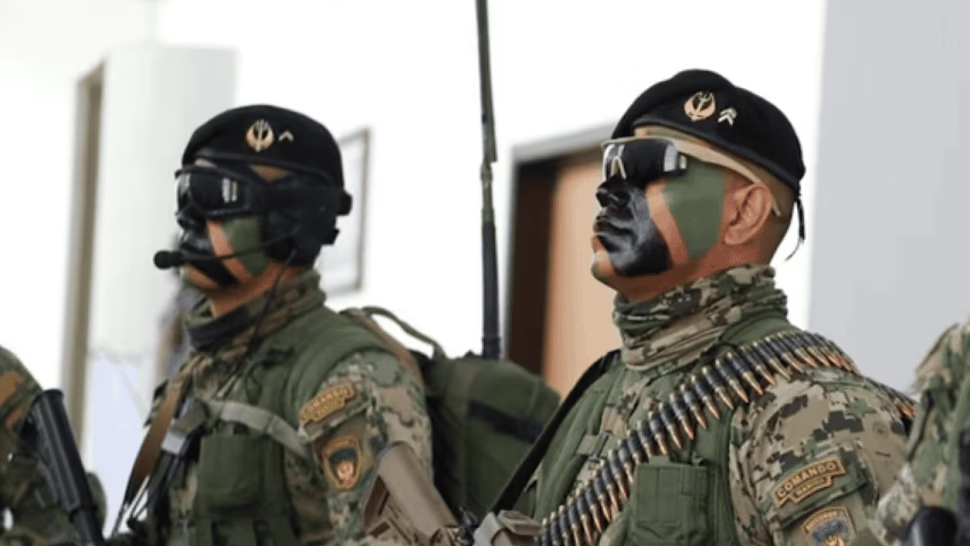
Navy Special Forces celebrate 25 years of service

Elite naval units commemorate 25 years with demonstrations of capacity and the Quachic Challenge.

Elite demonstration in Veracruz

Members of the Special Forces and Amphibious Commands of the Mexican Navy commemorated their 25th Anniversary with an exhibition of their capabilities at the Heroic Naval Military School, in Veracruz. The units carried out sports activities, swimming circuits, walking with equipment, transporting the wounded, boat maneuvers and precision shooting.

Created in 2001, these units are specially organized, trained and equipped to operate in hostile or politically sensitive areas. Its staff has unique skills and competencies in their training.

Quachic Challenge and historical presentations

During the day, presentations were made on the evolution of the Special Forces and the Commandos, highlighting the quality of their preparation. A tactical gallery with specialized equipment was also set up.

The seventh edition of the national competition “Reto Quachic” was held, which included active personnel, cadets and retirees. The participants faced obstacles such as swimming 300 meters, walking 1,400 meters with 20 kilos of equipment and weapons, transporting the injured and boat, and precision shooting.

The exercises tested physical fitness, discipline and responsiveness, while fostering camaraderie and group cohesion. The commemoration not only celebrated an anniversary, but reaffirmed the importance of the continued training of these key units for national security.

Continue reading