Strategic Deployment against Organized Crime on the Southern Border
The Attorney General’s Office of the State of Chiapas, under the direction of Jorge Luis Llaven Abarca, has provided a detailed report that reveals the existence of more than fifty arrest warrants pending execution. These court orders are directed against leaders and members of criminal cells that, for a period of more than two years, exercised coercive control over the population of Frontera Comalapa, systematically suppressing the conditions for peace and social stability in the region. The international dimension of this investigation is confirmed with the request for four red cards before the International Criminal Police Organization (Interpol), managed through Interpol Mexico more than sixty days ago.
International Coordination and Operational Results
This formal request for international police cooperation has as its fundamental objective that the authorities of the Republic of Guatemala provide assistance for the location and arrest of the identified ringleaders, who are allegedly fugitives in Guatemalan territory. Prosecutor Llaven Abarca emphasized that his institution has achieved full identification of the generators of violence who operated with impunity in the Sierra area, a strategic corridor for illicit activities.
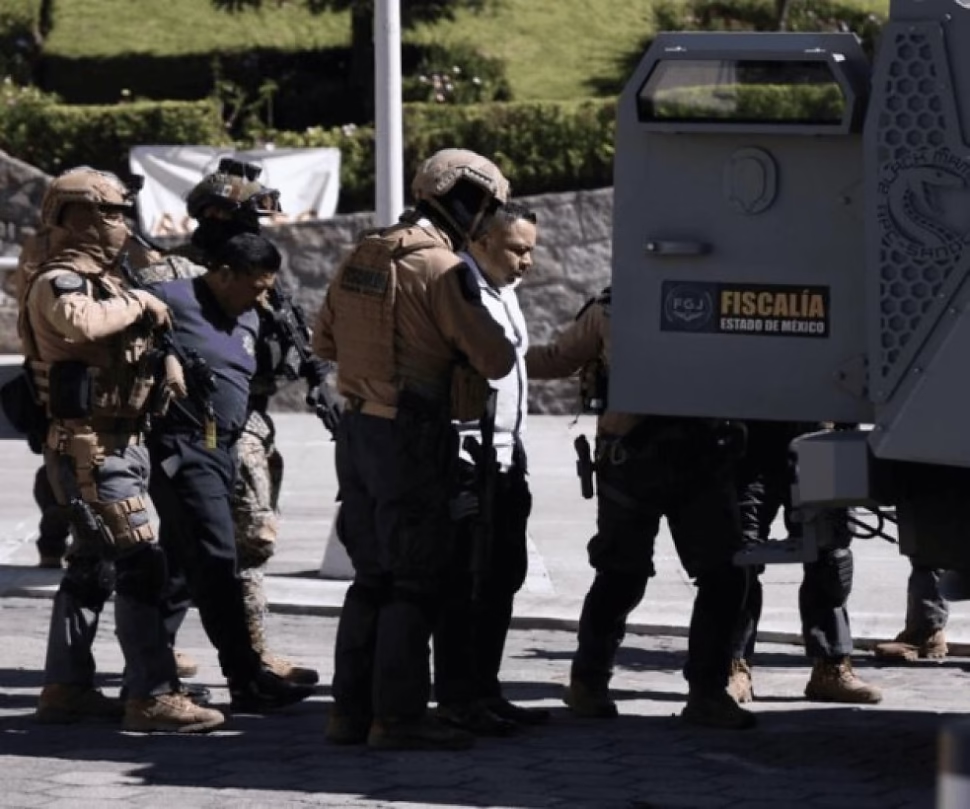
The tangible results of this judicial and police offensive are significant. To date, 129 individuals linked to high-impact crimes have been captured, including homicide, forced disappearance of people, extortion, drug dealing and abuse of authority. Of these detainees, 127 are already formally charged and linked to criminal proceedings. At the same time, the security forces have managed to execute 90 arrest warrants and have seized more than 78 vehicles, among which one of the so-called “monsters” stands out, handmade armored vehicles used by criminal groups.
Criminal Structure and Security Deployment
The investigation analysis describes a criminal network with primary operational strongholds in the towns of El Sabinalito, Paso Hondo and Santa Teresa Llano Grande. This criminal organization developed an arm of social influence known as “El Maíz”, whose members are also the subject of arrest warrants. The expansion capacity of this group allowed it to extend its illicit operations to surrounding municipalities such as Mazapa de Madero and Chicomuselo, demonstrating a complex logistical capacity.
Among those arrested with a high profile is the former municipal president of Frontera Comalapa, José Antonio Villatoro, who faces judicial proceedings for his alleged commission of various crimes. The investigation has also reached other former officials of that local administration and more than a dozen elements of the municipal police, evidencing deep levels of infiltration and corruption.
Regarding population displacement, the Prosecutor’s Office clarified that the inhabitants of the El Sabinalito ejido who moved to Guatemala did so voluntarily, possibly motivated by “family or kinship relationships with the people generating violence.” It is emphasized that, as a result of the coordination operation between the three levels of government, no family currently has well-founded reasons for forced displacement from this border area.
The Secretary of People’s Security, Oscar Alberto Aparicio Avendaño, detailed the robust security deployment implemented. The strategy includes the presence of more than one thousand five hundred elements of the Mexican Army, the National Guard, the Mexican Navy Secretariat and the Pakal Immediate Reaction Force. Surveillance and deterrence tasks are reinforced by daily overflights carried out with an gunned Black Hawk helicopter, as well as by operational actions supported by three gunned drones and the establishment of three Permanent Kanan Citizen Attention Points in the towns of Pacayal, Santa Teresa Llano Grande and El Sabinalito.
The official conclusion is categorical: the scene of endless violence that occurred a year ago belongs to the past. The consolidated institutional presence of all security corporations today guarantees peace and tranquility in Chiapas, allowing free movement through the Sierra and marking a turning point in the recovery of the territory for the law.
Do you consider that this type of joint operations are the most effective strategy to combat organized crime? Share this analysis on your social networks to expand the conversation and explore more content related to national security.