CDMX replaces its palm trees with native trees

The capital says goodbye to a landscape icon infested by a fungus. An ambitious plan seeks to transform urban greenery.

Goodbye to the asphalt queens (and hello to real trees)

It seems that the Government of Mexico City is giving a definitive swipe left to the palm trees. Yes, those same ones that have been the Instagram background of half of CDMX for decades, but that apparently have more red flags than we thought. In a movement that has got everyone talking, the head of Government, Clara Brugada, announced that the capital’s greening plan does not include, not even by mistake, these divas of the urban landscape. The official reason: a fungus that has been sending them to the other side since 2011 and that has turned some 9,000 of them into a latent risk. Basically, they are the toxic party guest who refuses to leave.

The ‘plant-pocalypse’ has begun

Between September and December of this year, 1,500 palm trees that already show lethal symptoms will be removed. The rest… well, they will have to wait their turn during the six-year term. The reason? Their roots are anarchists who do not respect the pavement and, to make matters worse, they do not provide shade or environmental resilience. Come on, they are more decorative than functional. They will be replaced by native trees such as duraznillo, tejocote or arrayán—species that do know how to behave and that also truly beautify the city. In other words, we are changing the catwalk model for the scientist who saves the planet. Priorities, dear ones.

RelatedAntigentrification march in CDMX concludes without serious incidents

86% of these palm trees are concentrated in the municipalities Benito Juárez, Cuauhtémoc, Coyoacán and Miguel Hidalgo. Just where it hurts the most… and where there is the greatest risk that a palm tree will decide to say goodbye dramatically on top of a car or, worse, a person.

And how did these exotic divas get here?

Turns out it was all the fault of a work trip. Like in a bad episode of *Emily in Paris*, but in the 40s. Miguel Alemán returned enthralled by the luxurious Beverly Hills, with its tropical aura and its palm trees as a status symbol, and decided that CDMX needed that *vibe*. So he imported the phoenix canariensis directly from the Canary Islands. And so, for decades, we have lived in a low-cost version of California… until the fungus said “that’s good.”

Since 2011, these specimens began to show a progressive decline associated with fungi and microorganisms that attack leaves, trunks and roots. Come on, they got the worst of the Tinderinos: the one who not only ghosts, but destroys.

The operation: more complex than a neighborhood drama

For this almost apocalyptic mission, Sedema will provide around 120 specialists, including climbers, examiners, biologists and pruners trained to work with tall specimens. 25 units and support equipment will also be added, including a mini loader, three stump grinders and two 40-ton cranes. It sounds like an action movie, but with trees.

In coordination with the Secretary of Works and Services (Sobse), crews will be formed to operate on high-traffic roads and parks. There will be weekly felling, stump removal and planting goals. And each replaced tree will have irrigation, maintenance and monitoring tasks. In other words, they don’t just remove them: they ensure a good future for their replacements. #GreenAffectiveResponsibility.

So now you know: if in the coming months you see that your trusted palm tree disappears, it is not the end of the world… it is the beginning of a new one, with more oxygen and less fungal drama.

Did you like this irreverent look at urban ecology? Share this note on your networks and follow us for more content that makes the city’s green (and sarcastic) future cool.
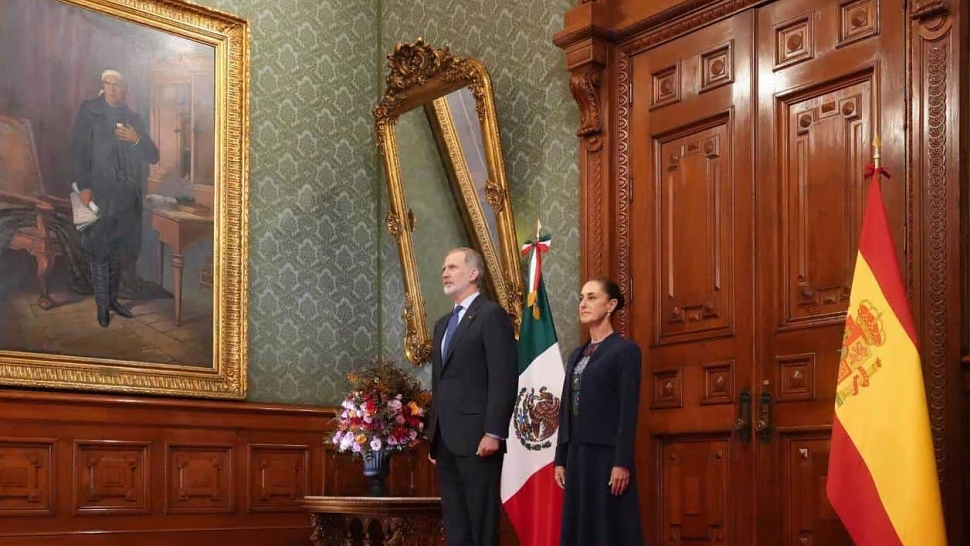

Mexico receives King Felipe VI with honors at the National Palace

Sheinbaum and the Spanish monarch discuss the bilateral relationship in the National Palace.

Welcome ceremony at the National Palace

President Claudia Sheinbaum Pardo received King Felipe VI of Spain this day in the Ambassadors Room of the National Palace. During the official ceremony, the national anthems of both countries were sung, followed by the official photograph of the meeting.

Bilateral meeting

Sheinbaum and the monarch will hold a dialogue about the state of the relationship between Mexico and Spain. Senior officials from both governments attend the meeting.

On behalf of Mexico: the Secretary of Foreign Affairs, Roberto Velasco Álvarez; the head of the Office of the Presidency, Lázaro Cárdenas Batel; and the Mexican ambassador to Spain, Quirino Ordaz Coppel.

For Spain: the Minister of Foreign Affairs, European Union and Cooperation, José Manuel Albares Bueno; the Minister of Education, Vocational Training and Sports, Milagros Tolón Jaime; the head of the King’s House, Camilo Villarino Marzo; the ambassador of Spain in Mexico, Juan Duarte Cuadrado; the diplomatic advisor of the King’s House, Carmen Castiella Ruiz de Velasco; and the head of the Minister’s Office, Sergio Cuesta Francisco.

The visit of King Felipe VI takes place within the framework of his official tour of Mexican territory. Both leaders are expected to address issues of cooperation, trade and culture.

Continue reading

Passenger trains: Mexico City-Querétaro and Pachuca would start in 2027

Federal government advances in six passenger train routes; two would begin operations in 2027.

Advances in the passenger and freight railway network

President Claudia Sheinbaum reported that the construction of passenger trains is advancing significantly. The Mexico City-Querétaro and Mexico City-Pachuca routes will be inaugurated in 2027, while other lines such as Saltillo-Nuevo Laredo and Querétaro-Irapuato continue to be developed.

“We are very advanced. The other sections to Guadalajara and Nuevo Laredo will be put out to tender this year or carried out by the Ministry of Defense,” he stated during the morning conference. The complete project includes an investment of 750 billion pesos.

Right of way and community work

Edna Elena Vega Rangel, Secretary of Agrarian Development, reported that 28 million 452 thousand 804 square meters of right of way have been released. Of that total, 72% corresponds to historical right of way, 14% to social property and 14% to private property. To serve the communities, 268 social tables were held, 95 assemblies with more than 4,500 attendees and 987 plots were acquired.

Andrés Lajous, head of the Train Agency, explained that clearings, embankments and drainage works are being carried out on the Querétaro-Irapuato and Saltillo-Nuevo Laredo sections. In Monterrey, 30 thousand tons of steel are already manufactured and 9-kilometer viaduct projects are being developed. In addition, the manufacturing of sleepers began: 330 thousand for Querétaro-Irapuato, 430 thousand for Saltillo-Monterrey and 490 thousand for Monterrey-Nuevo Laredo.

Tenders and first trains

Phase 2 of bidding for the Mexico City-Saltillo and San Luis Potosí-Saltillo sections began. Six stations, three auxiliary buildings and maintenance bases will be put out to tender. The first AIFA-Pachuca train will arrive in Mexico on July 25 and this month the construction of the first unit of the northern trains begins.

In the metropolitan area of ​​Querétaro, three vehicular underpasses, four overpasses and 11 pedestrian overpasses are considered, among other works.

Participation of the Sedena and progress by section

General Gustavo Ricardo Vallejo Suárez reported that 33,072 personnel participate in railway work, of which 6,380 are women, with 7,000 units of machinery. Nearly 800 kilometers of basic engineering have been developed in the first four sections.

The specific advances are: Mexico City-Pachuca at 37.06% (121 km of new roads, 10 km of viaducts, 10 work fronts); Mexico City-Querétaro at 19.22% (232.42 km, 14 fronts).

As for the Mayan cargo train, it reaches 54.05% progress. Intermodal complexes are built in Palenque, Mérida, Progreso and Cancún. A multimodal complex is planned for 2027 in Chetumal and five operations yards.

Néstor Núñez, from the SICT, indicated that the stations and auxiliary buildings are advancing, and 26 social attention tables and 36 techniques have been made to explain the coexistence of the train with the environment.

Continue reading

Roberto Lazzeri begins management as ambassador with call for cooperation

The diplomat participated in a Trump event where a 66% reduction in fentanyl was reported.

First public intervention

Roberto Lazzeri participated this Wednesday in his first public event as Mexican ambassador to the United States. It was during an event organized by Donald Trump on the National Mall for the 250th anniversary of American independence.

There he heard the message from President Trump, who highlighted a 66% reduction in the flow of fentanyl into his country. Lazzeri pointed out that these results strengthen bilateral security cooperation, promoted by President Claudia Sheinbaum based on respect for sovereignty and coordination.

A 35% decrease in overdose deaths in the United States was also mentioned, as well as the seizure of nearly 30,000 firearms. The ambassador attributed these figures to the joint work between both nations.

Trump used the event to refer to the 2026 FIFA World Cup, which will be played in North America. Lazzeri assured that Mexico contributes to the project with actions in security, connectivity and tourism, with an estimated economic benefit of more than 18 billion pesos.

Continue reading